Broughton Castle
Broughton Castle stands as a remarkable example of English heritage, combining medieval fortification with Tudor grandeur in the heart of Oxfordshire. Its origins trace back to a Romano-British villa dating from the 1st to 4th centuries AD, highlighting the site's long-standing significance well before the medieval era. This continuity of occupation underscores the strategic and residential importance of the location, situated on a natural island formed by the confluence of three streams.
The castle's medieval phase began around 1300 when Sir John de Broughton established a manor house designed for defense, utilizing the natural waterways to create a broad moat. This early manor house was later acquired in 1377 by William of Wykeham, Bishop of Winchester, whose family retained ownership for generations. By the early 15th century, Sir Thomas Wykeham had fortified the manor with crenellations, transforming it into a defensible residence by 1406, as evidenced by the imposing gatehouse that still marks the castle's main entrance.
Medieval fortification and architectural evolution
The castle's defensive features include the artificial island surrounded by a broad moat, accessed via a small bridge connecting to the adjacent parish church of St Mary the Virgin. The gatehouse, built in the early 15th century, exemplifies medieval military architecture with its robust construction and crenellated battlements. Adjacent to the gatehouse is a block with gothic-style windows overlooking the moat, now repurposed as a shop and café, blending historical preservation with modern use.
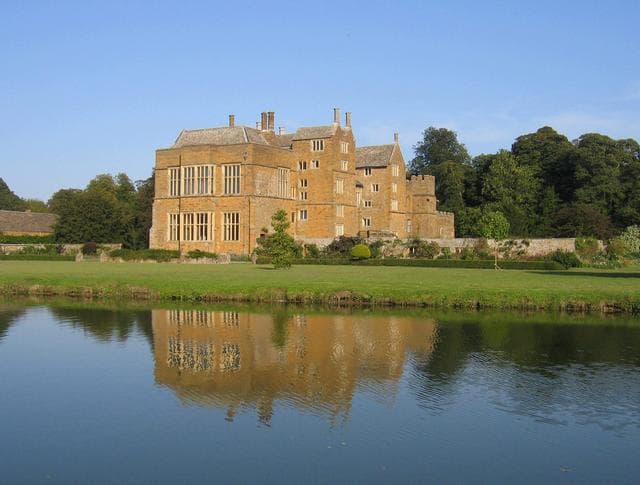
Following its medieval fortification, the castle underwent significant transformation in the mid-16th century under Richard Fiennes, who remodeled and expanded the manor into a grand Tudor-style house. This remodeling introduced elements characteristic of the Elizabethan prodigy house, combining defensive architecture with the elegance and grandeur expected of a noble residence. The façade today reflects this blend, with earlier medieval sections on the left and later Elizabethan additions centrally and to the right.
The chapel and interior features
Within the castle, the 14th-century chapel stands out for its decorated gothic style, featuring intricate stone tracery and ornamentation typical of the period. The principal rooms, primarily dating from the Elizabethan era, include a great hall running along the main façade and a long gallery overlooking the rear gardens, spaces designed for both public gatherings and private enjoyment.
Notable interior features include two exceptional chimneypieces reflecting Renaissance influences. The Queen's Bedroom contains a stone fireplace decorated with Renaissance motifs and medieval human head carvings, likely inspired by design books such as those by Hans Vredeman de Vries. Another chimney in the James I bedroom showcases polished stucco in the Fontainebleau style, featuring a medallion copied from Rosso Fiorentino's designs and flanked by statues of nude boys, probably crafted outside England.
Several rooms retain elaborately decorated plaster ceilings, particularly the Great Parlour and the Oak Room, exemplifying the high craftsmanship of Elizabethan artisans. Additionally, three bedrooms preserve exquisite 18th-century Chinese painted wallpaper, depicting natural motifs such as trees, birds, and flowers, offering a rare glimpse into period tastes for exotic decoration.
Historical significance and civil war connections
During the 17th century, Broughton Castle became a center of political activity under William Fiennes, the 1st Viscount Saye and Sele. The castle hosted key meetings of Parliamentarian leaders like John Pym and John Hampden as tensions escalated toward the English Civil War. The Viscount raised forces for the Battle of Edgehill in 1642, and the castle endured a siege and brief occupation by Royalist troops, sustaining damage from cannon fire that necessitated extensive repairs.
A particularly notable feature is the "room with no ears" at roof level, reputedly used as a secret meeting place where the Viscount conferred with Parliamentary leaders. Despite his opposition to King Charles I, the Viscount ultimately reconciled with the monarchy after the Restoration, reflecting the complex political dynamics of the era.
19th and 20th century restoration and garden design
The castle experienced a decline in the 19th century until restoration efforts led by Frederick Fiennes, the 16th Baron Saye and Sele, who enlisted the renowned architect Sir George Gilbert Scott to revive the house. Around 1900, Lady Algernon Gordon-Lennox leased the property, undertaking significant garden redesigns and hosting notable figures such as King Edward VII.
The gardens are celebrated for their long herbaceous borders, which provide lush and varied displays during summer months. These gardens reflect a blend of traditional English landscaping with Victorian and Edwardian influences, enhancing the castle's aesthetic and historical appeal.
Archaeological discoveries and ancient heritage
Archaeological excavations beneath Broughton Castle have revealed the remains of a high-status Roman villa dating from the 1st to 4th centuries AD. Discoveries include mosaic tesserae used in intricate floor patterns, tiles from a hypocaust heating system, and terraced ponds for water management, underscoring the villa's sophistication.
A remarkable find was a lead-lined sarcophagus uncovered in the 1960s containing the remains of a wealthy woman, highlighting the site's importance during Roman Britain. These findings provide a deeper understanding of the continuous occupation and evolving use of the site from antiquity through the medieval and Tudor periods.
Visitor experience and cultural heritage
Today, Broughton Castle remains in the hands of the Fiennes family, preserving its legacy as a family home and historic monument. Visitors can explore the castle's extensive interiors, including the chapel, great hall, and long gallery, as well as enjoy the picturesque gardens and moat.
The castle's blend of medieval fortifications and Tudor architectural elegance offers a unique insight into English country house development and aristocratic life across centuries. Its rich history, from Roman origins through the turbulent Civil War era to Victorian restoration, makes it a significant cultural and heritage landmark in Oxfordshire.
Frequently asked questions (FAQ)
- When was Broughton Castle originally built?
- The earliest medieval construction of Broughton Castle began around 1300, with significant fortifications added by 1406.
- What architectural styles are represented at Broughton Castle?
- Broughton Castle features a blend of medieval defensive architecture and Tudor Elizabethan prodigy house elements, with Gothic and Renaissance interior details.
- Can visitors see the Roman villa remains at Broughton Castle?
- Archaeological remains of the Roman villa are beneath the castle and not generally accessible to visitors, but the castle's history highlights this ancient heritage.
- What role did Broughton Castle play in the English Civil War?
- Broughton Castle was a Parliamentarian stronghold under Viscount Saye and Sele, hosting key leaders and enduring a Royalist siege in 1642.
- Are the gardens at Broughton Castle open to the public?
- The castle gardens feature notable herbaceous borders and are part of the visitor experience, showcasing landscaping from the late 19th and early 20th centuries.
Photo gallery

Information
Sources & official resources
Verify the information above using these authoritative references.
Loading map...
Visitor reviews
No reviews yet. Been here? Write the first review and help other travelers!
Write the first reviewVisited this castle? Share your experience
Your review helps other travelers and adds first-hand knowledge to our encyclopedia.