Beaumont Palace
Beaumont Palace was a significant royal residence constructed in the 12th century outside the north gate of Oxford. Commissioned by King Henry I around 1130, the palace was strategically located near the royal hunting lodge at Woodstock, which later became part of the park of Blenheim Palace. This proximity allowed the monarch convenient access to hunting grounds while maintaining a residence close to Oxford. The palace's historical footprint is commemorated today by Beaumont Street in Oxford, where a stone inscription marks the site, noting that King Richard I was born there in 1157 and King John in 1167.
Architectural features and royal significance
The palace was known for its "King's House," the range containing the royal lodgings. This structure served as the main residential area for the monarch and was part of a larger complex that likely included halls, chambers, and service buildings typical of a high medieval royal palace. Although no substantial above-ground remains survive today, historical records and archaeological findings suggest the palace was a substantial stone-built complex. The "nova aula" or "new hall" was a particularly notable feature, where Henry I celebrated Easter in 1133 with great ceremony marking the birth of his grandson, the future Henry II.
Historical events and royal connections
Beaumont Palace played a role in several key historical events. It was the birthplace of two English kings, Richard I and King John, underscoring its importance as a royal residence during the high medieval period. The palace remained in royal use until the reign of Edward I, who was the last monarch to officially reside there. In 1275, Edward I granted the palace to Francesco Accorsi, an Italian lawyer and diplomat who had served the English crown.
The palace's later history is tied to the Carmelite order (White Friars). Following the defeat of Edward II at the Battle of Bannockburn in 1314, the king vowed to found a monastery if he escaped safely. Fulfilling this vow, Edward II granted Beaumont Palace to the Carmelites in 1318, marking a transition from royal residence to religious use.
The john deydras affair
In 1318, Beaumont Palace was the setting for the John Deydras affair, an episode involving a pretender who claimed to be the rightful king of England. Deydras asserted ownership of the palace as part of his claim. The affair ended with Deydras's execution for sedition, highlighting the palace's continued symbolic importance in royal legitimacy.
Decline and archaeological remains
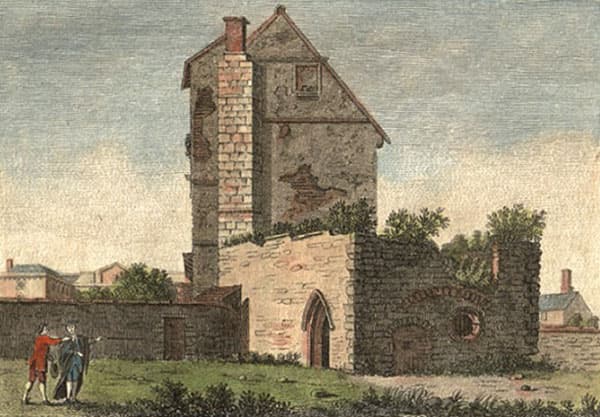
The dissolution of the monasteries under the Reformation led to the disbanding of the White Friars and the dismantling of much of Beaumont Palace. Stones from the palace were repurposed in the construction of prominent Oxford institutions, including Christ Church and St John's College. By the late 18th century, only ruins remained, as depicted in an engraving from 1785. The final remnants were destroyed during the development of Beaumont Street in 1829, leaving no visible structures today.
Today, Beaumont Palace exists primarily as an archaeological site. Its historical significance is preserved through documentary records, the commemorative inscription on Beaumont Street, and archaeological investigations that have helped reconstruct its past layout and importance.
Beaumont palace in the context of medieval royal residences
Beaumont Palace exemplifies the type of royal residence used during the high medieval period, combining strategic location, functional architecture, and proximity to royal hunting grounds. Unlike larger castles designed primarily for defense, Beaumont functioned as a comfortable and prestigious palace reflecting the status and lifestyle of the English monarchy in the 12th and 13th centuries.
The palace's transition from royal residence to monastic property also reflects broader social and political changes in medieval England, particularly the impact of religious orders and the shifting priorities of the crown.
Frequently asked questions (FAQ)
- How do I find the site of Beaumont Palace in Oxford?
- Beaumont Palace no longer stands above ground, but its location is marked by an inscription on a pillar on the north side of Beaumont Street near Walton Street in Oxford.
- What is the historical significance of Beaumont Palace?
- Beaumont Palace was a royal residence built in the 12th century, birthplace of Kings Richard I and John, and later a Carmelite monastery.
- When was Beaumont Palace built?
- Beaumont Palace was constructed in the early 12th century, around 1130, by King Henry I.
- Can I visit Beaumont Palace today?
- The palace no longer exists as a standing structure; it is an archaeological site with no public visitor facilities on site.
- Why was Beaumont Palace granted to the Carmelites?
- King Edward II granted Beaumont Palace to the Carmelites in 1318 as fulfillment of a vow made after his escape at the Battle of Bannockburn.
Photo gallery

Photo by Unknown authorUnknown author•Public domain
Information
Current owner
Unknown
Loading map...
Visitor reviews
No reviews yet. Been here? Write the first review and help other travelers!
Write the first reviewVisited this castle? Share your experience
Your review helps other travelers and adds first-hand knowledge to our encyclopedia.