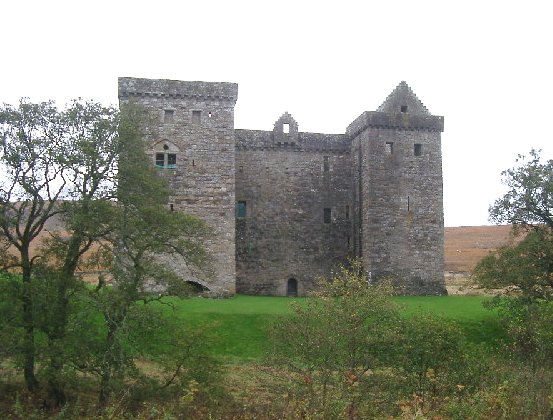
Branxholme Castle
Branxholme Castle is a significant historic fortress located near the town of Hawick in the Scottish Borders region. Known as the ancestral seat of Clan Scott since the early fifteenth century, the castle embodies the turbulent history and architectural evolution of the borderlands between Scotland and England. Its strategic position atop a hill provided natural defensive advantages, making it a formidable stronghold during centuries of Anglo-Scottish conflicts.
Medieval origins and border conflicts
The castle's origins trace back to the medieval period, with the earliest known structures dating to the fifteenth century. Branxholme was originally built as a tower house—a common form of fortified residence in Scotland designed to provide both defense and domestic accommodation. Its initial layout featured a distinctive Z-plan design, characterized by a rectangular main block with towers at diagonally opposite corners. This architectural form was intended to maximize defensive coverage, allowing defenders to cover all approaches with overlapping fields of fire.
Throughout the sixteenth century, Branxholme Castle was repeatedly embroiled in the violent border conflicts that defined the era. In 1532, the original tower was burned by forces loyal to the Earl of Northumberland, reflecting the ongoing strife between Scottish clans and English nobles. During the War of the Rough Wooing (1543–1551), a series of aggressive English military campaigns aimed at forcing a marriage alliance, Branxholme's fortifications proved resilient. Notably, in 1547, the castle withstood an English siege, with attackers acknowledging that artillery would be necessary to breach its defenses.
Despite its strength, the castle was deliberately damaged in 1570 by members of the Scott family themselves through the process of slighting, a strategic demolition to prevent enemy occupation. That same year, an English force commanded by the Earl of Sussex and Lord Hunsdon completed the castle's destruction using explosives. These events underscore the castle's importance as a military asset and its vulnerability amid the shifting alliances and hostilities of the border region.
Reconstruction and the role of the scotts
Following its destruction, Branxholme Castle was rapidly rebuilt beginning in 1571 under the direction of Sir Walter Scott of Buccleuch, a prominent leader of the Scott clan and Warden of the Middle March. The reconstruction was completed in 1576 by his widow, Margaret Douglas, ensuring the castle remained a symbol of Scott power and resilience. This rebuilding phase maintained the original defensive characteristics while adapting the castle for continued habitation and control over the surrounding lands.
The Scotts' role as Wardens of the Middle March was crucial in maintaining law and order along the volatile Anglo-Scottish border. This administrative and military position placed them at the center of border diplomacy, conflict resolution, and defense, with Branxholme Castle serving as a key operational base.
Architectural features and later modifications
Branxholme Castle's surviving sixteenth-century tower house rises to five storeys, featuring vaulted basement chambers designed for secure storage and protection. A characteristic newel stair, or spiral staircase, provides internal vertical circulation, allowing defenders to control access between floors effectively. The castle's original Z-shaped footprint, with towers at both ends, enhanced its defensive capabilities by enabling flanking fire and reducing blind spots.
One notable surviving element is the Tentyfoot Tower, a fifteenth-century defensive bastion located at the northeastern edge of the complex. Though now in ruins and classified as a Category A listed building, it remains a testament to the castle's extensive fortifications. Unfortunately, the tower's condition was reported as very poor and at high risk in 2012, highlighting the challenges of preserving such historic structures.
In the eighteenth and nineteenth centuries, Branxholme underwent significant architectural transformation. Large portions of the original tower house were incorporated into expansions reflecting changing tastes and functions. In 1837, the renowned architect William Burn was commissioned by the fifth Duke of Buccleuch to remodel the castle extensively. Burn's work integrated medieval defensive elements into a more comfortable and stylish mansion, signaling a shift from martial fortress to noble residence. This remodeling included the addition of refined interiors, expanded living quarters, and landscaped gardens and orchards that enhanced the castle's setting.
Cultural significance and preservation
Branxholme Castle's importance extends beyond its military and architectural history. It has been recognized as a Category A listed building since 1971, marking it as a structure of national significance in Scotland. This designation reflects both its historical value and the architectural interest of its composite form, which spans medieval fortification and nineteenth-century mansion styles.
The castle's heritage has also inspired cultural connections abroad. For example, Branksome Hall School in Toronto was named after Branxholme, and the school received a replica of a mantle originating from the castle, symbolizing the enduring legacy of the Scott family and their ancestral home.
Today, Branxholme Castle stands as a remarkable example of Scottish border fortifications adapted over centuries to meet changing needs. Its combination of medieval defensive architecture and later residential modifications offers valuable insights into the evolution of noble estates in Scotland. The castle's layered history, from violent conflict to genteel residence, embodies the complex narrative of the Scottish Borders region.
Visiting branxholme castle and its surroundings
While Branxholme Castle remains a private residence and is not generally open to the public, its historical significance attracts interest from historians, architects, and enthusiasts of Scottish heritage. The surrounding landscape of the Scottish Borders, with its rolling hills and rich history, offers additional attractions including nearby historic towns, walking trails, and other castles associated with the turbulent border past.
Visitors to the area can explore the broader context of the Anglo-Scottish border conflicts and the legacy of clans like the Scotts, whose influence shaped much of the region's history. The castle's enduring presence on a strategic hilltop continues to dominate the local skyline, serving as a powerful reminder of Scotland's medieval and early modern past.
Frequently asked questions (FAQ)
- How do I get to Branxholme Castle?
- Branxholme Castle is located near Hawick in the Scottish Borders. Visitors can reach the castle by car, with ample parking available nearby. Public transport options include local buses that connect Hawick with surrounding areas.
- What is the historical significance of Branxholme Castle?
- Branxholme Castle dates back to the 12th century and is known for its rich history, serving as a stronghold for various Scottish clans. It played a significant role during the turbulent times of the Scottish Wars of Independence. The castle's strategic location made it a key site for defense and power in the region.
- When was Branxholme Castle built?
- Branxholme Castle was originally constructed in the 12th century, with subsequent modifications and expansions over the centuries. Its architecture reflects various styles due to these changes, showcasing the evolution of Scottish castle design. The most notable renovations occurred in the 15th and 16th centuries.
- Can I tour Branxholme Castle?
- Yes, Branxholme Castle is open to the public during specific times of the year. Guided tours are available, allowing visitors to explore the castle's rich history and impressive architecture. It is advisable to check the castle's official website for tour availability and booking details.
- Why is Branxholme Castle considered an architectural gem?
- Branxholme Castle features a blend of medieval and more modern architectural styles, showcasing the craftsmanship of different eras. Its distinctive towers and fortified walls are notable examples of Scottish castle architecture. The castle's picturesque setting adds to its charm, making it a popular subject for photographers.
- Is it possible to visit Branxholme Castle year-round?
- Branxholme Castle has specific opening hours that vary by season, so it is best to check the official website for the most accurate information. While the castle may be open for tours during the warmer months, winter access may be limited due to weather conditions. Always plan ahead to ensure a visit aligns with the castle's schedule.
- What are the ticket prices for Branxholme Castle?
- Ticket prices for Branxholme Castle can vary depending on the season and type of tour selected. Generally, adult tickets are reasonably priced, with discounts available for children, students, and seniors. It is recommended to purchase tickets in advance during peak tourist seasons to avoid disappointment.
- What is the best time to visit Branxholme Castle?
- The best time to visit Branxholme Castle is during the spring and summer months when the weather is generally milder, and the gardens are in full bloom. This season also offers more frequent tours and events. Autumn can also be lovely, but visitors should prepare for cooler temperatures.
- Are there any nearby attractions to Branxholme Castle?
- Yes, the area surrounding Branxholme Castle boasts several attractions, including the charming town of Hawick, known for its textile heritage. Visitors can also explore the scenic landscapes of the Scottish Borders, which offer numerous hiking and walking trails. Nearby historical sites, such as other castles and ruins, provide additional opportunities for exploration.
Information
Website
Visit websiteSources & official resources
Verify the information above using these authoritative references.
Loading map...
Visitor reviews
No reviews yet. Been here? Write the first review and help other travelers!
Write the first reviewVisited this castle? Share your experience
Your review helps other travelers and adds first-hand knowledge to our encyclopedia.