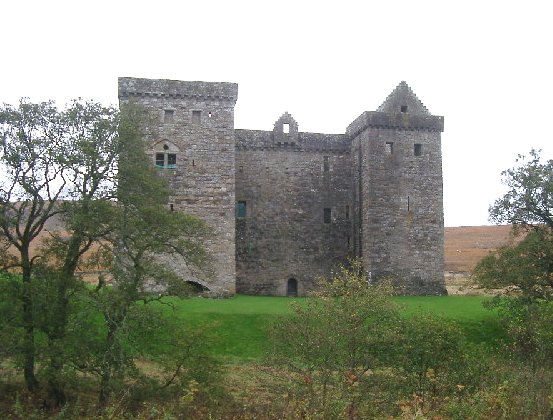
Fatlips Castle
Fatlips Castle is a notable example of a 16th-century peel tower located near Hawick in the Scottish Borders. Constructed by the Turnbull clan, who were prominent Border reivers, the castle served as a fortified residence and defensive stronghold during a turbulent period marked by frequent cross-border raids. Its strategic position on the ridge of Minto Crags provided commanding views over the River Teviot and surrounding lands, crucial for early warnings against incursions.
Historical context and origins
The castle's origins lie in the volatile environment of the Anglo-Scottish borderlands during the 16th century. The Turnbull family, known for their involvement in border reiving, established Fatlips Castle as part of a network of fortified towers to protect their territory and assert clan dominance. The site, historically known as "Mantoncrake" or "Mynto Crag," was subjected to devastation during the War of the Rough Wooing in 1545, when forces under the Earl of Hertford launched destructive raids across the region, including the burning of the settlement around the castle.
The castle's distinctive name, "Fatlips," is derived from a local tradition tied to the customs of its inhabitants. Visitors were reportedly entitled to a kiss from one of the women inside upon arrival, a practice that earned the tower its memorable nickname and reflects the social customs of the time.
Architectural features and layout
Fatlips Castle is a rectangular tower house measuring approximately 8.15 meters north to south and 9.83 meters east to west. It rises to four main storeys topped by an attic floor, which is surrounded by a 19th-century parapet walk. This parapet, along with the roof, was added during Victorian restoration efforts to enhance both the castle’s defensive appearance and usability.
The tower's walls have remained largely intact, preserving its original rectangular footprint and multi-level design. The cap-house at the top of the tower, a small structure providing access to the roof, was a key focus of restoration work in the early 21st century. The castle’s elevated position on the ridge allowed defenders to monitor the landscape effectively, controlling access routes along the River Teviot.
Defensive elements
As a peel tower, Fatlips Castle was designed primarily for defense. Its thick stone walls and limited openings minimized vulnerability to attack. The elevated parapet walk provided a vantage point for lookouts and archers, while the tower’s height and position offered natural protection and visibility. The castle’s design reflects the typical features of border fortifications built to withstand raids and skirmishes common in the region during the 16th century.
Later history and restoration
Ownership of the castle transferred to Sir Gilbert Elliot in 1705, initiating the Elliot family’s long stewardship, which later produced the Earls of Minto. In the 19th century, Fatlips Castle underwent significant restoration. The exterior was substantially repaired in 1857, and between 1897 and 1898, the prominent architect Sir Robert Lorimer remodeled the interior to convert the tower into a shooting lodge and private museum. These adaptations reflected Victorian interests in preserving and repurposing historic Scottish architecture.
The castle remained occupied and functional until the 1960s, after which it fell into disrepair. A major restoration project carried out between 2011 and 2013 focused on stabilizing the cap-house, parapet, and roof, ensuring the structural integrity of the tower and restoring its historic silhouette. These efforts preserved Fatlips Castle as a significant cultural monument.
Today, Fatlips Castle is recognized as a scheduled monument, reflecting its national importance in Scotland's heritage. Its classification as a former Category B listed building underscores its architectural and historical value.
Cultural significance and legacy
Fatlips Castle embodies the turbulent history of the Scottish Borders, illustrating the lifestyle and defensive needs of clans involved in the border reiving era. Its unique name and associated customs provide insight into the social practices of the time. The Victorian restoration and continued conservation efforts highlight changing attitudes towards heritage preservation in Scotland.
As a restored hill castle, it offers visitors a tangible connection to the past, showcasing typical peel tower architecture and the strategic importance of such structures in controlling and defending border territories.
Frequently asked questions (FAQ)
- What is the historical significance of Fatlips Castle?
- Fatlips Castle is a fascinating example of medieval architecture, dating back to the 13th century. It played a crucial role in the defense of the surrounding area during various conflicts, making it a site of historical importance in the region.
- When was Fatlips Castle built?
- Fatlips Castle was constructed in the early 1200s, with its origins linked to the turbulent times of the medieval period in Britain. It has undergone various renovations and restorations, preserving its historical integrity over the centuries.
- Can I visit Fatlips Castle?
- Yes, Fatlips Castle is open to visitors throughout the year. Guests can explore the castle grounds, enjoy guided tours, and learn about its rich history.
- What are the opening hours for Fatlips Castle?
- Fatlips Castle typically opens daily from 10 AM to 5 PM. However, it is advisable to check the official website for any seasonal changes in hours or special holiday openings.
- Is it possible to access Fatlips Castle with a wheelchair?
- While Fatlips Castle has made efforts to improve accessibility, some areas may be challenging for wheelchair users due to uneven terrain and historical features. It is recommended to contact the castle staff in advance to inquire about specific accessibility options and assistance.
- What is the best time to visit Fatlips Castle?
- The best time to visit Fatlips Castle is during the spring and early autumn months when the weather is generally mild and the surrounding landscape is beautiful. Additionally, visiting during weekdays can help avoid larger crowds.
- Are there any nearby attractions to Fatlips Castle?
- Yes, there are several nearby attractions, including scenic walking trails and quaint villages that showcase the local culture. Visitors can also explore other historical sites in the area, enriching their overall experience.
- What are the ticket prices for Fatlips Castle?
- Ticket prices for Fatlips Castle are typically affordable, with discounts available for children, seniors, and families. It's a good idea to check the official website for the latest pricing and any special promotions or events.
Information
Website
Visit websiteSources & official resources
Verify the information above using these authoritative references.
Loading map...
Visitor reviews
No reviews yet. Been here? Write the first review and help other travelers!
Write the first reviewVisited this castle? Share your experience
Your review helps other travelers and adds first-hand knowledge to our encyclopedia.