Braniewo
Braniewo Castle stands as a significant example of a high medieval hill castle in Poland, embodying the historical and architectural legacy of the Warmian episcopate. Founded in the 13th century amidst the turbulent times of the Teutonic Order's expansion in Prussia, the castle was originally constructed as the fortified residence of the bishops of Warmia. Its strategic location within the fortified town of Braniewo reflects its dual role as both an ecclesiastical seat and a military stronghold.
The castle's origins date back to 1236, following a papal bull that established the Warmian diocese on lands conquered by the Teutonic Knights. The first bishop, Anselm, chose Braniewo as the diocesan capital. However, the early settlement was destroyed by Prussian tribes in 1261, necessitating a re-foundation of the town by Bishop Henryk Fleming in 1284. It was during this period that the initial stone castle was erected within the southern part of Braniewo's defensive walls.
Architectural design and early construction
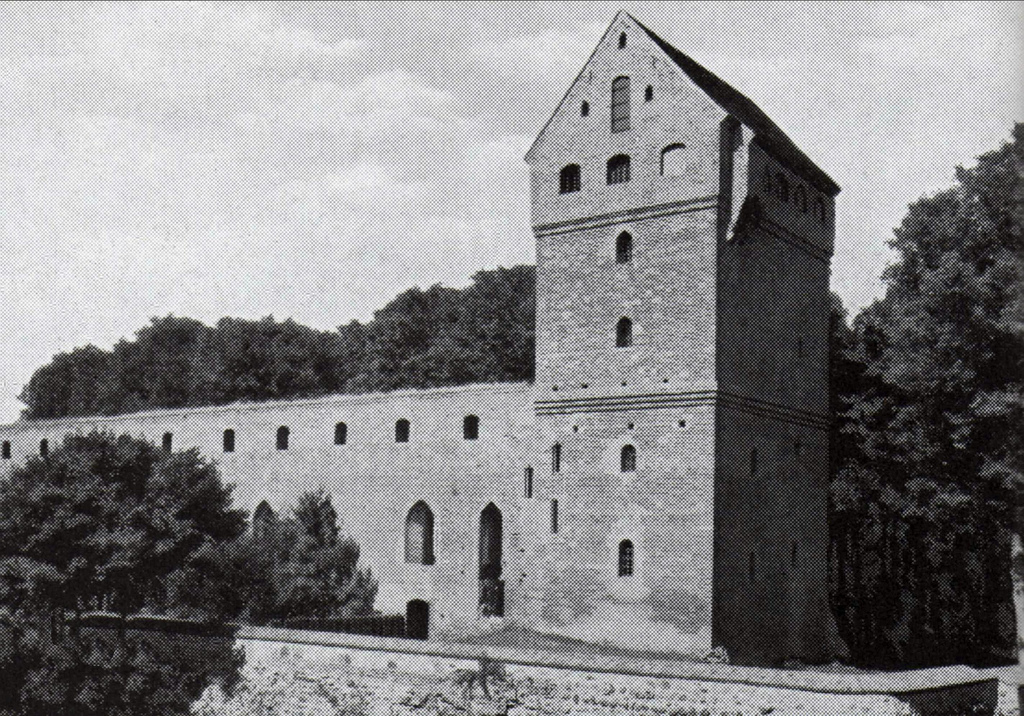
The castle was built on a rectangular plan with a single residential wing occupying the entire southern curtain wall. Defensive walls enclosed the courtyard on the other sides, with the main entrance located centrally on the eastern curtain. This entrance was protected by a prominent gate tower that projected beyond the wall face and housed the castle chapel. This modest initial structure quickly became insufficient for the needs of the episcopal residence, prompting expansion to the east.
Expansion and fortification enhancements
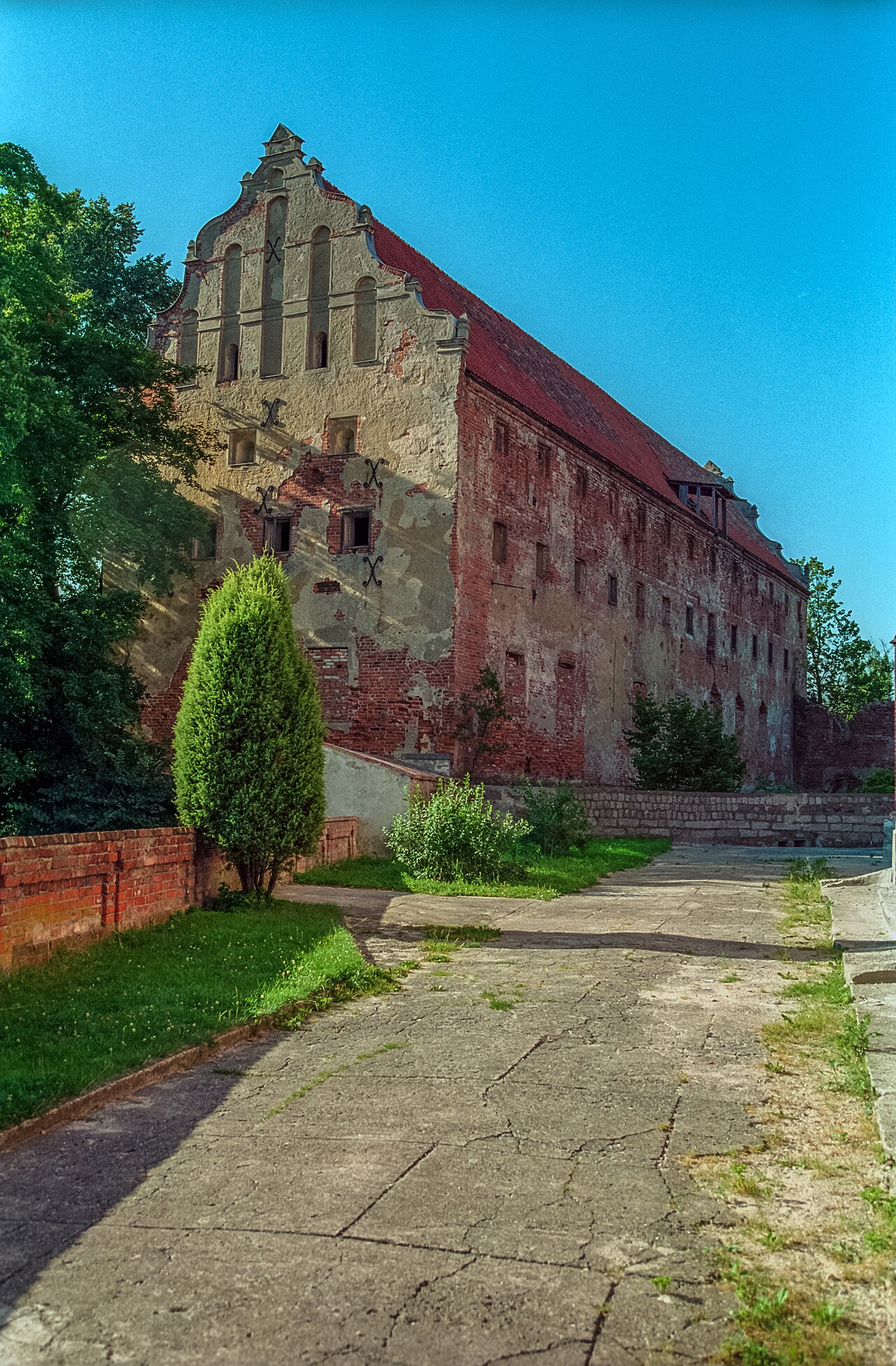
By the late 13th century, a substantial two-story vaulted building was constructed on the eastern side, measuring approximately 10 by 36 meters. This building included the bishop's chambers and a refectory, forming the main castle with its own courtyard surrounded by defensive walls. The original gate tower and adjoining structures were reclassified as the outer bailey, serving primarily economic and service functions. The entire complex thus consisted of two courtyards measuring about 55 by 80 meters.
During the period 1320-1330, the castle underwent significant strengthening to improve its defensive capabilities. Three corner towers were added on the northern and western sides, and a moat was excavated on the city-facing side. The entrance was further secured by a barbican defended by a half-bastion. Access to the castle was via a causeway over an old branch of the Pasłęka River, protected by walls and ending in a watchtower.
Historical significance and conflicts
Braniewo Castle served as the seat of the Warmian bishops until 1340. The castle's history is marked by repeated conflicts involving the town's burghers, the Teutonic Order, and the Kingdom of Poland. In 1396, during civil unrest, Braniewo citizens attacked the castle, damaging walls and towers facing the town. The Grand Master Konrad von Jungingen intervened, ordering the reconstruction of fortifications within five years.
The Thirteen Years' War (1454-1466) saw the castle again contested. On February 6, 1454, the townspeople stormed and plundered the episcopal castle, damaging its defenses. The castle was garrisoned by Polish troops who successfully defended it in 1455. However, shifting allegiances saw the castle fall to Bishop Legendorf in 1461, who was initially pro-Teutonic. Subsequent assaults by the townspeople expelled the Polish garrison. The 1466 Second Peace of Toruń incorporated Warmia into the Polish Crown as a fief, with Bishop Mikołaj Tungen assuming office in 1467. His contested election led to the so-called "Priests' War," during which he retook Braniewo with Teutonic support in 1472. Polish forces unsuccessfully attempted to recapture the town in 1478, and peace was restored in 1479, affirming Polish sovereignty.
During the last Polish-Teutonic conflict (1519-1521), the castle was seized by the Teutonic Knights in 1520. Polish attempts to retake it failed, and a truce was established in 1521. The secularization of Prussia in 1525 ended the Teutonic Order's rule, with the last Grand Master, Albrecht Hohenzollern, paying homage to the Polish king. The castle and town later endured Swedish occupation in 1626, during which bastion fortifications were added.
Later transformations and decline
Following the First Partition of Poland in 1772, Braniewo fell under Prussian control. The castle suffered artillery damage during the Napoleonic Wars in 1807, especially to its southern parts and the southwest tower of the outer bailey, which was demolished. In 1811, the Prussian authorities repurposed the castle as a school, demolishing the Gothic outer bailey structures and erecting new buildings in their place. Further modifications in 1874 included lowering the main residential wing by one floor, removing economic buildings, and partial demolition of fortifications.
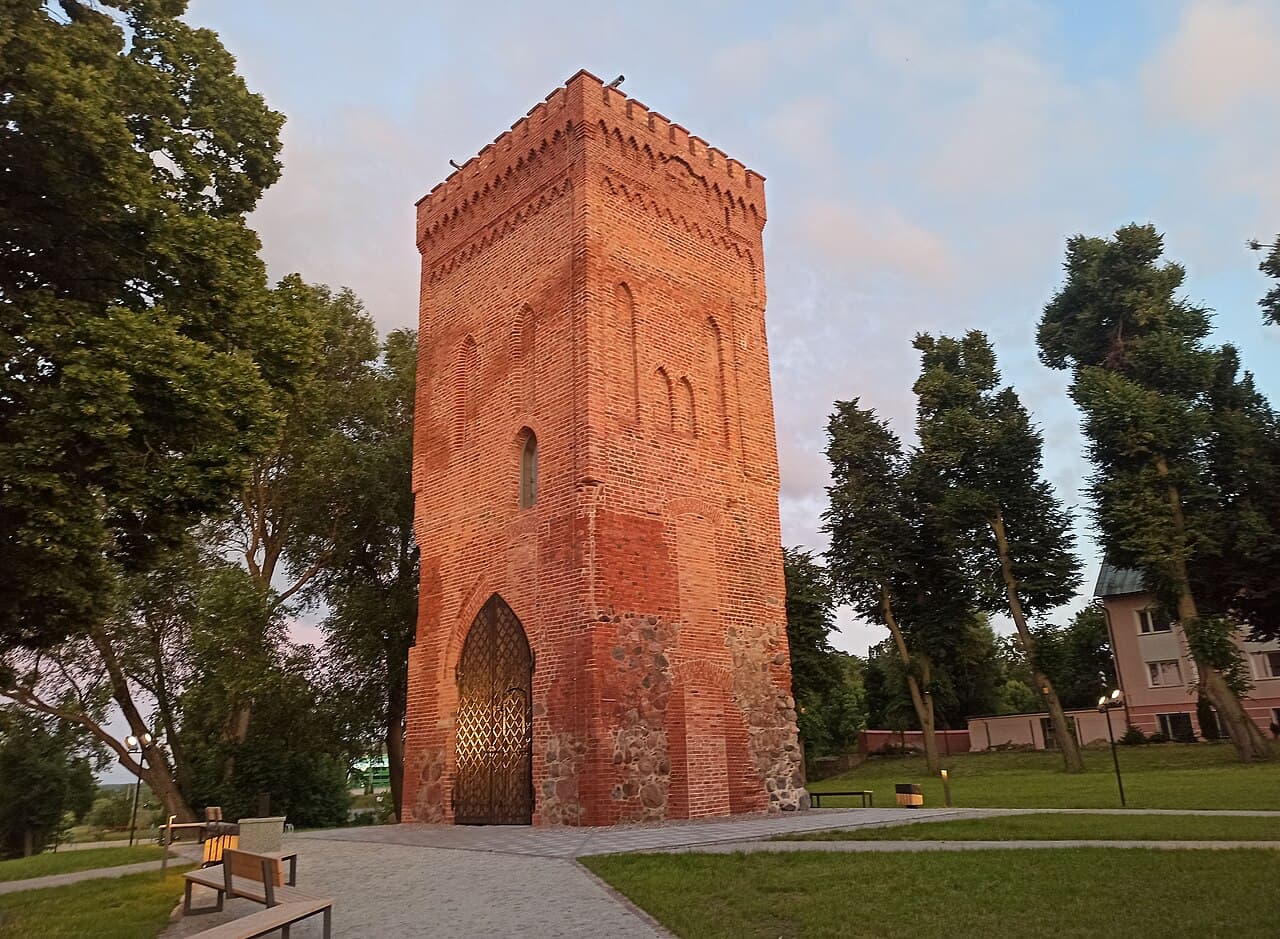
The castle's final destruction occurred during World War II in 1945, leaving only the gate tower intact. This surviving Gothic gate tower connected the main castle with the outer bailey. Its lower section dates from the earliest construction phase and features a pointed arch gateway with a gate, a vaulted chamber with star-shaped rib vaulting, and concealed stairs within the walls. The tower also includes a defensive gallery, bricked-up arrow slits, and Gothic decorative elements such as pointed panels.
Modern restoration and cultural use
After years of neglect, restoration efforts began in 2018 under the project "New life for the episcopal castle gate tower in Braniewo." Essential utilities and installations were added, and a spiral metal staircase was installed in the northwest corner, providing access to a viewing terrace. The main chapel niche was refurbished with a replica of the Warmian bishop's coat of arms plaque, and stained glass windows depicting the Braniewo coat of arms and Saint Andrew were installed in the southern walls. The external walls on the eastern and western sides were restored to outline the original gate passage, complete with wooden gates.
Restoration was completed in September 2020 at a cost exceeding 3.5 million PLN, mostly funded by European Union grants through the Regional Operational Program, with the remainder covered by the city budget. The renovated tower now serves as a museum space, housing a tourist information point and offering panoramic views from the top terrace. Visitors can explore the tower during the opening hours of the Braniewo Public Library.
Architectural features and significance
Braniewo Castle exemplifies the evolution of a medieval episcopal fortress adapting to changing military and residential needs over centuries. Its combination of Gothic defensive architecture with ecclesiastical functions illustrates the complex role of bishoprics in territorial control during the Middle Ages. The surviving gate tower remains a valuable cultural monument, offering insights into medieval construction techniques, defensive strategies, and the religious symbolism embedded in castle architecture.
The castle's layered history of construction, destruction, and restoration reflects broader regional dynamics, including the conflicts between the Teutonic Order, Polish Crown, and local urban populations. Its preservation and adaptive reuse today contribute to Braniewo's cultural heritage and tourism, highlighting the importance of protecting historical monuments as living parts of community identity.
Frequently asked questions (FAQ)
- How do I visit Braniewo Castle?
- Braniewo Castle's restored gate tower is accessible to visitors during the opening hours of the Braniewo Public Library. Admission is free, making it an excellent cultural stop when exploring Braniewo.
- What is the historical significance of Braniewo Castle?
- Braniewo Castle was the seat of the Warmian bishops and played a crucial role in regional conflicts involving the Teutonic Order and the Polish Crown. Its history reflects the complex political and religious dynamics of medieval Prussia.
- When was Braniewo Castle built?
- The castle was originally constructed in the 13th century, following the establishment of the Warmian diocese in 1236 and the re-founding of Braniewo in 1284.
- Can I see the original medieval architecture at Braniewo Castle?
- Yes, the Gothic gate tower is the primary surviving medieval structure. It features original elements such as the pointed arch gateway, star-vaulted chamber, and defensive galleries, restored and accessible to visitors.
- Is Braniewo Castle wheelchair accessible?
- Due to the historic nature and structure of the gate tower, full wheelchair accessibility may be limited. Visitors with mobility concerns are advised to contact local tourist information for specific guidance.
- What are the best times to visit Braniewo Castle?
- Visiting during the warmer months offers pleasant weather for exploring the castle and surrounding town. Checking the Braniewo Public Library's opening hours ensures access to the tower museum and viewing terrace.
Photo gallery

Information
Opening hours
During the opening hours of the Braniewo Public Library
Ticket prices
Free
Current owner
Municipality
Loading map...
Visitor reviews
No reviews yet. Been here? Write the first review and help other travelers!
Write the first reviewVisited this castle? Share your experience
Your review helps other travelers and adds first-hand knowledge to our encyclopedia.