Bramber Castle
Bramber Castle stands as a significant example of early Norman military architecture in the county of West Sussex, England. Constructed circa 1070 by William de Braose, 1st Lord of Bramber, the castle was strategically positioned to control the River Adur estuary and serve as the administrative center of the newly created Rape of Bramber. This fortress played a vital role in consolidating Norman power in southern England following the 1066 Norman Conquest.
The castle is a classic example of a motte-and-bailey design, a common Norman fortification style characterized by a raised earthwork (the motte) with an enclosed courtyard (the bailey). The motte at Bramber rises approximately 9 to 10 meters above the surrounding landscape and is surrounded by deep ditches, originally designed for defense. The castle's layout includes an inner and outer bailey, both encircled by dry moats, with remnants of curtain walls and towers still visible today.
Historical significance and ownership lineage
After its construction, Bramber Castle remained in the possession of the Anglo-Norman House of Braose for several centuries. The de Braose family were influential Norman lords who played a prominent role in the politics and military affairs of medieval England and Wales. However, in 1208, William de Braose, 4th Lord of Bramber, fell out of favor with King John of England, resulting in the confiscation of his estates, including Bramber Castle.
During King John's reign, the castle underwent repairs to strengthen its defenses amid the turbulent political climate that eventually led to the Magna Carta in 1215. In 1218, the castle was restored to the de Braose family when Reginald de Braose, son of William, received the property from King Henry III. The family maintained control until their extinction in 1326, after which the castle passed to the Bohun family and subsequently to the Anglo-Norman House of Mowbray in 1328.
The Mowbrays appear to have been absentee lords who maintained the castle in repair until the late 14th century. After the 1380s, the castle was likely abandoned and gradually fell into ruin. By the mid-16th century, it was described as "the late castle" with its grounds repurposed for grazing livestock.
Architectural features and defensive structures
Motte and baileys
The castle's motte is a natural hillock approximately 170 meters long and 85 meters wide, rising sharply with a height of around 9 to 10 meters. It was surrounded by a substantial dry ditch measuring between 15 and 17 meters wide and up to 4 meters deep. Later, a three-story stone gatehouse tower was constructed on the site of the original wooden guardhouse, which led to the partial infilling of the ditch.
An outer ditch was excavated around 1209, plunging as deep as 25 meters below the motte's summit, with a dam built along its edge to enhance defensive capabilities. The summit was enclosed by a curtain wall made of stone or wooden palisades. On the western side, surviving wall fragments reach up to 3 meters in height, representing a late medieval reconstruction built over earlier 12th-century masonry.
Gatehouse tower and living quarters
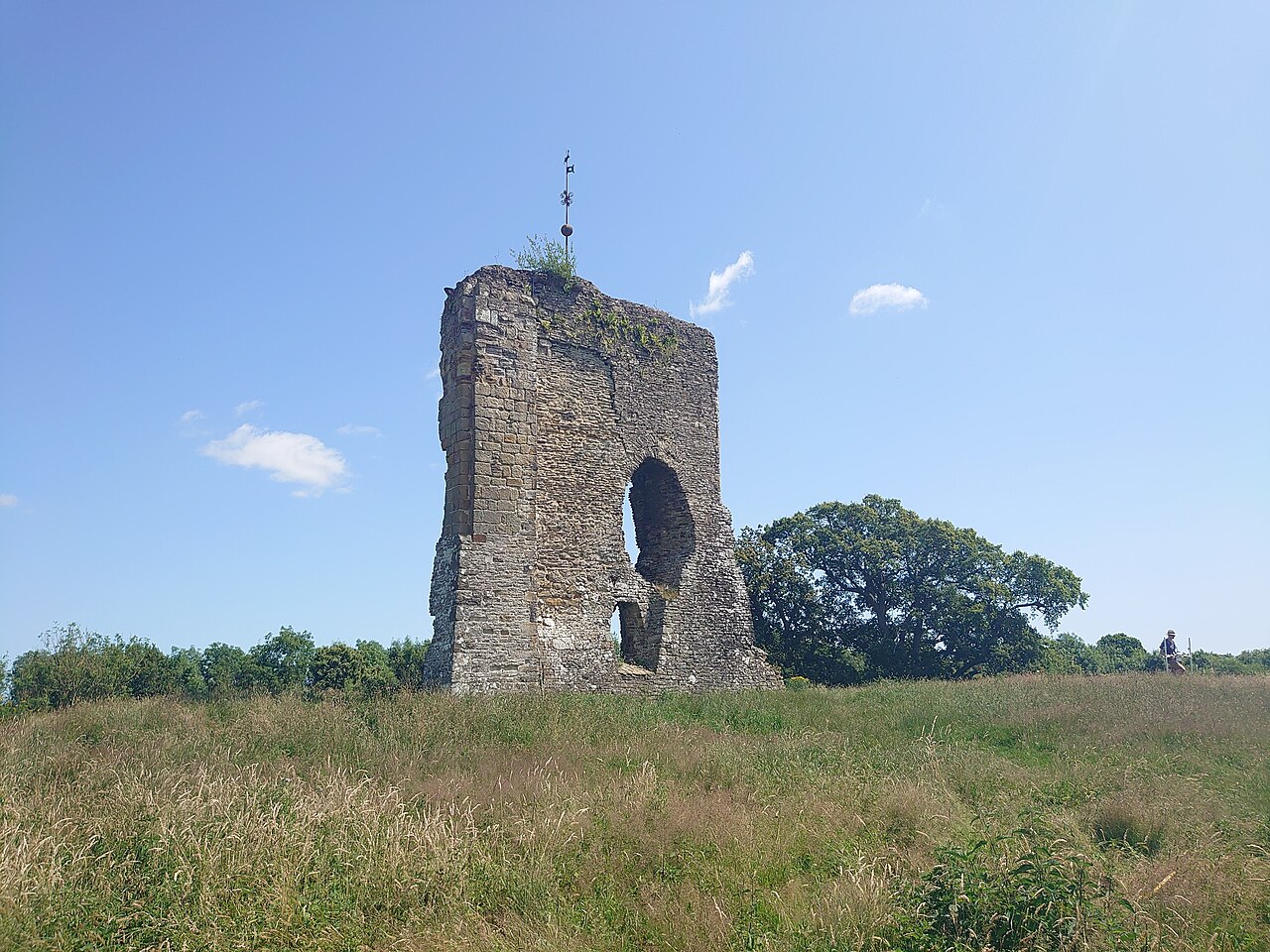
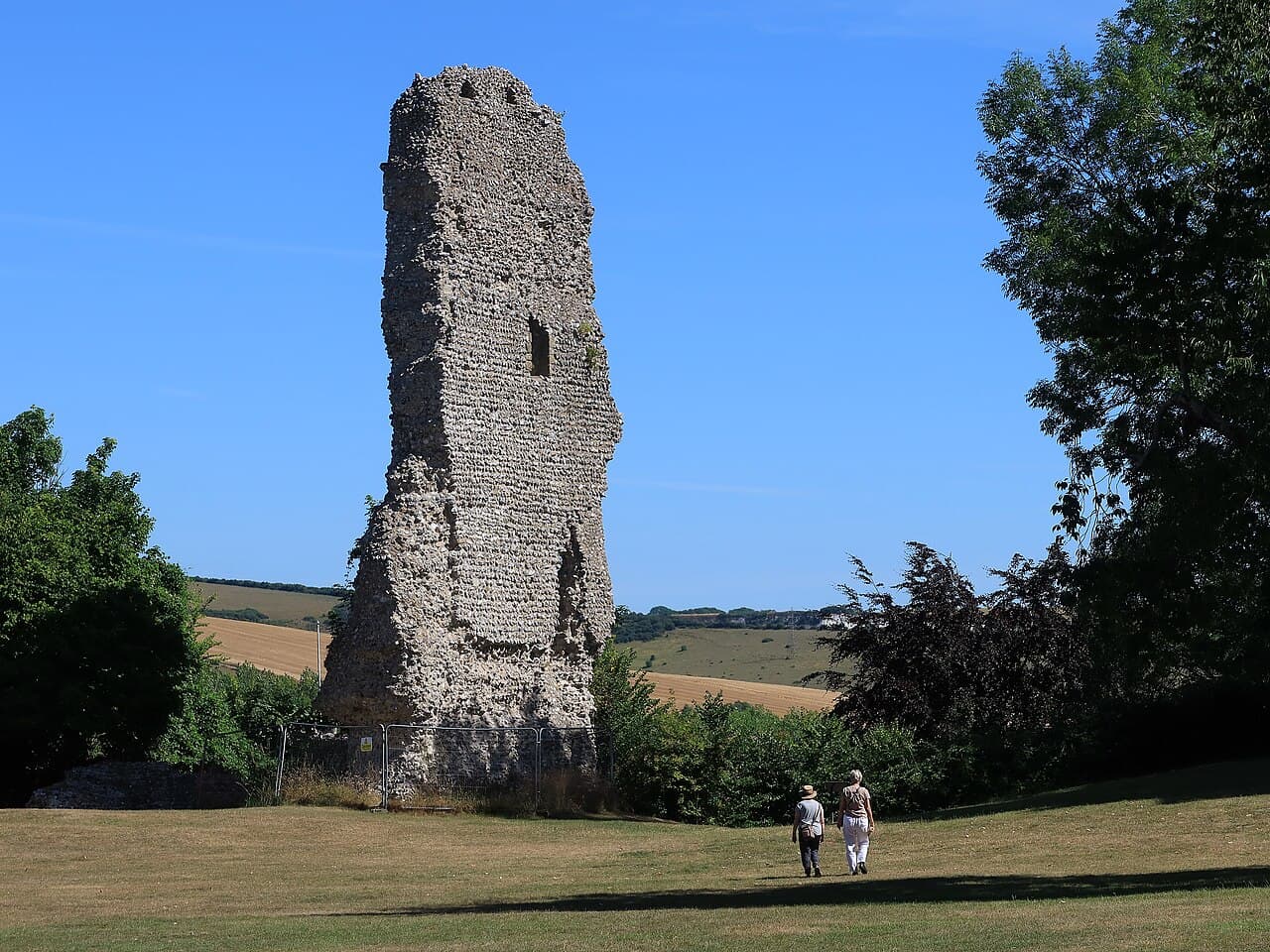
The most prominent surviving structure is the gatehouse tower, which retains much of its original height and features window openings and beam holes indicating former floors. Originally the castle's entrance, the gatehouse was transformed during the 12th century into a fortified tower by raising it approximately 3 meters and sealing its entrances to improve defensibility during King John's reign.
Foundations of living quarters and a guardhouse remain visible as low stone courses. Excavations north of the guardhouse revealed buildings constructed with clay and gypsum, including a kitchen area identified to the west. By the 14th century, the area east of the motte was used as a refuse dump, indicating a shift in the castle's residential use.
Decline, reuse, and preservation
Following its abandonment in the late medieval period, much of Bramber Castle's stonework was quarried for local construction projects such as roads and bridges, contributing to its ruinous state. A small church near the castle entrance, originally built to serve the castle's inhabitants, remains in use today.
During the English Civil War, there is some evidence of military activity near the site, including a skirmish in 1643, though it is unclear if the castle itself was occupied. In the 20th century, archaeological excavations in the 1960s and 1980s uncovered details about the castle's construction phases and later alterations.
During World War II, two defensive pillboxes were installed on the grounds as part of Britain's coastal defenses; these have since been removed. The National Trust acquired the 12-acre site in 1945, and the castle has been designated a Grade I listed historic monument since 1955, recognizing its cultural and architectural significance.
Visitor experience and current status
Today, Bramber Castle's grounds function as a village park, freely accessible to the public. Visitors can explore the ruined curtain walls, the gatehouse tower, and the remains of the motte and baileys, gaining insight into Norman military architecture and medieval feudal administration.
While the castle is largely a ruin with limited architectural detail remaining, its historical significance as an early Norman stronghold and administrative center makes it a noteworthy heritage site. The surrounding landscape offers scenic views of the River Adur estuary and the village of Bramber, enhancing the visitor experience.
Frequently asked questions (FAQ)
- How do I get to Bramber Castle and what are the visiting hours?
- Bramber Castle is located behind 1 The St in the village of Bramber, West Sussex. The grounds are freely accessible as a public park, open daily with no formal opening hours or entrance fee.
- What is the historical importance of Bramber Castle?
- Bramber Castle was built around 1070 as a Norman motte-and-bailey fortress and served as the administrative center for the Rape of Bramber. It played a key role in controlling the River Adur estuary and regional defense during the Norman consolidation of England.
- Can I explore the ruins and what remains of the castle?
- Visitors can explore the remains of the motte, curtain walls, and the prominent gatehouse tower. While much of the castle is in ruins, these surviving features provide insight into its medieval defensive architecture.
- Is there any evidence of later historical events at the castle site?
- Yes, archaeological excavations revealed phases of construction and alterations from the 11th to 14th centuries. Additionally, World War II pillboxes were once installed on site, highlighting its continued strategic importance.
- Are there any facilities or nearby attractions to visit?
- The village of Bramber offers amenities such as cafes and shops. Nearby attractions include the South Downs National Park and other historic sites in West Sussex, making it a good base for exploring the region.
Photo gallery

Information
Sources & official resources
Verify the information above using these authoritative references.
Loading map...
Visitor reviews
No reviews yet. Been here? Write the first review and help other travelers!
Write the first reviewVisited this castle? Share your experience
Your review helps other travelers and adds first-hand knowledge to our encyclopedia.