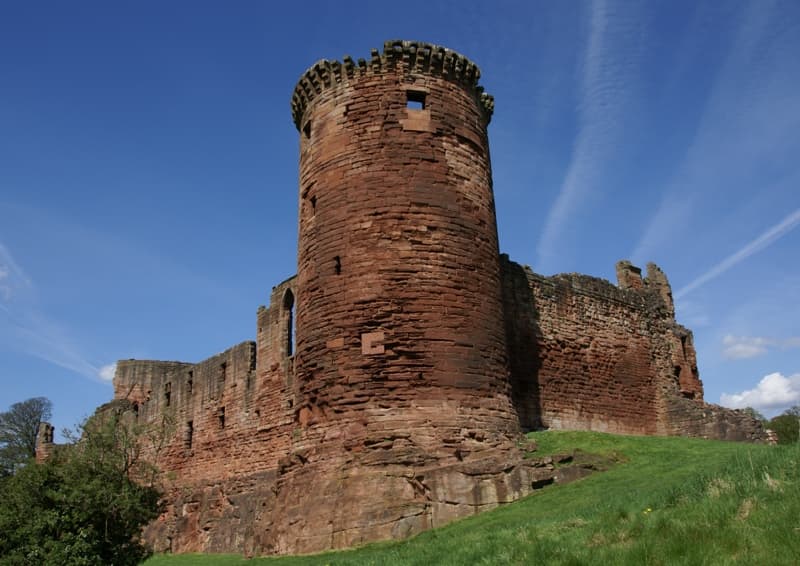
Bothwell Castle
Bothwell Castle stands as a monumental example of medieval Scottish military architecture, perched on a commanding bluff overlooking a bend in the River Clyde. Construction began in the latter half of the 13th century under the direction of Walter of Moray, a prominent Scottish noble. The castle's strategic location was chosen to guard a vital crossing point over the river, making it a key defensive stronghold during turbulent periods of Scottish history.
The castle's original design was ambitious, featuring a massive cylindrical donjon or keep, which was among the largest of its kind in Scotland. This great keep, with walls nearly 4.6 meters thick and originally rising about 25 meters, was designed to serve as both a formidable defensive structure and a residence. However, the castle's construction was interrupted and altered by the Wars of Scottish Independence, during which Bothwell changed hands multiple times between Scottish and English forces. Repeated sieges and battles left the castle damaged, and the original plan was never completed as intended.
Early construction and strategic importance
The land on which Bothwell Castle stands was initially granted in the mid-12th century by King David I to David Olifard, the Justiciar of Lothian. By the mid-13th century, ownership passed to Walter de Moravia (Walter of Moray), who began replacing earlier timber defenses with stone fortifications. At the outbreak of the Wars of Scottish Independence in 1296, the castle consisted of the central donjon, a prison tower, and a short curtain wall, with other defenses still reliant on timber palisades.
Role in the wars of independence
During the wars, Bothwell Castle was a focal point of military action. Captured early by King Edward I of England, it served as a forward base for English operations. Scottish forces laid siege to the castle for over a year between 1298 and 1299, but Edward I reclaimed it in 1301 with a large army and siege engines. The castle was used as English headquarters under Aymer de Valence until Scottish fortunes improved.
Following the pivotal Battle of Bannockburn in 1314, the castle sheltered English nobles. The Scottish constable, Sir Walter FitzGilbert, surrendered the fortress to Scottish control, and the castle was deliberately damaged to prevent English reoccupation. Despite this, the English briefly retook and repaired it in the 1330s. Scottish leader Sir Andrew Murray recaptured it in 1337 and further slighted the fortress by demolishing part of the keep and casting debris into the river.
Rebuilding and expansion under the douglas family
After a period of ruin, restoration began in the 1360s under Archibald Douglas, "the Grim", who married into the Bothwell family. He repaired the donjon and strengthened the curtain walls. His son, the 4th Earl of Douglas, expanded the castle significantly by adding a Great Hall, a chapel, and additional towers by 1424. These additions reflected the dual military and residential functions of the castle, combining strong defenses with noble living quarters.
The castle remained in the hands of the powerful Black Douglas family until their fall from grace in 1455. Subsequent owners included Lord Crichton, Sir John Ramsay, and Patrick Hepburn, the first Earl of Bothwell, who exchanged the castle in 1492 with Archibald Douglas, 5th Earl of Angus.
Architectural features and layout
Bothwell Castle is roughly rectangular, enclosed by thick curtain walls fortified with round towers at the south-east and south-west corners. The western end is dominated by the remains of the massive cylindrical donjon, originally about 25 meters high with walls nearly 4.6 meters thick. This keep contained four floors, accessed by a wooden drawbridge crossing a moat on its western side. Battlements and a deep well inside provided defense and self-sufficiency.
The eastern end features the Great Hall on the first floor, with storage rooms below. Adjacent is the south-east tower, a three-story structure topped with corbelled battlements. The south wing preserves the remains of a chapel on its first floor, indicating the integration of religious functions within the castle.
The prison tower near the donjon includes a notable "prison hole" used to securely confine prisoners. A 14th-century postern gate bears the heraldic arms of the Douglas family, marking their historic tenure. A latrine tower from the 15th century connects to the now-lost southern wing, revealing the complexity of the castle's domestic arrangements.
The north-east tower, once home to the Douglas family, featured a unique drawbridge entrance. Although largely destroyed around 1700, its base remains. Foundations north of the main enclosure show an unfinished 13th-century extension with a gatehouse flanked by two latrine towers and a round tower with a well.
The original north gatehouse was dismantled circa 1700, but the north wall was reconstructed in 1987 to stabilize the ruins. These remains illustrate the castle's evolution through construction, warfare, and adaptation over centuries.
Later history and preservation
In the late 17th century, Archibald Douglas, 1st Earl of Forfar, demolished part of the north-east tower to reuse stone for a nearby mansion. After the death of the 2nd Earl of Forfar in 1715, ownership passed through senior branches of the Douglas family and eventually to the Earls of Home.
The 13th Earl of Home placed Bothwell Castle under state care in 1935. Today, it is a scheduled monument and preserved as an important heritage site. The castle's ruins remain a testament to Scotland's medieval past, attracting visitors interested in history, architecture, and the dramatic events of the Wars of Independence.
Bothwell castle's significance in scottish heritage
Bothwell Castle is one of Scotland's most impressive surviving medieval fortresses. Its massive round keep is a rare example of 13th-century military architecture, showcasing advanced defensive design. The castle's history reflects the broader struggles for Scottish independence and noble power dynamics during the Middle Ages.
The castle's architectural evolution, from its early stone keep to the later additions of halls, towers, and domestic buildings, provides valuable insight into the changing needs of medieval fortifications. The site also illustrates the impact of warfare, siege tactics, and political shifts on castle construction and maintenance.
Today, Bothwell Castle is a popular destination for tourists and historians alike. Its dramatic location on the River Clyde, extensive ruins, and rich history make it a significant cultural landmark in Scotland's heritage landscape.
Frequently asked questions (FAQ)
- How do I get to Bothwell Castle?
- Bothwell Castle is conveniently located just a short drive from Glasgow, making it accessible by car or public transport. The nearest train station is Bothwell, which is within walking distance of the castle. For those driving, there are parking facilities available nearby.
- What is the historical significance of Bothwell Castle?
- Bothwell Castle is one of Scotland's largest and most impressive castles, dating back to the 13th century. It played a significant role in Scottish history, particularly during the Wars of Scottish Independence and was a stronghold for the powerful Dunbar family. The castle's ruins are a testament to its historical importance and architectural grandeur.
- When was Bothwell Castle built?
- Bothwell Castle was originally constructed in the late 13th century, with significant modifications made in the 14th century. Its construction reflects the medieval military architecture of the time, designed to withstand sieges and defend against invasions. Over the centuries, the castle has witnessed numerous historical events that shaped the region.
- Can I visit Bothwell Castle year-round?
- Yes, Bothwell Castle is open to visitors throughout the year, although specific opening hours may vary seasonally. It is best to check the official website for the most current visiting information and any potential closures due to weather or maintenance. Guided tours are often available to enhance your experience.
- Why is Bothwell Castle a popular tourist attraction?
- Bothwell Castle attracts visitors due to its rich history, stunning architecture, and picturesque location along the River Clyde. The castle's dramatic ruins provide a glimpse into Scotland's medieval past and are perfect for photography enthusiasts. Additionally, the surrounding area offers lovely walking paths, making it a great destination for a day out.
- Is it possible to access Bothwell Castle for individuals with disabilities?
- Bothwell Castle strives to be accessible to all visitors; however, some areas may present challenges due to the castle's historic nature and uneven terrain. It is advisable to contact the site in advance to inquire about specific accessibility options and accommodations. Staff are generally willing to assist visitors to ensure a pleasant experience.
- What are the best times to visit Bothwell Castle?
- The best times to visit Bothwell Castle are during the spring and summer months when the weather is typically milder and the gardens are in full bloom. Weekdays tend to be less crowded than weekends, allowing for a more relaxed exploration of the site. Additionally, special events and guided tours may be offered during peak tourist seasons.
- Are there any nearby attractions to explore after visiting Bothwell Castle?
- Yes, there are several nearby attractions to consider after your visit to Bothwell Castle. The nearby town of Bothwell offers charming shops and cafes, while the scenic Clyde Walkway provides beautiful views along the river. Additionally, the historic Hamilton Palace and its park are just a short drive away, perfect for further exploration.
- What are the ticket prices for Bothwell Castle?
- Ticket prices for Bothwell Castle are generally affordable, with discounts available for children, students, and seniors. Admission fees contribute to the preservation and maintenance of the site. It is advisable to check the official website for the latest pricing information and any special offers that may be available.
- What are the opening hours for Bothwell Castle?
- Bothwell Castle's opening hours may vary throughout the year, typically operating from morning until late afternoon. Seasonal changes may affect these times, so it is important to verify the current schedule before planning your visit. The castle may also have extended hours during special events and holidays.
Photo gallery

Information
Website
Visit websiteSources & official resources
Verify the information above using these authoritative references.
Loading map...
Visitor reviews
No reviews yet. Been here? Write the first review and help other travelers!
Write the first reviewVisited this castle? Share your experience
Your review helps other travelers and adds first-hand knowledge to our encyclopedia.



