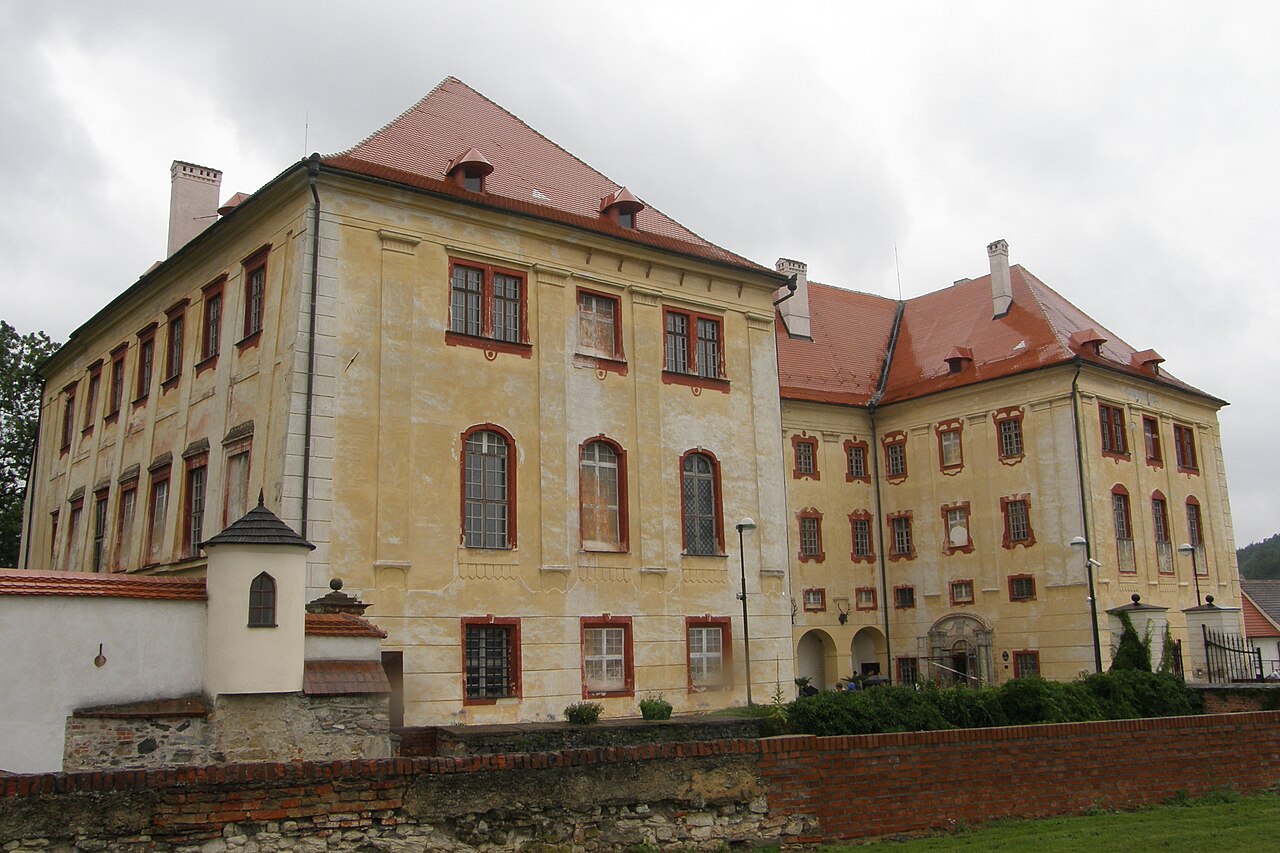
Boskovice Castle
Boskovice Castle stands as a significant medieval fortress perched on a prominent hill overlooking the town of Boskovice in the Moravian region of the Czech Republic. Established in the early 13th century, it served as the ancestral seat of the noble Boskovice family, symbolizing their regional power and influence throughout the Middle Ages. The earliest documented mention of the castle dates back to 1312, underscoring its longstanding historical importance.
Early history and medieval conflicts
Constructed initially as a hill castle, Boskovice Castle was strategically located to oversee and control the surrounding landscape. During the late 14th century, it became embroiled in the Moravian Margrave Wars, a period marked by intense regional conflict. The castle endured a siege, during which its defender, Jan Ozor z Boskovic, tragically lost his life in 1389 defending the fortress. Subsequently, the castle changed hands when it was seized and granted to the Kunštát family in 1398, who undertook significant reconstruction and fortification efforts to strengthen the site against future attacks.
The impact of the hussite wars
The early 15th century brought further turmoil as the Hussite Wars swept through Moravia. Boskovice Castle was captured by Hussite forces, reflecting the widespread religious and political upheaval of the era. This period of occupation lasted for some time before the Boskovice family managed to reclaim the castle in the mid-15th century, maintaining ownership until the mid-1500s.
Renaissance transformation and later ownership
Significant architectural and functional changes occurred during the 16th century under the stewardship of Kryštof z Boskovic, who initiated extensive renovations that aligned the castle with contemporary Renaissance styles. These modifications included the addition of new defensive elements and aesthetic enhancements that modernized the medieval fortress.
Financial difficulties led to the sale of the estate in 1547 to Šimon Eder, who continued the Renaissance-style improvements and expanded the castle's fortifications. Ownership transferred again in 1567 to the Zástřizl family, who held the property until 1690. That year, the Dietrichstein family acquired Boskovice Castle, becoming its final noble owners.
By around 1720, Walter Xaver of Dietrichstein relocated from the aging castle to a newly constructed Baroque residence in Boskovice town, marking the beginning of the castle’s decline. The fortress was repurposed for economic uses but gradually fell into disrepair.
Decline and preservation of the ruins
Abandoned by 1784, the castle’s roof was dismantled to provide building materials for local structures, accelerating its deterioration. The extensive ruins cover approximately 64 ares, making Boskovice Castle one of the largest castle ruins in Moravia. The site reflects a complex layering of medieval fortifications and Renaissance adaptations, offering valuable insights into architectural evolution over several centuries.
Unique architectural features
Among the most remarkable surviving elements is a deep wooden well dating from the 16th century, measuring 26 meters in depth and about 3.6 meters in diameter. This well is equipped with a treadwheel, a large wooden wheel powered by human effort, used to draw water from great depths. It remains the only functional well of its kind in the Czech Republic, highlighting the castle’s advanced engineering.
The well was originally connected via a rock-carved passage to an external water source outside the defensive walls, though this external well has since been sealed. Nearby stands a large bastion, a defensive structure likely constructed in the 15th or 16th century, which is comparable in size to the main castle area and underscores the fortress's strategic importance.
Renaissance additions and cultural heritage
During the Renaissance period, the castle complex was enhanced with a new gate portal prominently displaying the Zástřizl family coat of arms, symbolizing their influence. A spacious armory was also added to house weapons, and the castle was known to possess a substantial library, reflecting its role as a cultural as well as military center.
Modern history and conservation efforts
In the 19th century, the estate came under the ownership of the Mensdorff-Pouilly family, who retained it until the mid-20th century. Following confiscation during the communist era in 1950, the property was returned to the family after political changes in 1991, and they remain its custodians today.
Recent restoration efforts have focused on stabilizing the outer defensive walls to prevent further decay. However, the absence of a roof since the 18th century has left the ruins vulnerable to weather damage. Additionally, the removal of masonry for local construction has contributed to the site's gradual erosion.
Historical mining attempts and local lore
The nearby hill known as Zlatník attracted attention in the 16th century for attempts to mine gold deposits. Although these efforts were unsuccessful, they form part of the castle’s rich historical narrative and illustrate the economic ambitions associated with the estate.
Today, Boskovice Castle remains a significant cultural landmark, offering visitors a glimpse into the layered history of Moravian nobility, medieval military architecture, and Renaissance transformation. Its extensive ruins, unique well, and bastion provide a compelling destination for those interested in Czech heritage and castle architecture.
Frequently asked questions (FAQ)
- How do I visit Boskovice Castle?
- Boskovice Castle is accessible to the public as a historic ruin. Visitors can explore the site year-round, but it is advisable to check local tourism information for any seasonal restrictions or guided tour availability.
- What is the historical significance of Boskovice Castle?
- Boskovice Castle played a crucial role in regional defense and noble residence from the 13th century through the Renaissance. It witnessed key events such as the Moravian Margrave Wars and the Hussite Wars, reflecting the turbulent history of Moravia.
- What architectural styles are present at Boskovice Castle?
- The castle exhibits a blend of medieval fortifications and Renaissance modifications, including a notable 16th-century wooden well with a treadwheel, a bastion, and a Renaissance gate portal bearing the Zástřizl family coat of arms.
- Is the wooden well at Boskovice Castle unique?
- Yes, the wooden well with its 16th-century treadwheel is the only functional well of its kind in the Czech Republic, highlighting the castle’s advanced engineering and historical importance.
- Can I see the bastion at Boskovice Castle?
- Visitors can view the large bastion near the castle ruins, which dates from the 15th or 16th century and is a significant part of the castle’s defensive system.
Information
Sources & official resources
Verify the information above using these authoritative references.
Loading map...
Visitor reviews
No reviews yet. Been here? Write the first review and help other travelers!
Write the first reviewVisited this castle? Share your experience
Your review helps other travelers and adds first-hand knowledge to our encyclopedia.