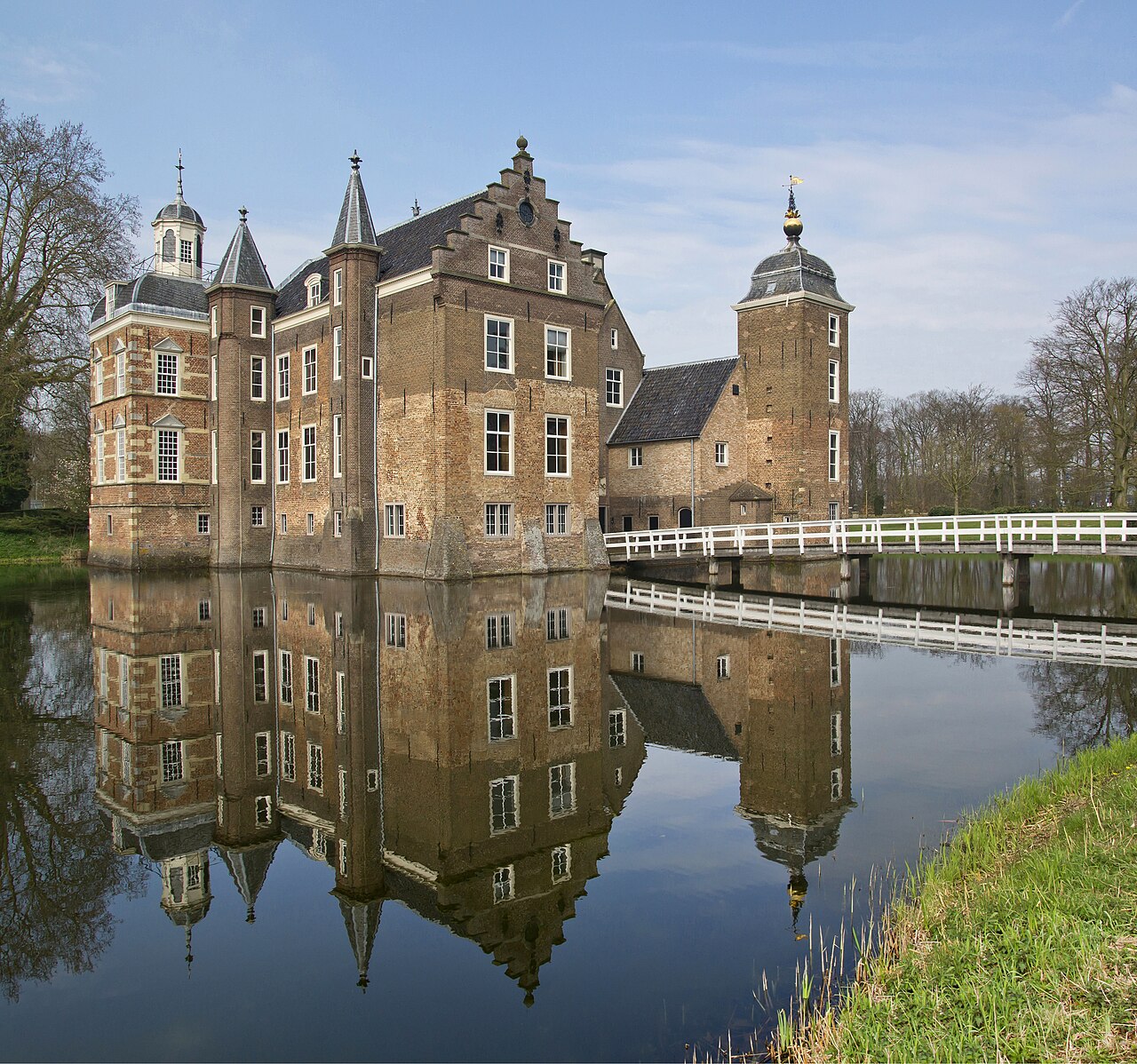
Borculo Castle
Borculo Castle was a medieval fortress located near the town of Borculo in the province of Gelderland, Netherlands. Constructed in the 12th century, it served as the seat of the Lords of Borculo, a noble family first mentioned in historical records during that century. The castle played a central role in the development of the adjacent settlement, which was first documented in 1337. As a typical high medieval stronghold, Borculo Castle featured a rectangular layout with round corner towers, one of which likely functioned as a keep, a fortified tower serving as a last line of defense and residence.
Medieval origins and architectural features
The original castle was built in the high medieval period as a fortified residence and defensive structure. Its design included a rectangular plan surrounded by a moat, of which remnants survive today as a ditch on three sides of the site. The round towers at the corners were characteristic of the period's military architecture, providing vantage points for defense and surveillance. The keep tower was probably the strongest part of the castle, designed to withstand sieges and protect the lord and his retinue.
Historical significance and ownership disputes
During the 16th century, Borculo Castle came under the control of the Counts of Limburg-Bronckhorst. The last count's death in 1553 sparked a dispute over ownership, contested by Christoph Bernhard von Galen, the Prince-Bishop of Münster. This conflict culminated in a ruling by the Court of Gelderland in 1615, which awarded ownership to the heirs of the last count. The decision was enforced militarily in 1616 when troops from the nearby town of Zutphen seized the castle after brief combat. Following this, the castle underwent repairs and expansions around 1640, reflecting its ongoing strategic and residential importance.
Decline and transformation in the early modern period
By the early 18th century, Borculo Castle's fortunes waned. It was sold in 1727 and soon fell into disuse and disrepair. By 1743, it was described as dilapidated and partly ruined. Between 1760 and 1764, the medieval structure was demolished and replaced by a smaller L-shaped building. This new building was repurposed by William V, Prince of Orange, who acquired the lordship of Borculo in 1777, into a stud farm. The stud farm operated through the French era and beyond until 1852, after which it too was demolished in 1870.
Current site and archaeological remains
Today, no visible structures of Borculo Castle remain above ground. The site is partially occupied by a library, a cultural center, and a private residence. The original castle's footprint is still discernible through the surviving moat ditch on three sides. Archaeological investigations have revealed 16th-century vaulted cellars, fragments of outer walls, and the foundations of the keep beneath the modern buildings. These underground remains provide valuable insights into the castle's original layout and construction techniques.
Architectural and cultural legacy
Borculo Castle exemplifies the evolution of a medieval fortress through centuries of political change, conflict, and adaptation. Its transformation from a high medieval stronghold to a stud farm reflects broader shifts in Dutch society and land use. Although no above-ground structures survive, the castle's historical footprint and archaeological remnants contribute to the cultural heritage of Gelderland and the Netherlands. The title of 'Lord of Borculo' remains with the Dutch monarchy, linking the site to the nation's royal history.
Frequently asked questions (FAQ)
- When was Borculo Castle originally built?
- Borculo Castle was likely constructed in the 12th century during the high medieval period by the Lords of Borculo.
- What remains of Borculo Castle can be seen today?
- No above-ground structures remain; however, 16th-century vaulted cellars, outer wall fragments, and foundations lie beneath modern buildings on the site.
- Who owned Borculo Castle during the 16th century?
- In the 16th century, the castle was ruled by the Counts of Limburg-Bronckhorst until the last count died in 1553.
- What happened to Borculo Castle after 1760?
- Between 1760 and 1764, the medieval castle was demolished and replaced by a smaller L-shaped building, later converted into a stud farm by William V, Prince of Orange.
- Is Borculo Castle accessible to visitors today?
- The castle site is partly built over with modern buildings, and no visible castle remains exist above ground, limiting direct visitor access to the original structure.
Information
Address
Hoflaan 1, Netherlands
Loading map...
Visitor reviews
No reviews yet. Been here? Write the first review and help other travelers!
Write the first reviewVisited this castle? Share your experience
Your review helps other travelers and adds first-hand knowledge to our encyclopedia.