Bolsover Castle
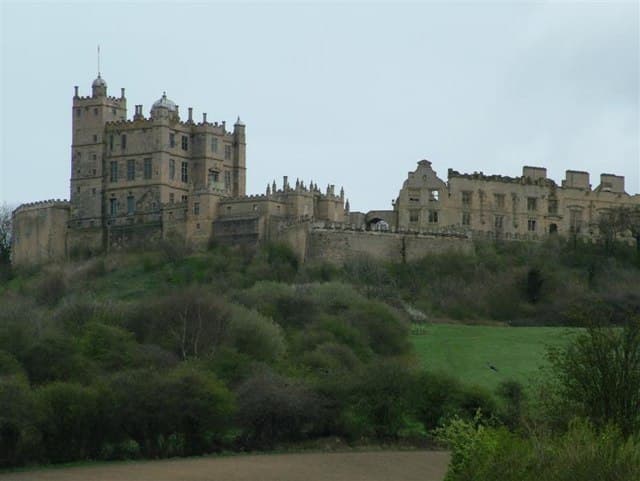
Bolsover Castle stands as a remarkable example of a Renaissance hill castle located in Bolsover, England. Constructed in the early 17th century on the site of a medieval fortress originally established in the 12th century, this castle offers a fascinating glimpse into the evolution of English castle architecture and aristocratic life. Today, it is managed by English Heritage and recognized as a Grade I listed building and a Scheduled Ancient Monument.
The castle was initially built by Sir Charles Cavendish in 1612 and completed by his son, William Cavendish. Designed primarily as a residence for entertainment and leisure rather than military defense, Bolsover Castle epitomizes the Golden Age of Chivalry with its elegant architecture and scenic views over the Vale of Scarsdale. Its most famous structure, the Little Castle, features richly decorated interiors including ornate panelling, elaborate fireplaces, and intricately painted ceilings. The castle also boasts an atmospheric Terrace Range in ruins and the enchanting Venus Garden, complete with secluded love seats and classical statues.
Historical background and ownership
The origins of Bolsover Castle trace back to the Norman Conquest, when the site was first fortified as a motte-and-bailey castle by the Peverel family in the 12th century. Throughout the 12th and 13th centuries, the castle played a strategic role in local power struggles between noble families and the Crown, including notable involvement during the reigns of Henry II, King John, and Henry III. Over time, the medieval fortress fell into decline and disuse, transitioning largely to agricultural oversight by the late 13th century.
In the mid-16th century, the estate passed to George Talbot, 6th Earl of Shrewsbury, before being sold to Sir Charles Cavendish in 1590. Cavendish initiated a transformation from a military stronghold into a refined country residence, commissioning the renowned architect Robert Smythson and later his son John Smythson to oversee the project. The architectural design embraced the emerging Renaissance ideals, blending comfort with artistic expression.
Following Sir Charles's death, his sons continued the work, culminating in the completion of the Little Castle around 1621. This building reflects the influence of Inigo Jones and the Italianate style, marking a shift in English castle construction toward elegant, pleasure-focused homes. In 1634, the castle famously hosted King Charles I and Queen Henrietta Maria, who were entertained with a masque by the playwright Ben Jonson.
During the English Civil War beginning in 1642, Bolsover Castle was seized by Parliamentary forces and subsequently slighted to prevent its military use. Restoration efforts led by William Cavendish, 1st Duke of Newcastle, revived the castle as a noble residence with new halls and decorated chambers. The property later passed to the Bentinck family, the Dukes of Portland, through marriage.
Architectural features and layout
The little castle
The centerpiece of Bolsover Castle is the Little Castle, an uncommon example of early 17th-century architecture that merges Romanesque rounded arches, Gothic pointed arches, and elements of the Mannerist movement. Positioned on a hillside, it offers commanding views and is accessed from the south through a distinctive entrance marked by a carving of Hercules.
Inside, the ground floor houses an entrance hall and an antechamber adorned with murals depicting the four humors. The great hall features Gothic ribbed vaults supported by Doric columns and a grand fireplace dated 1616. The pillar parlour is richly decorated with gold-painted panels and murals illustrating the five senses, framed by Ionic columns.
The first floor contains the famous Star Chamber, a reception room with a ceiling painted to resemble a starry night sky. Its walls display panels of saints and biblical figures, with tapestries that have been replaced by replicas. Adjacent is the marble closet, an intimate chamber clad entirely in marble and decorated with light erotic scenes inspired by the engravings of Hendrick Goltzius.
William Cavendish's bedroom occupies the southeast corner, notable for its low ceilings and originally gold-embossed wooden panelling. This suite connects to three small rooms: a private closet, the heaven closet with a ceiling painting of Christ dancing among angels, and the Elysium closet, featuring mythological and bacchanalian imagery with the motto "All is But vanitie."
Upper floors and cellar
The second floor includes bedrooms and smaller chambers arranged around a central dome that provides natural light. Stone benches built into the walls likely served as seating for dessert courses after meals. The original flat roof was replaced with a pitched roof around 1750 and is now closed to visitors.
Beneath the main floors, the cellar contains kitchens with ovens built into the walls for wood-fire cooking, storage rooms for beer, wine, and cheese, and a stairway connecting directly to the great hall above. These kitchens remained operational until the late 19th century.
Grounds and auxiliary buildings
The castle grounds include the Venus Garden, a walled garden enclosed by crenellated walls featuring fountains, statues of Venus, busts of Roman emperors, and carvings symbolizing desire. Walkways and integrated rooms within the garden were reportedly used for alchemical experiments, reflecting the era's interests in mysticism and science.
Adjacent to the Little Castle are the ruins of servants' quarters and a well-preserved 17th-century horse stable capable of housing up to fifteen horses. Though the stable roof is a modern reconstruction, the structure retains much of its original layout and is used for historical equestrian demonstrations.
The western boundary of the estate is marked by the remains of the Terrace Range, a long building originally designed by John Smythson as an opulent gallery apartment. It included kitchens, storage spaces, and a brewery arranged to minimize servant traffic. Severely damaged during the Civil War and left roofless, it was partially rebuilt with an arched floor and chapel but fell into ruin by the 18th century.
Preservation and visitor experience
Today, Bolsover Castle is a protected historic site under English Heritage. Restoration efforts continue to address moisture and mold damage in cellar rooms and maintain the structural integrity of the ruins. Visitors can explore the accessible grounds, including level gravel paths suitable for wheelchair users, though the Little Castle itself is not wheelchair accessible.
The site offers an audio trail included with admission, tactile exhibits in the Discovery Centre, and extensive use of sound for visually impaired visitors. Hearing loops are also available to assist hearing-impaired guests. The castle provides a rich educational experience, combining architectural splendor with historical narratives from the medieval period through the Renaissance and beyond.
Frequently asked questions (FAQ)
- What are the opening hours of Bolsover Castle?
- Bolsover Castle is typically open from 10:00 AM to 5:00 PM during the peak season, which runs from March to October. In the winter months, the castle may have reduced hours, so it's advisable to check the official website for the most current information before your visit.
- Can I purchase tickets online for Bolsover Castle?
- Yes, you can purchase tickets online through the official Bolsover Castle website. Buying tickets in advance not only secures your entry but may also help you avoid long queues at the ticket office on the day of your visit.
- When was Bolsover Castle built?
- Bolsover Castle was originally constructed in the 12th century, with significant renovations and expansions taking place in the 17th century under the direction of Sir Charles Cavendish. The castle's current form reflects both its historical significance and the architectural style of the Renaissance period.
- Is Bolsover Castle accessible for visitors with mobility issues?
- Yes, Bolsover Castle strives to be accessible to all visitors. There are designated parking spaces for disabled visitors, and the site offers wheelchairs for hire. However, some areas of the castle may have limited access due to uneven terrain or stairs.
- What is the historical significance of Bolsover Castle?
- Bolsover Castle is an important example of 17th-century architecture and reflects the power and wealth of the Cavendish family. It served as a retreat for the family, showcasing lavish interiors and beautifully landscaped gardens that highlight the era's style and opulence.
- When is the best time to visit Bolsover Castle?
- The best time to visit Bolsover Castle is during spring and early autumn, when the weather is generally mild, and the gardens are in full bloom. These seasons also feature various events and activities, enhancing your experience at the castle.
- Are there any nearby attractions to Bolsover Castle?
- Yes, there are several attractions near Bolsover Castle, including the historic town of Chesterfield and the scenic Peak District National Park. Visitors can also explore the nearby Hardwick Hall, another grand property with rich history and beautiful gardens.
- What are the ticket prices for Bolsover Castle?
- Ticket prices for Bolsover Castle vary depending on the season and whether you are an adult, child, or family group. Discounts may be available for students, seniors, and members of certain organizations, so it's best to check the official website for detailed pricing information.
Photo gallery

Information
Website
Visit websiteSources & official resources
Verify the information above using these authoritative references.
Loading map...
Visitor reviews
No reviews yet. Been here? Write the first review and help other travelers!
Write the first reviewVisited this castle? Share your experience
Your review helps other travelers and adds first-hand knowledge to our encyclopedia.