Bolingbroke Castle
Bolingbroke Castle stands as a significant medieval fortress near the village of Old Bolingbroke in Lincolnshire, England. Originally constructed by the Normans, it played an important role in the consolidation of Norman power during the 12th century. The castle's strategic location on a hill and later on a plain surrounded by hills reflects the evolving defensive needs of medieval England.
Early fortifications and 13th-century transformation
The earliest fortification on the site was a motte-and-bailey castle built in the 12th century by William de Roumare, 1st Earl of Lincoln. This wooden structure was typical of Norman military architecture, designed for rapid construction and defense. However, between 1220 and 1230, a major reconstruction was undertaken by Ranulf de Blondeville, 6th Earl of Chester and 1st Earl of Lincoln. He replaced the timber castle with a substantial stone fortress on a flat plain encircled by three hills, marking a significant advancement in fortification techniques.
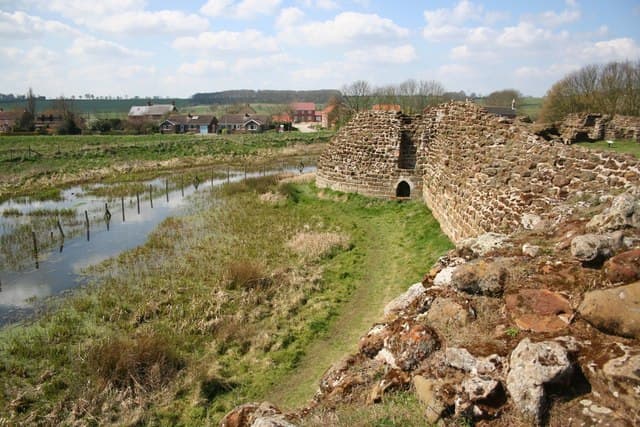
The new castle, documented between 1232 and 1240, featured a roughly polygonal enclosure approximately 75 meters across, surrounded by a wide, deep, water-filled moat about 30 meters wide. The curtain walls were impressively thick, up to 5 meters, reinforced by five distinctive D-shaped corner towers. The main entrance was defended by a twin-towered gatehouse with a drawbridge, remains of which were uncovered in 20th-century excavations.
Unlike many castles of the period, Bolingbroke lacked a central keep, relying instead on its formidable curtain walls and corner towers for defense. This design was similar to other castles built by Ranulf, such as Beeston Castle in Cheshire, and echoed continental influences like the castle at Boulogne-sur-Mer in France. The castle was primarily constructed from Spilsby greenstone, a local porous limestone that, while easy to quarry, has suffered weathering over the centuries.
Lancastrian connections and political significance
After Ranulf's death in 1232 without heirs, Bolingbroke Castle passed through his sisters to John de Lacy, 1st Earl of Lincoln, and subsequently to the de Lacy family. Through marriage, control transferred to Thomas Plantagenet, 2nd Earl of Lancaster, and later to John of Gaunt, son of King Edward III. The castle's political importance grew as it became a key administrative center for the Lancastrian family.
Blanche of Lancaster, wife of John of Gaunt, was born at the castle in 1342. Their son, Henry Bolingbroke, born there in 1367, would later ascend the throne as King Henry IV, cementing the castle's place in English royal history. This noble residence was not only a military stronghold but also a symbol of Lancastrian power during the late medieval period.
Decline and military history through the 17th century
Despite its royal connections, Bolingbroke Castle did not play a major role during the Wars of the Roses. By the Tudor era, the castle's condition had deteriorated significantly. By around 1600, four of its towers were uninhabitable, with only the gatehouse tower and an octagonal tower (rebuilt between 1446 and 1456 and known as the Royal Tower) still in use.
During the English Civil War in the 1640s, the castle was held by Royalist forces and endured a siege in 1643. It changed hands before being deliberately slighted in 1652 to prevent further military use. This slighting led to the demolition of most walls and towers, with rubble dumped into the moat. The last major standing structure, the gatehouse tower, collapsed in 1815.
Archaeological investigations and preservation
In the 20th century, archaeological excavations in the 1960s and 1970s revealed key details about the castle's layout and construction techniques. These studies helped preserve the site, which was transferred to Heritage Lincolnshire in 1995. Today, Bolingbroke Castle is maintained as a historic ruin, offering visitors insight into medieval castle design and Lancastrian history.
Architectural features and castle layout
The castle's roughly polygonal enclosure was protected by a broad water-filled moat approximately 30 to 31 meters wide, creating a formidable defensive barrier. The thick curtain walls reached up to 5 meters in thickness, with surviving sections standing about 6 meters high. Five D-shaped corner towers provided overlapping fields of fire, a sophisticated defensive feature for the period.
The gatehouse was a twin-towered structure with a drawbridge, serving as the main entry point. Within the walls lay a courtyard that housed wooden buildings including a great hall for the lord's household and various service structures. An outer bailey outside the main enclosure was used for livestock and additional functions.
Nearby stood a Norman church linked to the castle, with a southern aisle added in 1363 by John of Gaunt, underscoring the castle's dual role as a military and domestic center. The use of local Spilsby greenstone gave the castle a distinctive appearance but also contributed to its gradual decay due to the stone's porous nature.
Current condition and visitor experience
Today, visitors to Bolingbroke Castle can explore the remains of its thick curtain walls, some rising to about 6 meters, and the bases of the corner towers, which stand around 3 meters high. The moat, though partly filled in, remains visible as a broad defensive ditch. These ruins provide a tangible connection to the castle's medieval past and its role in English history.
The site offers a glimpse into the evolution of castle architecture from wooden motte-and-bailey designs to more sophisticated stone fortifications. It also highlights the castle's importance as a Lancastrian stronghold and birthplace of a king, making it a valuable cultural and historical landmark in Lincolnshire.
Frequently asked questions (FAQ)
- How do I get to Bolingbroke Castle?
- Bolingbroke Castle is located near the village of Old Bolingbroke in Lincolnshire, England. It is accessible by car via local roads, with parking available nearby. Public transport options are limited, so driving is recommended.
- What is the historical significance of Bolingbroke Castle?
- Bolingbroke Castle is historically significant as the birthplace of King Henry IV and a key Lancastrian stronghold. It reflects important developments in medieval military architecture and noble residence design.
- Can I visit the ruins of Bolingbroke Castle?
- Yes, Bolingbroke Castle is open to visitors as a historic ruin managed by Heritage Lincolnshire. Visitors can explore the remains of the curtain walls, towers, and moat, gaining insight into medieval castle construction.
- When was Bolingbroke Castle built?
- The original motte-and-bailey castle was built in the 12th century, with the stone castle constructed between 1220 and 1230 by Ranulf de Blondeville.
- Why does Bolingbroke Castle lack a central keep?
- Bolingbroke Castle was designed without a central keep, relying instead on thick curtain walls and D-shaped corner towers for defense. This design was innovative for its time and similar to other castles built by Ranulf de Blondeville.
Photo gallery

Information
Sources & official resources
Verify the information above using these authoritative references.
Loading map...
Visitor reviews
No reviews yet. Been here? Write the first review and help other travelers!
Write the first reviewVisited this castle? Share your experience
Your review helps other travelers and adds first-hand knowledge to our encyclopedia.