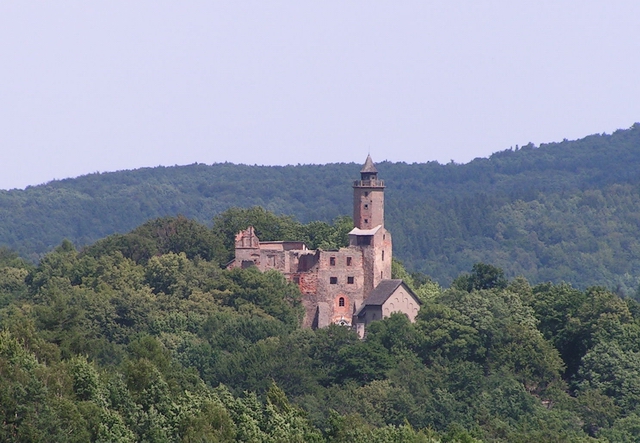
Bojanice castle was a medieval hill castle located on a strategic elevation west of the village of Bojanice, nestled in the valley of Bojanicka Woda at the foothills of the Sowie Mountains in Poland. Documented origins of the village date back to the 14th century, and it is likely that the settlement, along with the castle, existed earlier as part of the regional defensive network. The castle was probably constructed in the 14th century during the late medieval period and belonged to the Świdnica-Jawor duchy, a significant principality within the fragmented Piast-ruled Silesia.
Historical context and ownership
The Świdnica-Jawor duchy was a notable political entity in southwestern Poland during the Middle Ages, and Bojanice castle formed part of its border defenses. Castles like Bojanice served as administrative centers, military strongholds, and symbols of feudal authority. Unfortunately, detailed records about Bojanice castle's role and ownership are scarce, limiting comprehensive understanding of its historical significance.
Architectural features and layout
Due to the lack of surviving physical remains and limited archaeological research, the exact architectural design of Bojanice castle remains unknown. The castle was situated on a hilltop, typical for defensive sites in the region, providing commanding views over the surrounding valley and control of local routes. It likely featured typical medieval fortifications such as stone walls, a gatehouse, towers, and possibly a keep or donjon. However, no detailed plans or descriptions survive to reconstruct its layout.
Destruction and current condition
Bojanice castle was destroyed during the Thirty Years' War (1618-1648), a devastating conflict that affected much of Central Europe. By the 19th century, remnants of the castle's walls were still visible, but systematic quarrying of stone from the ruins led to the complete dismantling of the structure. Today, no visible traces of the castle remain on the hill, and the site is considered archaeological ruins. The absence of above-ground remains challenges preservation and interpretation efforts.
Archaeological potential and heritage significance
Although Bojanice castle no longer stands, its location and historical context offer potential for archaeological investigation. Excavations could reveal foundations, defensive features, and artifacts that illuminate medieval life in the region. The castle's association with the Świdnica-Jawor duchy contributes to understanding the complex feudal landscape of late medieval Silesia. Preserving knowledge of such vanished sites is crucial for regional cultural heritage.
Visiting the site today
Visitors to Bojanice can explore the surrounding countryside and the village, appreciating the natural beauty of the Sowie Mountains foothills. Although the castle itself has vanished, the site remains of interest to history enthusiasts and hikers. Interpretation is limited due to the lack of visible remains, so visitors should prepare accordingly and seek local historical resources for context.
Frequently asked questions (FAQ)
- When was Bojanice castle built?
- Bojanice castle was built in the 14th century during the late medieval period, likely as part of the Świdnica-Jawor duchy's defenses.
- What remains of Bojanice castle can be seen today?
- No visible remains of Bojanice castle exist today as the ruins were completely dismantled by the 19th century due to stone quarrying.
- Why was Bojanice castle destroyed?
- The castle was destroyed during the Thirty Years' War, a widespread conflict in Central Europe that led to the ruin of many medieval fortifications.
- Can I visit the site of Bojanice castle?
- Yes, visitors can explore the hill where Bojanice castle once stood, though no castle structures remain. The site is suitable for hiking and appreciating the local landscape.
- Is there archaeological research on Bojanice castle?
- Limited archaeological work has been conducted, but the site holds potential for future excavations to uncover foundations and artifacts from the medieval period.
Information
Loading map...
Visitor reviews
No reviews yet. Been here? Write the first review and help other travelers!
Write the first reviewVisited this castle? Share your experience
Your review helps other travelers and adds first-hand knowledge to our encyclopedia.