Bogensperk Castle
Bogenšperk Castle is a 16th-century Renaissance castle located in the Municipality of Šmartno pri Litiji in central Slovenia. It is widely recognized for its historical connection to the 17th-century scientist and natural historian Johann Weikhard von Valvasor, a fellow of the Royal Society in London. The castle stands on a low hill and is a significant cultural monument of Slovenia, reflecting the architectural and historical heritage of the region.
Architectural features and layout
The castle's structure consists of a three-story building with four tracts from different periods, which are connected by four towers surrounding an arcaded inner courtyard. The oldest part of the castle is the north tower, originally a standalone fortification. A wooden bridge was later constructed to connect this tower to the south-east tower, which served a defensive role and was once taller than the rest of the castle. However, after a 1759 fire caused by lightning, the south-east tower was never rebuilt to its original height.
The castle is built on solid bedrock, and one of its notable features is a deep well carved directly into the rock, demonstrating the ingenuity of its builders in securing water supply. The castle's layout and fortifications reflect typical Renaissance defensive architecture adapted for residential and administrative use.
Historical background and ownership
The origins of Bogenšperk Castle are linked to the noble house of Wagen. It was likely constructed as a replacement for the nearby Castle Lihtenberk, which suffered severe damage from a major earthquake in 1511 and was already in disrepair. The construction of Bogenšperk began in the 16th century, marking a transition from medieval fortress to Renaissance residence.
After the death of Jurij Wagen in 1630, the castle passed through various owners until it was purchased in 1672 by Johann Weikhard von Valvasor. Valvasor extensively renovated the castle, equipping it with a graphic studio, library, printing press, and a collection of curiosities. These additions highlight the castle's role as a center of learning and culture during Valvasor's residency.
Valvasor's impact and legacy
Johann Weikhard von Valvasor is the most famous figure associated with Bogenšperk Castle. His work, The Glory of the Duchy of Carniola, was a monumental publication documenting the geography, history, and culture of the region. The enormous cost of producing this book led to Valvasor's financial difficulties, forcing him to sell his valuable library and eventually the castle itself in 1692.
Despite his financial troubles, Valvasor's contributions to natural history and cartography remain significant. The castle during his time was a hub of intellectual activity, reflecting the Enlightenment spirit of the 17th century.
Later history and preservation efforts
Following Valvasor's departure, Bogenšperk Castle changed hands several times, with the noble family Windischgrätz being the last private owners before abandoning it in 1943. Although the castle's interior furnishings were destroyed or looted during the turmoil of World War II, the structure itself survived intact.
After the war, the castle served as a military hospital and later was occupied by Jesuits from 1957, who undertook some preventive maintenance. A systematic reconstruction effort began in 1972 under the guidance of art historian Milan Železnik, aimed at preserving the castle's architectural integrity and historical significance.
Lihtenberk castle and its relation to bogenšperk
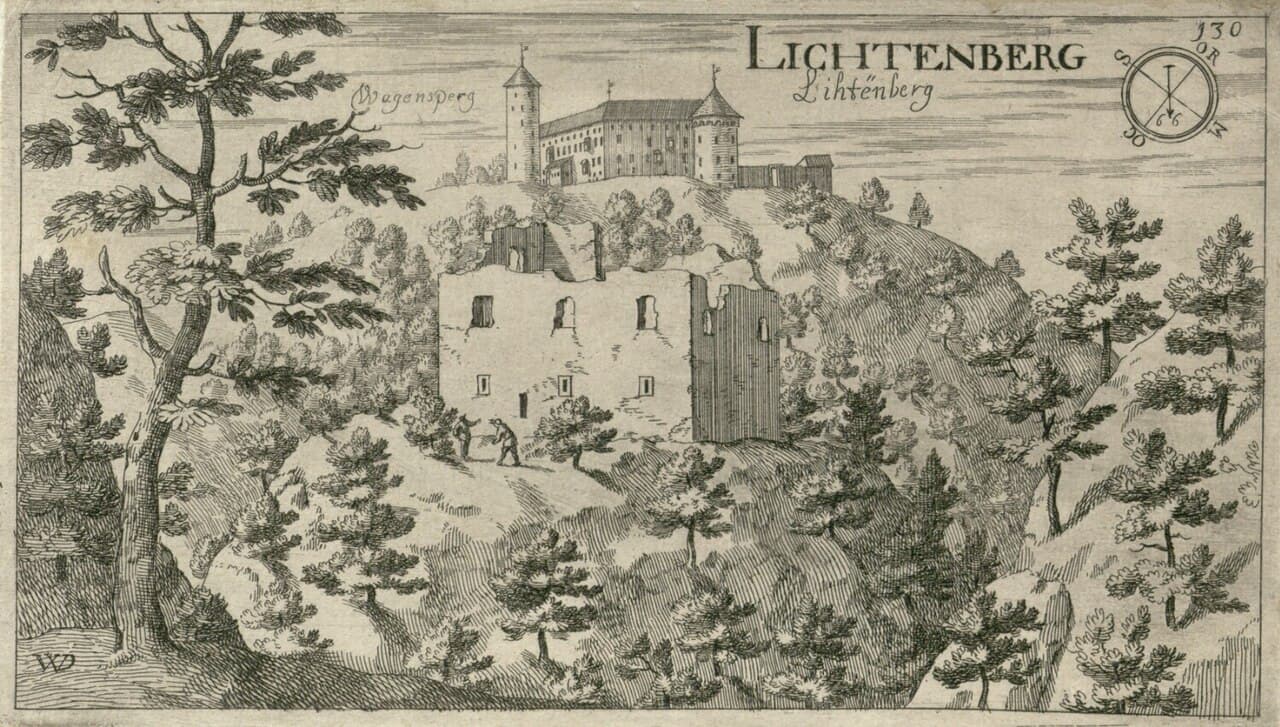
Lihtenberk Castle, a 13th-century ruin located adjacent to Bogenšperk, is historically connected to the latter. It was also owned by Johann Weikhard von Valvasor, who styled himself "von Lichtenberg" in reference to this older fortress. The ruin of Lihtenberk stands as a reminder of the medieval origins of the region's fortifications and the transition to Renaissance architecture exemplified by Bogenšperk.
Cultural significance and tourism
Today, Bogenšperk Castle is recognized as an important cultural monument of Slovenia. Its restoration and preservation allow visitors to explore the architectural evolution from medieval fortifications to Renaissance residences. The castle's association with Valvasor adds a layer of intellectual heritage, attracting historians, scholars, and tourists interested in Slovenian history and culture.
The castle's arcaded courtyard, towers, and historic well remain key attractions. Efforts continue to maintain the castle as a site for cultural events, exhibitions, and educational programs, ensuring its legacy endures for future generations.
Frequently asked questions (FAQ)
- How do I get to Bogenšperk Castle?
- Bogenšperk Castle is located in the Municipality of Šmartno pri Litiji, accessible by local roads from Ljubljana and other nearby towns. Visitors can reach the castle by car or regional bus services, with parking available near the site.
- What is the historical significance of Bogenšperk Castle?
- Bogenšperk Castle is renowned for its association with Johann Weikhard von Valvasor, a 17th-century scientist and historian. The castle served as a cultural and intellectual center during his residence and reflects Renaissance architecture and Slovenian heritage.
- Can I visit the interior of Bogenšperk Castle?
- Yes, the castle is open to visitors, featuring exhibitions on Valvasor's life and work, as well as the castle's history and architecture. Guided tours are available, providing detailed insights into its cultural significance.
- When is the best time to visit Bogenšperk Castle?
- The castle is best visited during spring to early autumn when the weather is favorable for exploring the grounds and participating in outdoor events. Seasonal exhibitions and cultural programs are often scheduled during this period.
- Is Bogenšperk Castle accessible for people with disabilities?
- While efforts have been made to improve accessibility, some areas of the castle, especially the older towers and courtyards, may present challenges for visitors with mobility impairments. It is recommended to check with the visitor center for specific accessibility information.
- Are there any nearby attractions to visit along with Bogenšperk Castle?
- Nearby attractions include the ruins of Lihtenberk Castle, located adjacent to Bogenšperk, as well as natural parks and historic towns in the Central Slovenia region. Visitors often combine trips to these sites for a comprehensive cultural experience.
Photo gallery

Photo by Johann Weikhard von Valvasor•Public domain
Information
Current owner
Municipality of Šmartno pri Litiji
Website
Visit websiteAddress
Bogenšperk, 1275 Šmartno pri Litiji, Slovenia
Sources & official resources
Verify the information above using these authoritative references.
Loading map...
Visitor reviews
No reviews yet. Been here? Write the first review and help other travelers!
Write the first reviewVisited this castle? Share your experience
Your review helps other travelers and adds first-hand knowledge to our encyclopedia.



