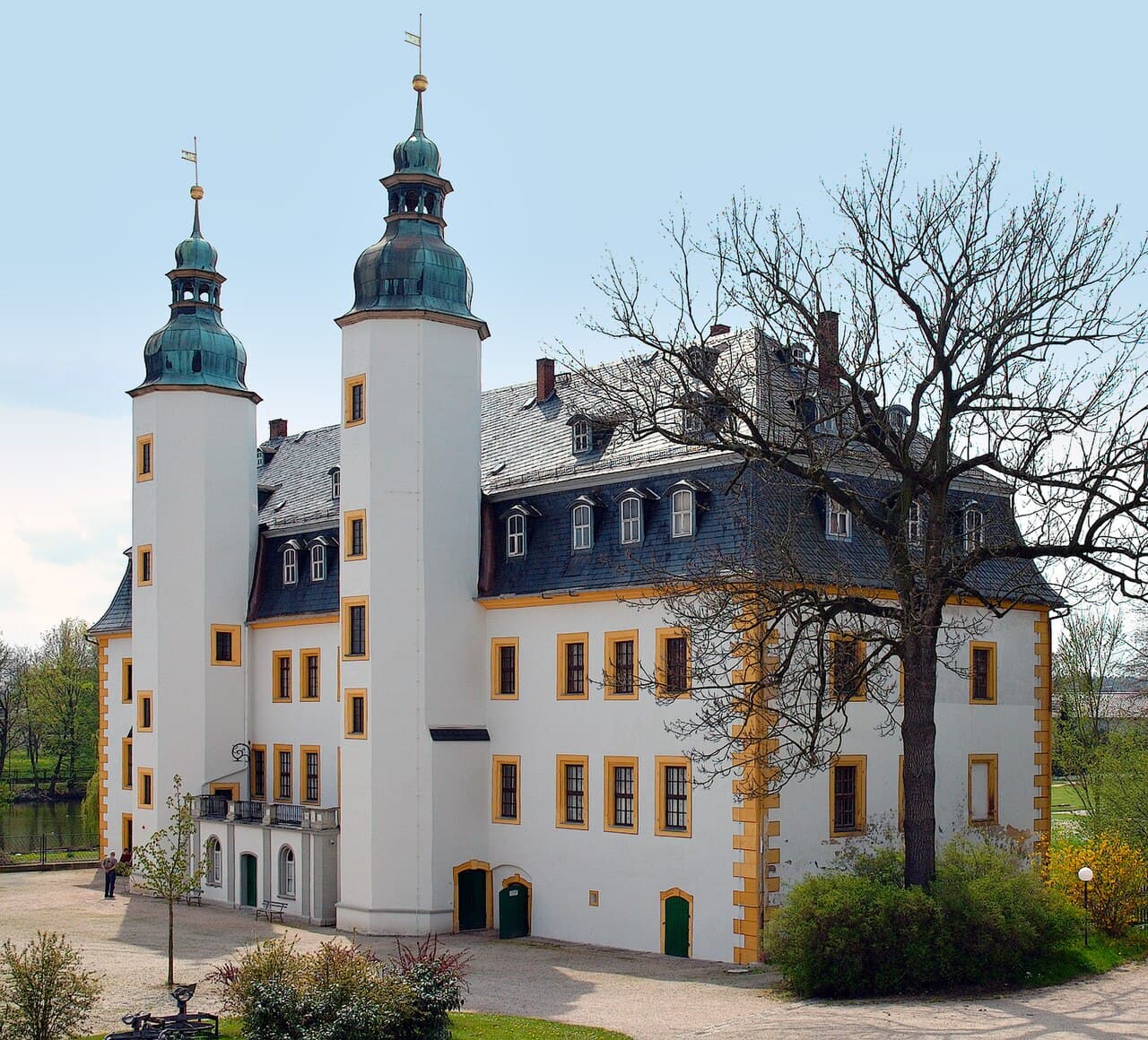
Blankenhain Castle
Blankenhain Castle stands as a significant historical monument near Crimmitschau in the town of Blankenhain, Germany. Dating back to the 12th century, this castle originally served as a fortified water castle, known in German as a Wasserburg, characterized by its strategic location within the floodplain of the Koberbach stream and surrounded by moats or water defenses. Over the centuries, it has evolved architecturally and functionally, becoming a prominent example of baroque castle architecture with a rich heritage tied to the region's rural and agricultural history.
The castle's earliest documentation dates to 1423, affirming its status as a water castle, which played a defensive and administrative role in the medieval landscape. In 1661, a devastating fire destroyed half of the castle, prompting extensive reconstruction completed by 1699 or 1700. This restoration period preserved the castle's medieval layout while adapting it to contemporary needs. The most visually striking transformation occurred in 1765 when the castle acquired its distinctive baroque appearance, featuring a mansard roof and domed turret towers, which remain defining elements of its silhouette today.
Historical development and ownership
Throughout its history, Blankenhain Castle has seen several changes in ownership that influenced its architectural and functional evolution. Notably, Generalleutnant Carl Gottlob von Neitschütz was among its early proprietors, contributing to its status and upkeep. In the late 19th and early 20th centuries, the castle came under the ownership of industrialist Gustav Münch-Ferber, who undertook revitalization efforts to restore the estate's prominence and condition, reflecting the era's interest in preserving noble estates.
The estate included a significant ancillary structure known as the forecastle, built in 1699 to support the castle's agricultural and economic activities. This building underwent multiple modifications during the 18th and 19th centuries and was eventually divided into two farmsteads in 1949, illustrating the shift in land use following World War II.
Post-war preservation and museum transformation
After World War II, Blankenhain Castle faced the threat of destruction under Soviet administration, which ordered its demolition. However, thanks to the determined intervention of local residents, the castle was spared. Since 1981, the site has been transformed into an open-air museum dedicated to agriculture and rural life in central Germany from 1890 to 1990. This museum complex now spans approximately 11 hectares and includes between 60 and 80 buildings, encompassing a castle museum, technology exhibits, and folklore displays.
The museum offers valuable insights into the region's agricultural heritage, featuring traditional buildings such as a post mill, a village school, historic barns with hearses, and a Byzantine-style mausoleum built in 1785 for the Scheuereck family. These elements collectively preserve and showcase the rural culture and history of the area.
Architectural features and archaeological significance
The main castle building is distinguished by its mansard roof and baroque turret caps on twin towers, emblematic of the 18th-century architectural style. The castle is surrounded by a scenic park and pond area that integrates remnants of the original water defenses, enhancing its historical ambiance.
The original foundations of the medieval water castle remain preserved and protected as an archaeological monument since 1970. These remains offer important insights into the castle's medieval defensive design and construction techniques. The overall condition of the castle and its associated buildings is good, supported by ongoing maintenance and conservation efforts within the museum complex.
The forecastle and supporting structures
The forecastle, constructed as an economic building in 1699, played a vital role in the estate's agricultural operations. Its expansions and modifications over the 18th and 19th centuries reflect changing needs and functions. The division of this building into two farmsteads in 1949 marks a transition from noble estate management to more fragmented agricultural use.
Additional historic buildings on site
Besides the main castle and forecastle, the site includes a variety of historic structures that contribute to the museum's comprehensive portrayal of rural life. These include a parish house, barns with historic hearses, a post mill, a village school, and burial sites of former estate owners. The Byzantine-style mausoleum is a notable architectural and cultural landmark within the complex.
Cultural and heritage importance
Blankenhain Castle is not only an architectural landmark but also a cultural repository reflecting centuries of rural life and agricultural practices in central Germany. Its transformation into an open-air museum has preserved its physical structures and enriched public understanding of the region's history. The castle's survival through war, fire, and political upheaval underscores its resilience and the community's commitment to heritage preservation.
Visitors to Blankenhain Castle can explore a wide array of exhibits that illustrate the evolution of agricultural technology, rural education, and local traditions over a century. The museum's extensive grounds and diverse buildings provide an immersive experience of historical rural life, making it a valuable destination for cultural tourism and education.
Frequently asked questions (FAQ)
- What are the opening hours of Blankenhain Castle museum?
- Blankenhain Castle museum is typically open daily from 10:00 to 17:00, but visitors should check the official website for seasonal variations and special events.
- Can I visit the original water castle foundations at Blankenhain Castle?
- Yes, the original foundations of the medieval water castle are preserved and accessible as part of the archaeological monument within the museum grounds.
- What types of exhibits are featured at the Blankenhain Castle open-air museum?
- The museum features exhibits on agriculture, rural life, technology, and folklore from central Germany between 1890 and 1990, including historic buildings and machinery.
- Is Blankenhain Castle wheelchair accessible?
- While efforts have been made to improve accessibility, some parts of the historic castle and open-air museum may have uneven terrain and limited wheelchair access. Visitors are advised to contact the museum for specific accessibility information.
- Why was Blankenhain Castle spared from destruction after World War II?
- The castle was saved due to the courageous intervention of local residents who opposed the Soviet administration's demolition order, preserving this important cultural landmark.
Photo gallery

Information
Sources & official resources
Verify the information above using these authoritative references.
Loading map...
Visitor reviews
No reviews yet. Been here? Write the first review and help other travelers!
Write the first reviewVisited this castle? Share your experience
Your review helps other travelers and adds first-hand knowledge to our encyclopedia.



