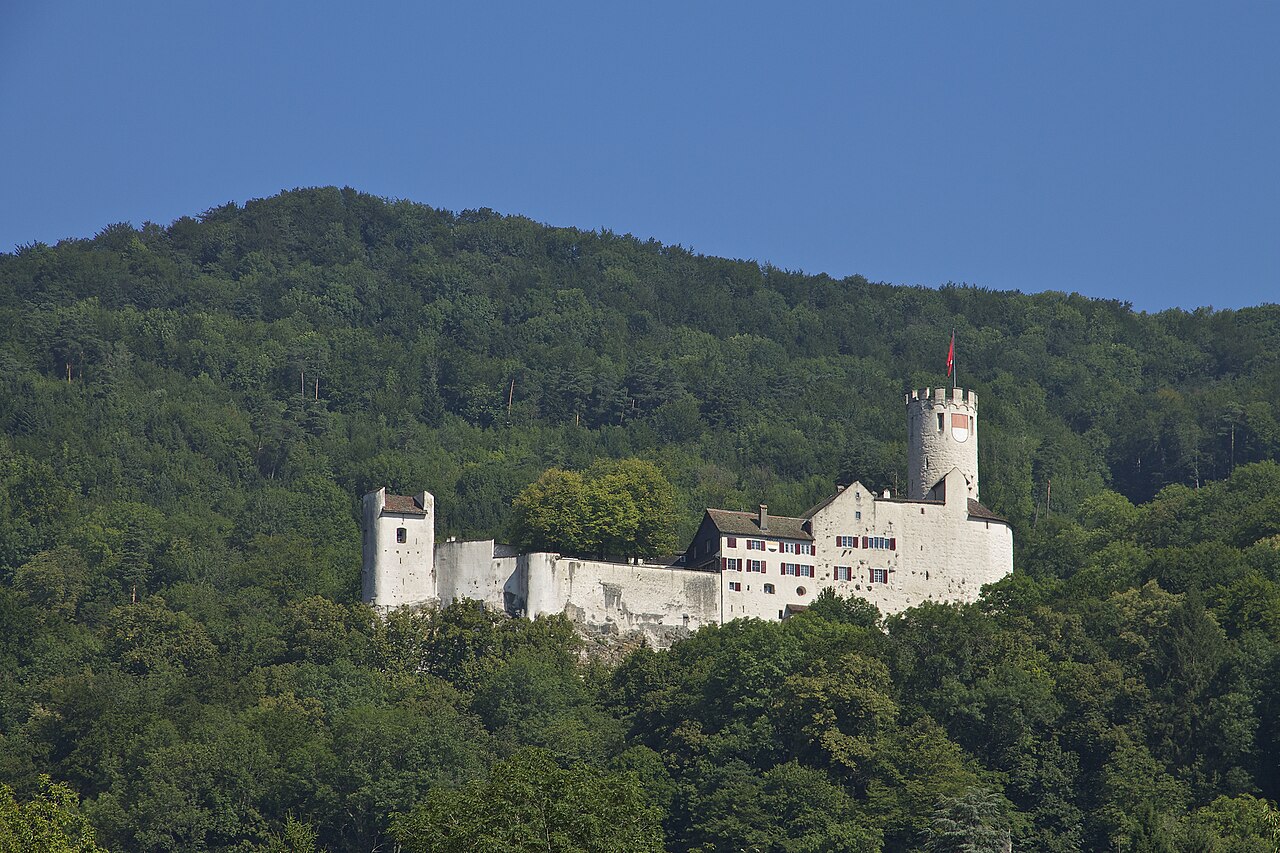
Bipp Castle
Bipp Castle stands as a compelling example of a High Medieval hill castle with a rich history dating back to the 13th century. Located near the village of Oberbipp in Switzerland, this castle was originally constructed around 1268, most likely by the counts of Froburg. Its strategic placement on a hill provided a commanding view of the surrounding region, which was vital for defense and control during the turbulent medieval period.
The castle's architecture reflects the typical design of medieval fortifications, featuring an elongated polygonal layout. The eastern side was dominated by a massive palas, or great hall, which served as the residential and administrative heart of the castle. On the western side stood a slender, round bergfried, a tall defensive tower used primarily as a lookout and last refuge during sieges. These two main structures were connected by a series of buildings, forming a cohesive defensive complex. The northern perimeter was secured by a curtain wall linking the palas and bergfried, further reinforced by a lower outer wall equipped with several round and square towers for enhanced protection.
Outside the main walls, on the southern flank of the castle hill, were essential ancillary structures including a granary and stables. These supported the castle's self-sufficiency and readiness for prolonged defense. The castle's design highlights the medieval emphasis on both defense and the functionality necessary to sustain its inhabitants.
The historical context and ownership transitions
The origins of Bipp Castle are closely tied to the feudal dynamics of the region. During the 12th century, the Bishop of Basel granted the Buchsgau region, which included Oberbipp, to the Count of Froburg as a fief. This established the counts of Froburg as the initial lords of the area and likely the builders of Bipp Castle. By 1268, the castle is first mentioned in historical documents, confirming its existence and importance.
Throughout the 13th century, the counts of Froburg gradually lost much of their territory in Buchsgau, retaining only a few villages including Bipp, Wiedlisbach, and Erlinsburg. The castle itself changed hands, though the exact circumstances—whether through sale or conquest—are unclear. By 1297, Count Rudolf of Neuchâtel-Nidau granted the castle to a Ministerialis knight, indicating a shift in control.
In 1313, Rudolf's son, also named Rudolf, granted the castle along with toll rights on the nearby bridge to Aarwangen, underscoring the castle's role in regional economic control. In 1362, the castle came under the lordship of Count Rudolf of Nidau, who also inherited the Froburg titles. Upon his death without heirs, the estates were divided, and eventually, the castle passed to the Kyburg family.
The Burgdorferkrieg (1383-84), a conflict triggered by a Kyburg raid on the town of Solothurn, led to significant territorial upheavals. Following this, the Kyburgs sold the lands, including Bipp Castle, to the Habsburgs in 1385. The following year, the castle briefly came under Basel's control before returning to the Kyburgs in 1406. That same year, the Kyburgs sold the castle to the cantons of Solothurn and Bern.
Bipp Castle as a Bernese administrative center
From 1406 until 1463, Bern and Solothurn jointly administered the surrounding villages from Bipp Castle. After 1463, the castle became fully integrated into Bern's domain, serving as the seat of the Bernese landvogt or reeve. Over the next three centuries, a total of 62 Bernese administrators governed the region from this castle, emphasizing its role as a local seat of power and governance.
The castle's administrative significance continued until the upheavals of the late 18th century. On 2 March 1798, during the French invasion of Switzerland, the French army captured Solothurn, prompting the last Bernese landvogt to flee Bipp Castle. Subsequently, local residents plundered the castle, stripping it of valuable materials including windows and doors, rendering it uninhabitable as noted in a French report dated 16 March 1798.
Decline, ruin, and later developments
Following its abandonment, the ruins of Bipp Castle were sold in 1805. Portions of the remaining structure were demolished to provide stone for other local buildings, accelerating its decline. In 1855, the ruins were purchased by the Stehlin family of Basel, who constructed a small mansion on the site of the former granary, blending new residential use with the historic castle grounds.
Today, Bipp Castle remains a partially ruined site that offers valuable insights into medieval castle architecture and feudal history in the region. Its surviving structures, including the palas, bergfried, curtain walls, and outer defenses, exemplify the military and residential design principles of the High Medieval period. The castle's layered history reflects the complex political and territorial shifts in medieval Switzerland, from local counts to powerful noble families and eventually to cantonal administration.
Architectural features and layout
The palas and bergfried
The palas served as the main residential building, typically housing the lord's chambers, great hall, and administrative offices. Its massive construction on the eastern side of the castle provided both comfort and defense. Opposite the palas, the bergfried was a tall, slender round tower that functioned primarily as a defensive stronghold and lookout point. The bergfried's height and shape made it difficult to assault and easy to defend during sieges.
Defensive walls and towers
The castle's northern side was fortified with a curtain wall connecting the palas and bergfried. This wall was further protected by a lower outer wall equipped with multiple round and square towers, designed to provide overlapping fields of fire and strengthen the castle's defenses. These features are characteristic of medieval military architecture aimed at resisting both direct assault and siege engines.
Outbuildings and supporting structures
Outside the main defensive walls, the castle included a granary and stables on the southern flank of the hill. These outbuildings were essential for the castle's functionality, supporting the storage of food supplies and housing horses necessary for transportation and military readiness.
Visiting Bipp Castle today
Although the castle is in a state of partial ruin, it remains a site of historical and architectural interest. Visitors can explore the surviving structures and appreciate the castle's strategic hilltop location. The combination of medieval ruins and the later mansion built by the Stehlin family offers a unique glimpse into the site's evolving use over centuries.
Bipp Castle's story embodies the complex feudal history of the region, illustrating the transitions from medieval noble control to cantonal governance and the impact of broader European conflicts on local strongholds. Its ruins serve as a tangible connection to Switzerland's medieval past and the architectural ingenuity of castle builders during the High Medieval period.
Frequently asked questions (FAQ)
- How do I get to Bipp Castle?
- Bipp Castle is located in Oberbipp, Switzerland, and can be easily reached by car or public transportation. If you are traveling by train, the nearest station is in Langenthal, from which you can take a short bus ride or taxi to the castle.
- What is the historical significance of Bipp Castle?
- Bipp Castle was built in the 13th century and has played a crucial role in the region's history. It served as a strategic fortification and residence for the local nobility, showcasing the architectural styles and historical events of its time.
- When was Bipp Castle last renovated?
- Bipp Castle underwent significant renovations in the early 21st century to preserve its structure and enhance visitor experience. The restoration has helped maintain its historical integrity while allowing for modern amenities.
- Can I take guided tours of Bipp Castle?
- Yes, guided tours are available for visitors who wish to learn more about the castle's history and architecture. These tours typically include access to the main halls and exhibitions, providing insights into life during the medieval period.
- Why is Bipp Castle an important architectural site?
- Bipp Castle is an important architectural site due to its well-preserved medieval structure and unique design elements. Its towers, walls, and interiors reflect the defensive strategies and aesthetic preferences of the era, making it a valuable example of Swiss medieval architecture.
- Is it possible to host events at Bipp Castle?
- Yes, Bipp Castle offers venues for various events, including weddings and corporate gatherings. The scenic backdrop and historical ambiance make it a popular choice for memorable occasions.
- What are the opening hours for Bipp Castle?
- Bipp Castle is typically open to visitors from March to November, with varying hours depending on the season. It is advisable to check the official website for the most current opening hours before planning your visit.
- What are the ticket prices for visiting Bipp Castle?
- Ticket prices for Bipp Castle are generally reasonable, with discounts available for students and seniors. Children under a certain age may enter for free, making it an affordable destination for families.
- When is the best time to visit Bipp Castle?
- The best time to visit Bipp Castle is during the spring and early autumn when the weather is mild and pleasant. These seasons also offer beautiful scenery as the surrounding landscape comes to life with flowers and fall colors.
- Are there any nearby attractions to visit along with Bipp Castle?
- Yes, there are several nearby attractions, including the charming village of Oberbipp and beautiful hiking trails in the surrounding region. Visitors may also explore local museums and other historical sites that enrich the cultural experience of the area.
Information
Website
Visit websiteSources & official resources
Verify the information above using these authoritative references.
Loading map...
Visitor reviews
No reviews yet. Been here? Write the first review and help other travelers!
Write the first reviewVisited this castle? Share your experience
Your review helps other travelers and adds first-hand knowledge to our encyclopedia.