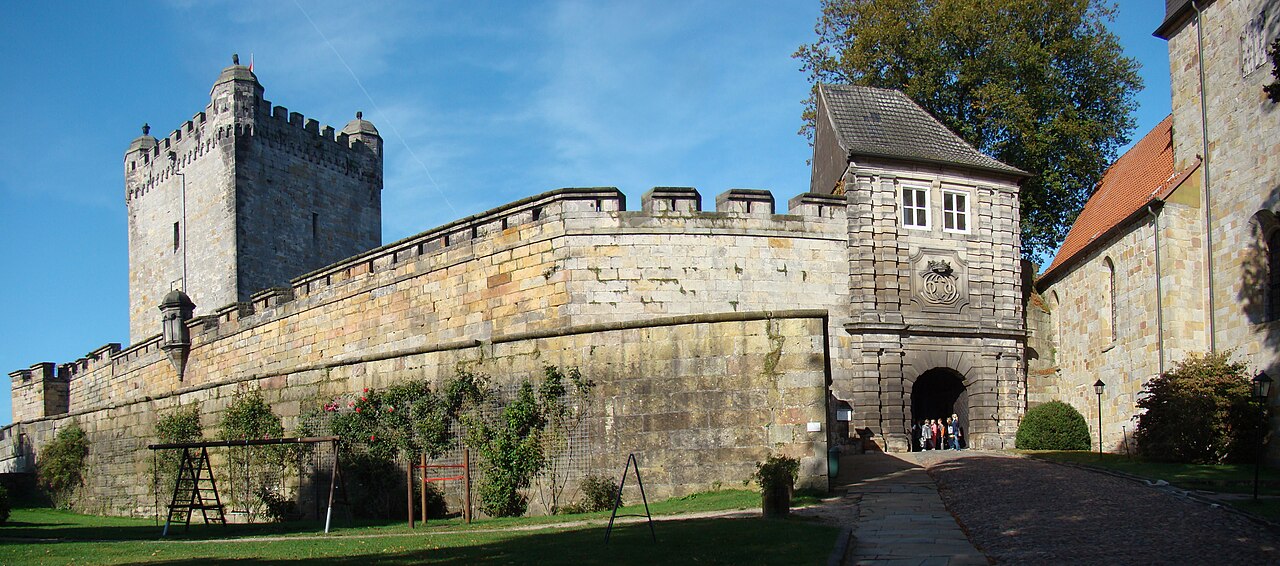
Bentheim Castle
Bentheim Castle stands prominently on a 91.9-meter-high sandstone ridge known as the Bentheimer Höhenrücken, the last ridge of the Teutoburg Forest in Bad Bentheim, Lower Saxony, Germany. This early medieval hill castle has a rich and complex history dating back to the 11th century, when it was first mentioned under the name "Binithem". The castle's strategic location atop a sandstone outcrop provided natural defense and commanding views of the surrounding landscape, making it a valuable stronghold throughout the centuries.
The origins of Bentheim Castle trace back even earlier to a Germanic refuge castle, predating the medieval fortress. The earliest written record appears around 1050 in the registries of Werden Abbey, where the site contributed grain, honey, and money. By 1020, Otto von Northeim, a notable Saxon noble, is recorded as the castle's owner, indicating its importance in the region during the High Medieval period.
Historical development and ownership
Early medieval origins and reconstruction
In 1116, Bentheim Castle was destroyed during a conflict between Duke Lothar von Süpplinburg (later Emperor Lothar III) and Henry V. At this time, the castle was likely a wooden fortification, which was common for early medieval castles. Soon after its destruction, Otto von Salm-Rheineck rebuilt the castle in stone, marking a significant transition to a more durable and imposing fortress. His wife, Gertrud von Northeim, used the castle as her widow's residence and is the first documented member of the Counts of Bentheim.
Feudal transitions and political significance
Following Otto von Rheineck's defeat in 1146, Bentheim Castle became a fief under the Bishopric of Utrecht. The bishop claimed ownership of the palace and chapel until 1190. In the mid-12th century, the castle passed through marriage to the Counts of Holland, who ruled it until 1421. That year, Eberwin IV von Götterswick acquired the castle, founding the Bentheim-Steinfurt line. From then on, the rulers styled themselves as Counts of Bentheim.
In 1486, Count Eberwin II received formal recognition from Emperor Frederick III, confirming the county as an independent imperial fief. This imperial immediacy elevated the castle's political and strategic importance within the Holy Roman Empire.
Religious and military upheavals
Between 1588 and 1593, Count Arnold II introduced the Reformation to Bentheim, following the teachings of Calvin and Zwingli. The castle and county endured numerous hardships during the Thirty Years’ War, including plundering by Spanish troops and devastating plague outbreaks in 1636 and 1664.
During the Seven Years’ War (1756–1763), Bentheim Castle was besieged and occupied multiple times by French and British forces. In 1795, amid the war against revolutionary France, the castle served as a field hospital. It was set on fire and captured by General Dominique Vandamme’s troops. An attempted demolition failed when a strong wind closed the powder tower door, preventing the explosion.
After the Napoleonic era, the castle returned to the Bentheim family in 1804. It remained largely ruined and uninhabitable until restoration began in 1848 under Prince Alexis II. Over time, the castle served various roles, including fortress, administrative center, court, and prison. Today, it remains owned by the princely family of Bentheim-Steinfurt and is open to the public as a family museum.
Architectural features and structural highlights
The pulverturm (powder tower)
The Pulverturm, or Powder Tower, is a striking 30-meter-high square tower with walls 5.5 meters thick at the base. Dating from the 11th or 12th century and remodeled in the early 16th century, it features a 12-meter-deep chamber carved into the rock beneath, which was used as a dungeon or powder storage. The tower bears inscriptions and coats of arms, including those of Count Everwin II and Mecklenburg. Embedded cannonballs from the 1795 French siege remain visible, serving as tangible reminders of the castle's turbulent military history. Notably, the holes in the stone blocks are from construction, not battle damage.
The batterieturm (round tower)
The Batterieturm, also called the Round Tower, stands 45 meters tall and was built in the early 15th century directly on the rock. It served as an artillery tower housing heavy firearms, equipped with smoke vents to clear gunpowder fumes. Connected to the main residential palace by a gallery, it also contained a torture cellar and dungeon, reflecting the castle's defensive and judicial functions.
The kronenburg palace
The Kronenburg is a multi-story Gothic residential palace originating in the 12th century. Between 1883 and 1914, architect Franz Anton Nordhoff remodeled it in English Neo-Gothic style under Prince Alexis II. The palace includes representative rooms such as a knights’ hall, library, and a princess’s bedroom furnished in Rococo style. The knights’ hall displays historical artifacts including horse armor, hunting weapons, and banners from the Thirty Years’ War. A large carpet there was a wedding gift from Queen Emma of the Netherlands.
The katharinenkirche (st. catherine’s church)
The Katharinenkirche, or St. Catherine’s Church, is a Gothic chapel with a Romanesque tower called the Bingelturm. First mentioned in the early 15th century, it was adapted for Protestant worship in 1544, later used by Catholics, and ceased religious functions in 1767. Now a museum, it contains a wooden gallery, stone pulpit, a 16th-century wooden Madonna statue by Evert van Roden, and numerous sandstone tombstones and coats of arms of the Bentheim family.
Inside the church is the "Herrgott von Bentheim," a large early Romanesque sandstone crucifix from the 11th century. Measuring 2.8 meters high and 1.4 meters wide, it depicts Christ as a triumphant judge. Originally displayed outdoors near the Pulverturm, it was moved indoors in 2016 to protect it from weathering.
Castle grounds and unique features
The castle's lower gate, dating from the 13th century, features intricate sandstone carvings combining pagan and Christian symbols. The upper gate was redesigned in the 17th century by Dutch architect Philipp Vingboom, showcasing rusticated stonework that exemplifies the period's architectural style.
Within the grounds is a 23-meter-deep well, reportedly dug by two knights during a siege, highlighting the castle's self-sufficiency in times of conflict. Nearby stands the Drususfelsen, a sandstone monolith bearing a Latin inscription from around 1715. This stone is linked to local legend and may mark a pre-Christian sanctuary site, adding a layer of cultural heritage to the castle's historical landscape.
The courtyard hosts 49 historic rose varieties planted in 2004, mainly sourced from the Rosarium in Sangerhausen. These roses reflect garden styles from the 17th to 19th centuries, enhancing the castle's aesthetic and historical ambiance.
Current status and public access
Bentheim Castle is well preserved with many original and restored elements visible today. The embedded cannonballs and inscriptions serve as tangible reminders of its turbulent past. While parts of the castle remain private residences of the princely family of Bentheim-Steinfurt, much of the complex is open to the public as a family museum, offering visitors a unique glimpse into medieval and early modern castle life.
The castle's museum exhibits include historical artifacts, architectural tours, and cultural events that celebrate the heritage of this high medieval hill castle. Its blend of Gothic architecture with Neo-Gothic renovations and the presence of original medieval structures make Bentheim Castle a significant cultural landmark in Germany.
Frequently asked questions (FAQ)
- How do I visit Bentheim Castle and what are the opening hours?
- Bentheim Castle is open to the public as a family museum. Visiting hours vary seasonally, so it is advisable to check the official website or contact the castle for current opening times and guided tour availability.
- What historical periods are represented in Bentheim Castle's architecture?
- Bentheim Castle features primarily high medieval architecture with significant Gothic elements, alongside later Neo-Gothic renovations from the 19th century. Visitors can see structures dating from the 11th century through to the early 20th century.
- Can I see original medieval artifacts at Bentheim Castle?
- Yes, the castle's knights' hall and museum display original medieval artifacts including horse armor, hunting weapons, banners from the Thirty Years’ War, and the early Romanesque sandstone crucifix known as the "Herrgott von Bentheim."
- Is Bentheim Castle accessible for visitors with mobility issues?
- Due to its hilltop location and historic structures, some areas of Bentheim Castle may be challenging for visitors with mobility issues. It is recommended to inquire in advance about accessibility options and available assistance.
- What is the significance of the Pulverturm at Bentheim Castle?
- The Pulverturm is a 30-meter-high powder tower dating from the 11th or 12th century, notable for its thick walls, deep rock chamber, and embedded cannonballs from the 1795 siege. It illustrates the castle's defensive capabilities and long military history.
Information
Sources & official resources
Verify the information above using these authoritative references.
Loading map...
Visitor reviews
No reviews yet. Been here? Write the first review and help other travelers!
Write the first reviewVisited this castle? Share your experience
Your review helps other travelers and adds first-hand knowledge to our encyclopedia.