Bellver Castle
Bellver Castle stands as a remarkable example of Gothic military architecture and royal residence design, perched on a hill approximately 3 kilometers west of Palma de Mallorca's city center. Constructed in the early 14th century between 1300 and 1311 by order of King James II of Majorca, this castle is one of the few circular castles in Europe, making it an architectural rarity and a symbol of Mallorca's medieval heritage.
The distinctive circular design and construction
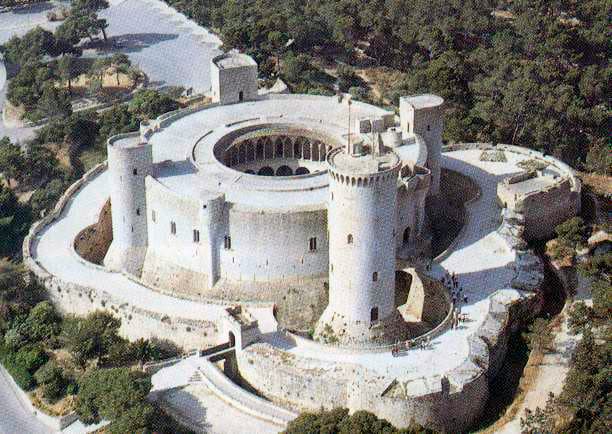
The castle's most striking feature is its perfectly circular plan, which encloses a central circular courtyard. This innovative design was likely inspired by the ancient Herodion fortress in Palestine, a rare example of circular fortification that included a principal tower and three smaller towers connected by a high bridge over a moat. Bellver Castle adapts this concept with four large round towers positioned at the cardinal points. The major or keep tower stands apart to the north, connected by a bridge, serving as the last defensive stronghold and a prison known as "the Pot" (l'Olla).
The castle was built primarily from marès sandstone, a local material quarried from caves beneath the hill and nearby quarries such as Portals Vells and Santanyí. This sandstone is soft and easy to work, allowing the intricate Gothic details and the circular form to be executed with precision. Harder stone was also incorporated for structural strength. The castle sits atop a hill 112 meters above sea level, providing commanding views of Palma, the bay, and surrounding landscapes.
Architectural features and defensive elements
The circular curtain wall is two stories high and surrounds the central courtyard, which features a large cistern beneath to collect rainwater. The walls include arrow slits and were originally topped with battlements and a barbican, which were later removed with the advent of artillery. The main gate is fortified with a machicolation, a projecting parapet with openings for dropping defensive materials on attackers. The keep tower also retains machicolation corbels, emphasizing its defensive role.
Additional defenses include a moat carved into the sandstone, a ravelin topped by a barbican, a countervall, and a covered way built during the War of Spanish Succession in 1713, although the latter is now in poor condition. Gunports were added to adapt the castle for cannon defense, reflecting the evolution of military technology over the centuries.
Interior layout and royal residence aspects
Inside, the ground floor of the circular structure housed service rooms essential for the castle's operation, while the noble floor contained the royal family's chambers, official reception rooms, and the chapel of Saint Mark, which features a Mudéjar-style grille. The courtyard is surrounded by a gallery with pointed Gothic arches supported by octagonal columns, decorated with blind triangular motifs and trefoil openings, similar to those found in the Almudaina Palace and the Palace of the Kings of Mallorca in Perpignan.
Despite its strong defensive purpose, Bellver Castle was designed to serve as a comfortable royal residence. The interiors reflect an elegant and refined taste, suitable for the leisure and governance activities of the Mallorcan kings.
Historical significance and usage through the centuries
Originally built as a royal residence for the Kings of Majorca, Bellver Castle hosted monarchs such as James II, Sanç, James III, and briefly King John I of Aragon. After 1408, the castle's lordship was granted to the Carthusian monastery of Valldemossa, which appointed its governors.
The castle played a key role in regional conflicts, enduring sieges in 1343 during Peter IV of Aragon's campaign to reincorporate Mallorca into the Crown of Aragon, in 1391 during an anti-Semitic peasant revolt, and in 1521 during the Revolt of the Brotherhoods. The 1521 siege was the only time the castle fell to enemy forces.
From the late 14th century onward, Bellver increasingly functioned as a prison. It held royal captives after the Battle of Llucmajor in 1349, rebels after the Revolt of the Brotherhoods, bandits in the 17th century, and political prisoners during the War of Spanish Succession and the French War of Independence. Notable prisoners included the enlightened intellectual Gaspar Melchor de Jovellanos, astronomer and politician François Arago, and liberal general Luis de Lacy. Jovellanos notably produced detailed descriptions and plans of the castle during his imprisonment from 1802 to 1808.
During the 20th century, the castle was owned by the city of Palma following the transfer of ownership in 1931. It was converted into a museum in 1932 and served as a prison during the Spanish Civil War, holding up to 800 Republican detainees who constructed the current access road. Since 1976, Bellver Castle has housed the Museum of the History of Palma, preserving the island's rich cultural and historical legacy.
Bellver castle today and cultural importance
Today, Bellver Castle is one of Mallorca's most iconic landmarks and a major tourist attraction. Its unique circular design, well-preserved Gothic architecture, and panoramic views of Palma and the Mediterranean make it a must-visit site. The castle's grounds include a forested area with stables for the city's mounted police and a 19th-century chapel dedicated to Saint Alphonsus Rodriguez.
The castle's main courtyard continues to host public ceremonies, cultural events, and concerts, maintaining its historical role as a center of social and political life. The surrounding landscape and the castle's elevated position offer visitors a vivid connection to Mallorca's medieval past and its evolving history through the centuries.
Bellver Castle's combination of military innovation, royal residence elegance, and its layered history as a fortress, prison, and museum make it a unique monument within Spain and Europe. Its preservation allows for an exceptional understanding of medieval fortification design and the socio-political dynamics of the Balearic Islands.
Frequently asked questions (FAQ)
- How do I get to Bellver Castle?
- You can reach Bellver Castle by taking public transportation or by car. If you're using public transport, take bus line 3 from Palma city center, which will drop you near the castle. The walk from the bus stop to the castle offers beautiful views of the surrounding area.
- What is the historical significance of Bellver Castle?
- Bellver Castle, built in the 14th century, is one of the few circular castles in Europe and served as a royal residence in Mallorca. Its unique design and strategic location made it an important defensive structure during the medieval period. Today, it stands as a symbol of Mallorca's rich history and is a popular tourist attraction.
- When was Bellver Castle constructed?
- Construction of Bellver Castle began in 1300 under the reign of King James II of Mallorca and was completed in 1311. The castle was designed to serve as a royal residence and fortress, showcasing the architectural style of the time. Its historical importance has been preserved through the centuries, making it a significant landmark in Mallorca.
- Can I enter Bellver Castle?
- Yes, visitors can enter Bellver Castle and explore its fascinating interior, including the museum that showcases the history of Palma and the castle itself. There is an admission fee, and guided tours are available for those who wish to learn more about its history and architecture. Be sure to check the opening hours before your visit.
- Why is Bellver Castle considered a unique architectural feat?
- Bellver Castle is unique due to its circular design, which is rare among medieval castles. This architectural choice not only provided a strategic advantage but also allowed for a panoramic view of the surrounding landscape. Its Gothic style and well-preserved structure make it a remarkable example of medieval architecture.
- Is it possible to visit Bellver Castle year-round?
- Yes, Bellver Castle is open to visitors throughout the year, although hours may vary by season. It's advisable to check the official website for the most current opening hours and any special events that may affect access. Visiting during the off-peak season can help you avoid large crowds.
- What are the ticket prices for Bellver Castle?
- Tickets for Bellver Castle are generally affordable, with discounts available for students and seniors. Children under a certain age often enter for free, making it a family-friendly destination. Prices may vary, so it's best to check the official site for the latest information before your visit.
- When is the best time to visit Bellver Castle?
- The best time to visit Bellver Castle is during the spring and fall when the weather is mild, and the tourist crowds are smaller. Early mornings or late afternoons are also ideal for a more relaxed experience and stunning views. Summer can be quite hot, so plan accordingly if visiting during that time.
- What nearby attractions can I visit after Bellver Castle?
- After visiting Bellver Castle, you can explore the beautiful Parc de la Mar, located nearby, which offers scenic views of the castle and the sea. Additionally, the historic center of Palma, with its stunning cathedral and vibrant markets, is just a short drive away. These attractions complement your visit and provide a deeper insight into Mallorca's culture.
Photo gallery

Photo by Poniol60•Public domain
Information
Website
Visit websiteSources & official resources
Verify the information above using these authoritative references.
Loading map...
Visitor reviews
No reviews yet. Been here? Write the first review and help other travelers!
Write the first reviewVisited this castle? Share your experience
Your review helps other travelers and adds first-hand knowledge to our encyclopedia.