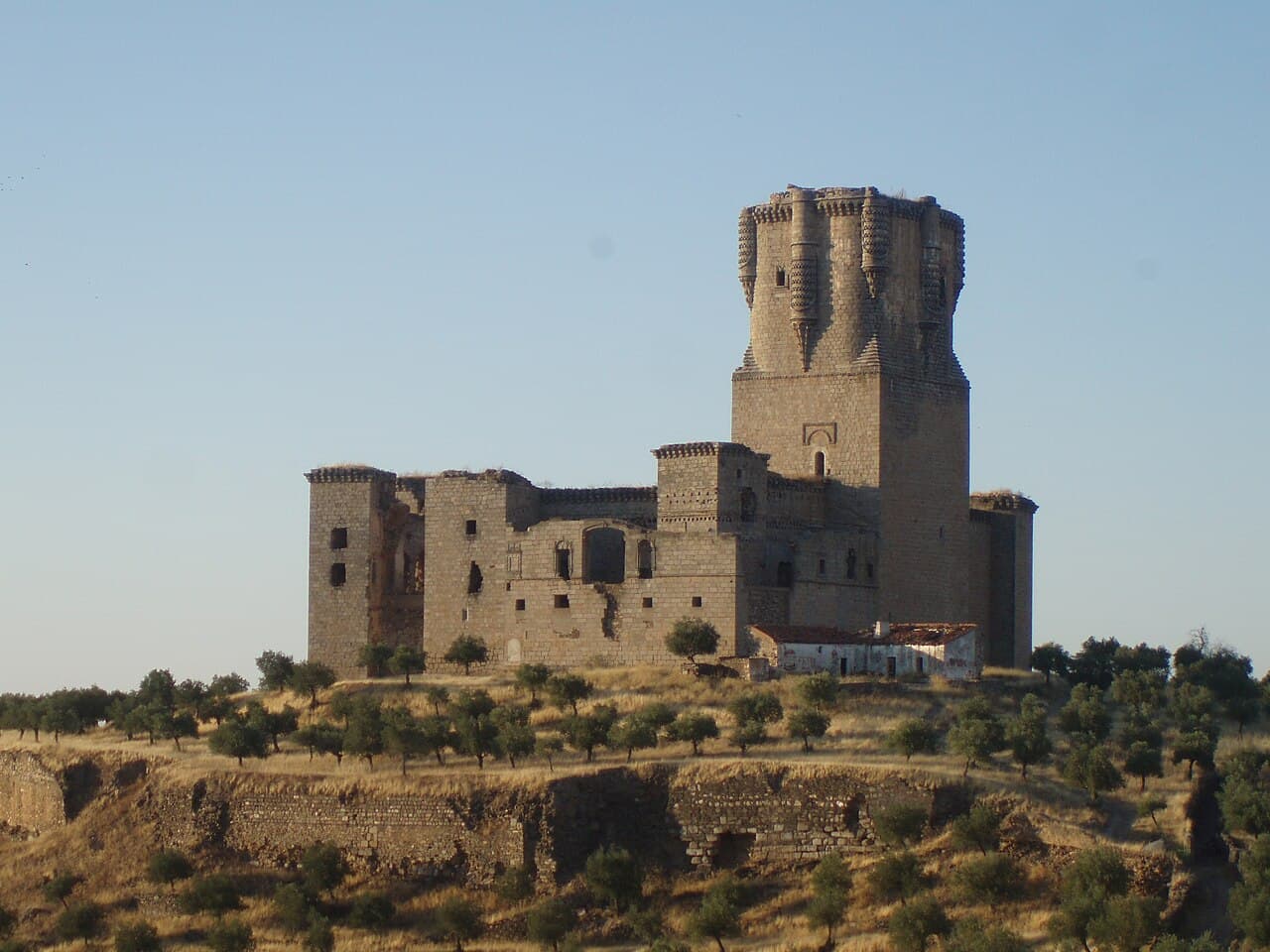
Belalcázar Castle
Belalcázar Castle, also known as Sotomayor Castle or Gahete Castle, stands as one of the most iconic and representative examples of late medieval military architecture in Spain. Constructed primarily in the 15th century, this stone fortress embodies the ambitions of the nobility during a period when castles served both defensive and prestigious residential functions. Located on a commanding high hill north of the town of Belalcázar, the castle dominates the surrounding landscape, offering strategic views across the region.
The castle complex consists of two main enclosures: an outer defensive wall that adapts to the irregular terrain with rectangular towers and an inner rectangular castle-palace featuring eight towers. These towers include one at each corner and one at the center of each side, with the eastern principal tower rising significantly above the rest. This keep, located on the southeast side facing the city, reaches an impressive height of 47 meters, making it the tallest keep in Spain. The keep is notable for its elaborate decorative elements, including intricately designed windows, escaraguaitas (small turrets), and machicolations (projecting parapets with openings for defensive purposes), which combine functionality with a unique architectural flair.
Architectural design and fortifications
The castle's trapezoidal plan conforms to the natural plateau on which it is built, optimizing defensive capabilities. The perimeter walls enclose a central courtyard that historically housed residential quarters and a cistern for water storage. The eight towers are divided into four solid corner towers and four hollow towers positioned at the midpoints of the walls. This layout reflects a sophisticated understanding of military architecture, blending both defensive strength and residential comfort.
The outer enclosure surrounding the main castle is situated at a lower altitude and follows the topography with an irregular layout. It features a total of 21 towers in varying states of preservation. Among these are the historically significant coracha tower and albarrana tower, which were integral to the castle's defensive system. The walls connecting these towers show visible evidence of architectural evolution, illustrating the castle's adaptation over centuries to changing military needs.
Renaissance additions and residential improvements
While the core structure dates to the late medieval period, the 15th century also saw the incorporation of Renaissance architectural elements to enhance the castle's residential facilities. These improvements addressed the inadequacies of the original principal tower's accommodations, reflecting a shift towards more comfortable and prestigious living spaces within the fortress. In the 16th century, a more sumptuous residential building was added to the eastern side of the original perimeter, further elevating the castle's status as both a defensive stronghold and noble residence.
Historical significance and ownership
The castle was commissioned by Gutierre de Sotomayor, the grand master of the Order of Alcántara, who funded its construction with revenues from his extensive possessions. The fortress later passed into the hands of the noble houses of Benavente and Osuna, prominent families in Spanish history. Its strategic importance endured through the centuries, notably during the Peninsular War (War of Independence) in 1811, when French troops used the castle as a defensive position against a siege led by the Duke of Wellington's British forces.
Earlier historical references trace the site back to Roman times, with the first documented fortress appearing in the 9th century. This long history underscores the site's enduring military and administrative significance in the region.
Current condition and preservation efforts
Today, the exterior of Belalcázar Castle remains almost entirely intact, preserving the imposing walls and towers that define its silhouette. However, the interior structures have not survived, leaving the castle primarily as an architectural shell. The castle was acquired by the Andalusian Government in 2008 and was declared an Asset of Cultural Interest in 2009, reflecting its cultural and historical value.
Preservation efforts focus on maintaining the structural integrity of the walls and towers, as well as enhancing public access. Visitors can traverse an old cobbled road that crosses the property to reach the castle, experiencing firsthand the medieval fortifications and panoramic views.
Connection to local heritage and surroundings
The castle is linked to the nearby Hydraulic Complex of the Fuente del Pilar, the Fuente del Chorrillo, and the Noria, forming a network of historical sites that enrich the cultural landscape of Belalcázar. This connection emphasizes the castle's role not only as a military fortress but also as a center of local life and resource management throughout history.
Visiting Belalcázar Castle
Belalcázar Castle offers visitors a remarkable glimpse into late medieval fortification architecture and the lifestyle of Spanish nobility during the 15th and 16th centuries. The towering keep and the extensive defensive walls provide an impressive backdrop for history enthusiasts and tourists alike. While the interior is largely in ruins, the castle's exterior and the surrounding landscape offer ample opportunities for exploration and photography.
Visitors are encouraged to explore the outer walls and towers, appreciating the castle's adaptation to the terrain and its strategic design. The site is accessible via the old cobbled road, which adds to the authentic medieval experience. The castle's designation as a protected cultural asset ensures ongoing conservation and public engagement with this significant historical monument.
Frequently asked questions (FAQ)
- What is the historical significance of Belalcázar Castle?
- Belalcázar Castle is a prime example of late medieval military architecture in Spain, built in the 15th century by Gutierre de Sotomayor. It played a strategic role during the Peninsular War and reflects the evolution of noble residences and fortifications in the region.
- How can I visit Belalcázar Castle?
- The castle is accessible via an old cobbled road crossing the property. Visitors can explore the exterior walls, towers, and enjoy panoramic views of Belalcázar and its surroundings. It is managed by the Andalusian Government and open for public visits.
- What architectural features make Belalcázar Castle unique?
- Belalcázar Castle features a trapezoidal plan with eight towers, including the tallest keep in Spain at 47 meters. Its blend of late medieval fortifications with Renaissance residential additions creates a distinctive mixed architectural style.
- Is the interior of Belalcázar Castle preserved?
- While the castle's exterior walls and towers are largely intact, the interior structures have not survived. Visitors primarily experience the castle's fortifications and the surrounding landscape.
- When was Belalcázar Castle built and by whom?
- The castle was constructed in the 15th century by Gutierre de Sotomayor, grand master of the Order of Alcántara, using resources from his possessions. It later passed to the houses of Benavente and Osuna.
Photo gallery

Information
Current owner
Andalusian Government
Loading map...
Visitor reviews
No reviews yet. Been here? Write the first review and help other travelers!
Write the first reviewVisited this castle? Share your experience
Your review helps other travelers and adds first-hand knowledge to our encyclopedia.


