Baradello Castle
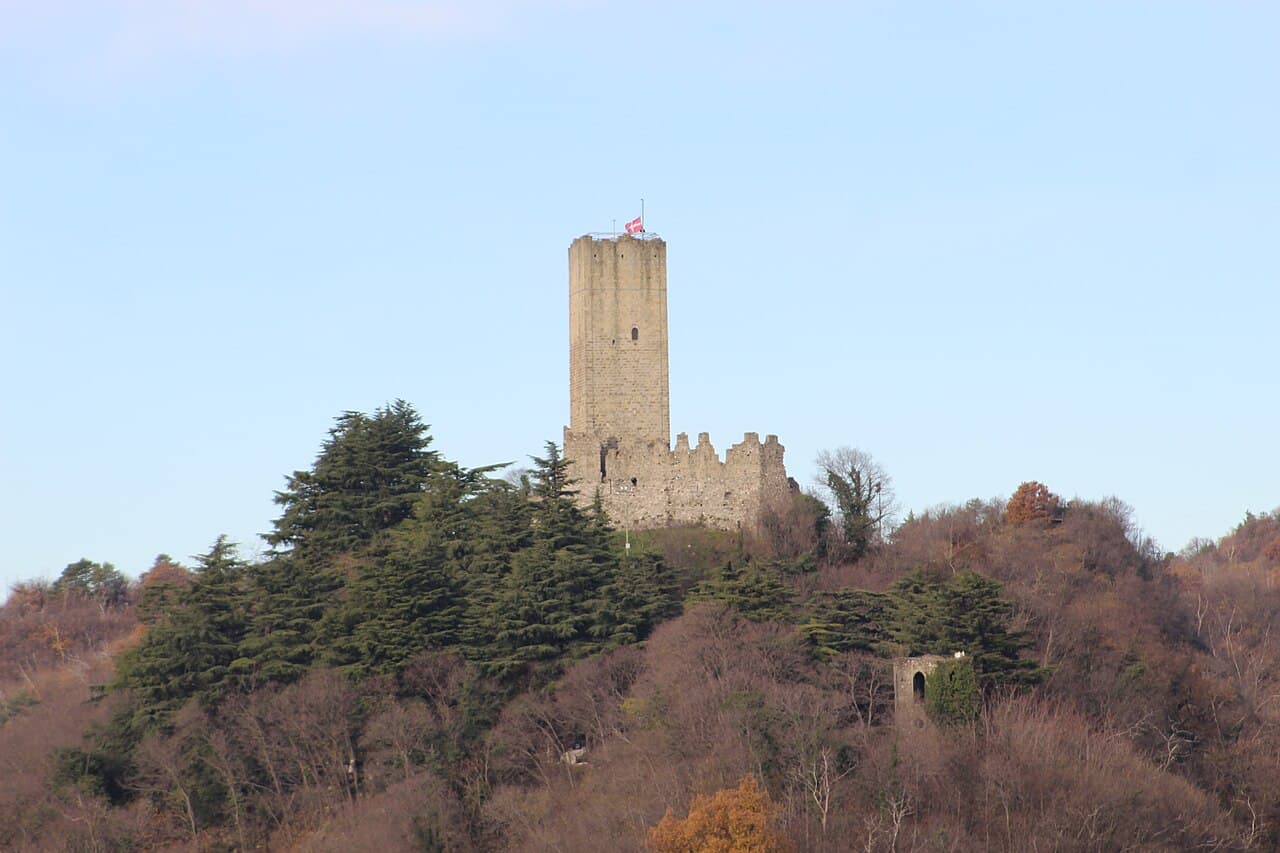
Baradello Castle, also known locally as Castel Baradello, is a prominent medieval fortress perched on a 430-meter high hill overlooking the city of Como in the Lombardy region of northern Italy. This hill castle occupies a site of exceptional historical significance, with archaeological evidence indicating human use dating back to the 1st millennium BC. Originally the location of Comum Oppidum, the earliest settlement of Como, the site was developed by ancient Celtic and Roman communities before evolving into a strategic military stronghold through the centuries.
The earliest fortifications at Baradello Castle date back to the Byzantine period in the 6th and 7th centuries, when it formed part of the Limes Byzantine—a defensive frontier constructed to resist the Lombard invasions into northern Italy. The castle's position allowed control over vital routes, including the via Regia, which connected Como to Milan and the Alpine passes to the north. Despite its formidable defenses, the fortress was one of the last Byzantine strongholds to fall to the Lombards in 588 AD. Historical records from 604 AD refer to the site as Castron Baractelia.
Medieval reconstruction and imperial patronage
After a period of relative obscurity, Baradello Castle regained prominence during the conflict between the cities of Como and Milan in the early 12th century. The city of Como was destroyed by Milanese forces in 1127, and in the aftermath, Como allied itself with the Holy Roman Emperor Frederick Barbarossa. Around 1158, Barbarossa ordered the reconstruction of the castle as part of a broader effort to restore Como's defenses. The emperor stayed at the castle in 1159 alongside his wife, Beatrice I, Countess of Burgundy, and in 1178, he officially donated Baradello Castle to the citizens of Como, solidifying its role as a key defensive and administrative center.
Political intrigue and imprisonment in the 13th century
The castle is closely linked to the turbulent power struggles of northern Italy during the late 13th century. Following the Battle of Desio in 1277, Napoleone della Torre, leader of the rival della Torre family, was imprisoned at Baradello. He suffered a grim fate, dying of starvation while confined in a wooden cage suspended from the castle's tower walls. Other members of the della Torre family, including Canevario and Lombardo della Torre, were similarly imprisoned and met the same fate. However, Guido della Torre famously escaped in 1283, and his brothers Corrado and Enrico were released the following year.
Visconti enhancements and later dismantling
In the 14th and 15th centuries, the powerful Visconti family, rulers of Milan, undertook significant restoration and enlargement of Baradello Castle. After conquering Como in 1335, Azzone Visconti raised the height of the castle's walls and keep, reinforcing its defensive capabilities. Further modifications were made between 1426 and 1436, including the addition of Ghibelline battlements and an outer ring of walls accessible through a pointed-arch gate. These fortifications connected to the extensive "Murata" defensive wall system that protected Como from southern approaches.
Despite these improvements, the castle's military importance declined in the 16th century. In 1527, by order of Emperor Charles V, Baradello Castle was largely dismantled to prevent its capture by invading French forces during the Italian Wars. Only the main tower was spared from demolition. Over subsequent centuries, the castle passed into the hands of monastic orders and later private owners, gradually falling into ruin.
Architectural features and archaeological remains
Baradello Castle's surviving structures reflect its long and complex history. The most prominent feature is the massive Romanesque square tower, measuring approximately 8.20 by 8.35 meters at its base and rising nearly 28 meters in height. The tower's lower 20 meters rest directly on natural rock and originally featured Guelph-style battlements with flat-topped merlons, though these have not survived. An additional upper section of about 8 meters was later added, distinguished by Ghibelline merlons with characteristic swallowtail shapes.
Encircling the tower is a trapezoidal inner defensive wall system dating from the Byzantine era, roughly 10.4 by 13.8 meters, which includes seven narrow arrow slits and a secure main entrance on the northwest side. The masonry of these walls employs Roman building techniques, incorporating repurposed Roman materials such as three sarcophagi embedded within the structure. The walls were later heightened and modified with battlements matching those on the tower.
A later outer ring of walls was added during the Visconti expansions, connected to the castle's main defenses via a pointed-arch gate. This outer enclosure linked to the "Murata" defensive wall, enhancing the castle's ability to control access routes to Como from the south and east.
Archaeological excavations have revealed foundations of several additional structures within the castle complex. These include the Chapel of St. Nicholas, a small single-nave chapel with a preserved apse dating from the 6th century, where Napoleone della Torre was buried. Nearby stands a quadrangular house-tower that likely served as the castellan's residence. Other uncovered features include a vaulted covered cistern predating Barbarossa's tower, rooms for a mill and oven built during the Visconti period, troop quarters, storage areas, additional cisterns, and an icehouse. These elements illustrate the castle's evolution into a self-sustaining fortress capable of withstanding prolonged sieges.
Modern history and cultural significance
In the 19th century, the Venini family added a small hexagonal tower in a neo-Gothic style and constructed a carriage road to improve access to the summit. The castle's commanding position offers sweeping views over Lake Como, the surrounding Alps, and the Po Valley, making it a prominent landmark in the region.
During the 20th century, Baradello Castle underwent partial restoration and consolidation efforts, notably in 1902-1903 and again in 1971 under the guidance of Professor Luigi Mario Belloni. In 1927, the castle became municipal property through a bequest. During World War II, the remaining tower served a military function, housing a Bersaglieri platoon tasked with monitoring for enemy parachute landings.
Today, Baradello Castle stands as a well-known emblem of the Parco della Spina Verde and remains accessible to visitors. The castle can be explored through guided tours that include climbing to the top of the keep, offering insights into its rich history and panoramic views. Although largely in ruins, the site retains significant architectural and historical value, attracting visitors interested in medieval fortifications and Lombardy's cultural heritage.
Frequently asked questions (FAQ)
- What is the historical significance of Baradello Castle?
- Baradello Castle, built in the 10th century, played a crucial role in the defense of Como during various conflicts, including the battles between the Lombards and the Franks. Its strategic position offers breathtaking views of the surrounding area, making it an important military stronghold throughout history.
- When was Baradello Castle built?
- Baradello Castle was constructed around the year 1000 AD, during a period of increasing political instability in the region. The castle has undergone several renovations and restorations over the centuries, reflecting its enduring importance in local history.
- How do I get to Baradello Castle?
- To reach Baradello Castle, visitors can take a short hike from the city of Como, which is about 2 kilometers away. There is also a designated parking area for those who prefer to drive, making it accessible for all types of visitors.
- Can I visit Baradello Castle year-round?
- Yes, Baradello Castle is open to visitors year-round, though specific opening hours may vary depending on the season. It is advisable to check the official website or local tourism information for the latest updates on visiting hours before planning your trip.
- What are the ticket prices for Baradello Castle?
- Admission to Baradello Castle is typically very affordable, with ticket prices usually ranging around €5 for adults and reduced rates for children and seniors. Special discounts may be available for groups or during certain events, so it's worth inquiring upon arrival.
- Is Baradello Castle accessible for visitors with mobility challenges?
- While Baradello Castle does have some accessible paths, the terrain can be steep in certain areas, which may pose challenges for those with mobility impairments. It is recommended to contact the castle management in advance to inquire about specific accessibility options and assistance.
- What is the best time to visit Baradello Castle?
- The best time to visit Baradello Castle is during the spring and early autumn months when the weather is mild and the surrounding landscapes are particularly beautiful. Visiting during these seasons also allows you to enjoy the stunning views without the crowds typically seen in the summer.
- Are there any nearby attractions to visit along with Baradello Castle?
- Yes, there are several nearby attractions, including the historic city center of Como, the picturesque Lake Como, and the funicular railway to Brunate for panoramic views. These sites offer a rich experience of the region's culture and natural beauty, making them perfect for a full day of sightseeing.
Photo gallery

Information
Sources & official resources
Verify the information above using these authoritative references.
Loading map...
Visitor reviews
No reviews yet. Been here? Write the first review and help other travelers!
Write the first reviewVisited this castle? Share your experience
Your review helps other travelers and adds first-hand knowledge to our encyclopedia.