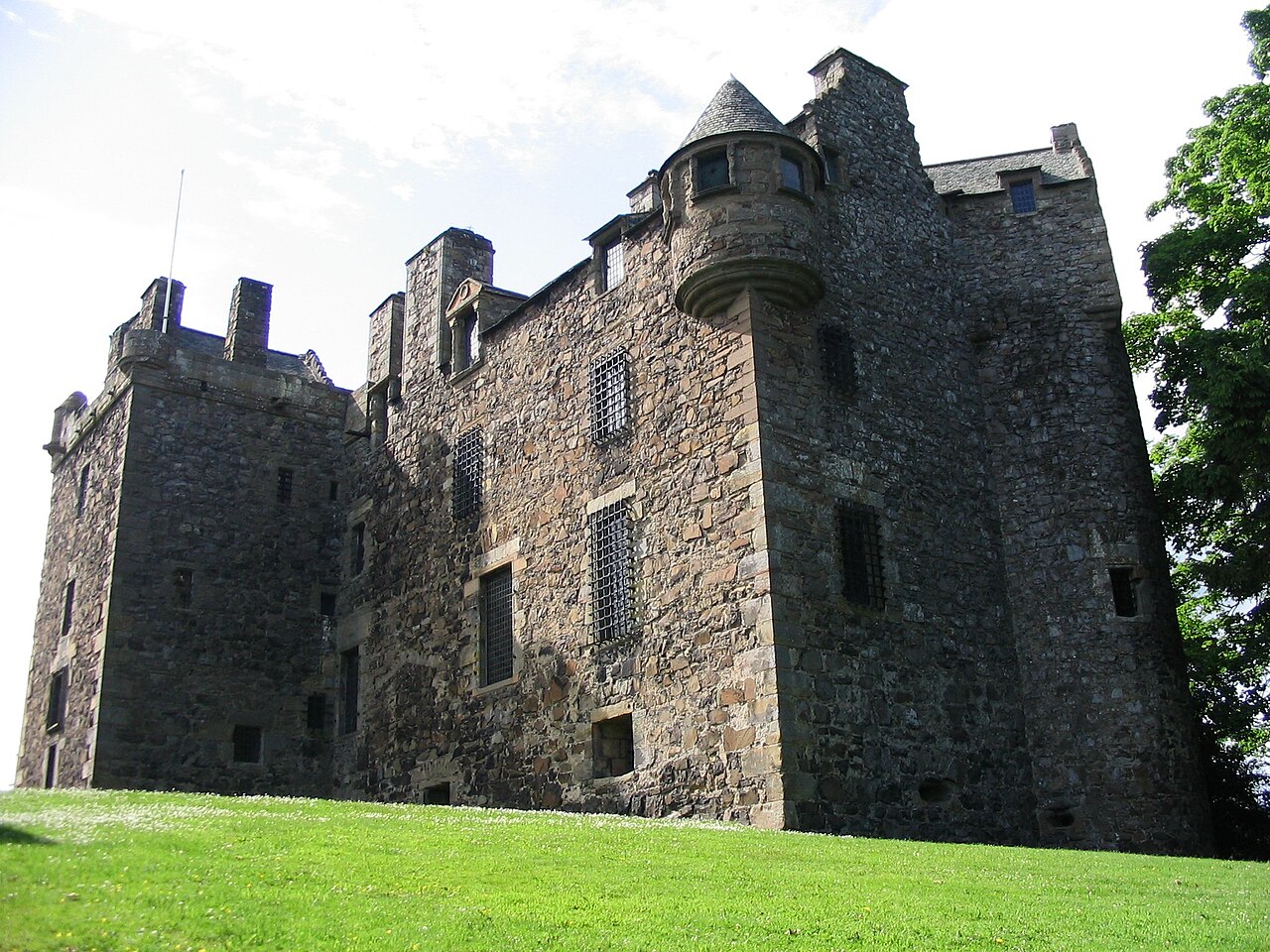
Balthayock Castle
Balthayock Castle is a notable example of a late medieval tower house located near Perth in Scotland. Constructed in the 14th century, this castle has a rich history tied to the prominent Blair family, who are believed to have owned the site since the time of William I (1165-1214). The castle’s thick walls, measuring nearly 10 feet thick, are built from sandstone and whin rubble, materials typical of Scottish defensive architecture of the period.
Architectural features and structure
The main block of Balthayock Castle rises to three storeys plus an attic, with a two-storey wing attached. The first floor of this wing is divided into a chamber and hall, illustrating the castle’s dual function as both a defensive stronghold and a residential home. The presence of tusking in the masonry indicates the former existence of a barmkin, a defensive enclosure typical of tower houses designed to protect the courtyard and ancillary buildings.
Notable architectural elements include an armorial panel dated 1370 located on the east side beside the stone stair, and another armorial with the initials "AB (Blair) GM" dated 1578 over an archway at the southeast corner. These heraldic features provide valuable insight into the castle’s ownership and the timeline of its construction and modifications.
The castle underwent significant alterations in 1870 under the direction of James Maclaren, who undertook restorative work to preserve the structure. Maclaren added the present battlements, a modern roof, a caphouse, and a forestair leading to the entrance. He also made changes to the interior, adapting the medieval structure for more comfortable habitation while maintaining its historic character.
Historical context and significance
Balthayock Castle was inhabited until the mid-20th century but is now unoccupied, though it remains in good condition. The castle played a role in the political and military events of late 16th-century Scotland. In September 1594, during the conflict involving the northern earls, James VI raised forces to confront them at the battle of Glenlivet. While at Perth, Euphemia Douglas, wife of the Master of Glamis, wrote to Alexander Blair, laird of Balthayock, requesting his armed support alongside Glamis Castle to follow the king north.
In 1599, the young laird of Balthayock, along with Lawrence Blair and William Row, the kirk minister at Kinnoull, were captured at Kinross by the Lord Sanquhar and imprisoned for two weeks. This incident reflects the turbulent nature of Scottish noble relations and the castle’s involvement in regional power struggles.
Preservation and current state
Despite being unoccupied, Balthayock Castle is considered to be in considerably good condition due to the extensive restoration work carried out in the 19th century. The castle’s defensive features, such as the crenellated parapet and the robust stone walls, remain intact, offering a clear view of medieval Scottish fortification techniques.
The castle’s location near Perth places it within a region rich in Scottish history, with many other castles and historic sites nearby. Its preservation allows visitors and historians alike to study the evolution of Scottish tower houses and the social history of the Blair family.
Architectural details and defensive features
The castle’s walls, composed of sandstone and whin rubble, demonstrate the use of locally sourced materials common in Scottish medieval construction. The thickness of the walls, nearly 10 feet, provided substantial defense against siege weaponry of the period.
The addition of the battlements and caphouse in the 19th century was sympathetic to the original style, enhancing the castle’s silhouette while protecting the structure from weather damage. The forestair added to the entrance is a typical feature in Scottish tower houses, providing a grand yet defensible access point.
Armorial panels and heraldry
The armorial panels are significant for their historical and genealogical information. The 1370 panel marks the early phase of the castle’s construction, while the 1578 armorial with the initials "AB GM" likely commemorates a later Blair family member and his marriage, as suggested by the initials.
Interior layout
The division of the wing’s first floor into a chamber and hall reflects the typical organization of living and public spaces in medieval tower houses. The hall would have served as a communal area for dining and gatherings, while the chamber provided private quarters.
Information
Loading map...
Visitor reviews
No reviews yet. Been here? Write the first review and help other travelers!
Write the first reviewVisited this castle? Share your experience
Your review helps other travelers and adds first-hand knowledge to our encyclopedia.