Balnagown Castle
Balnagown Castle stands as a historically significant estate located in Kildary, Scotland, known primarily as the ancestral home of the Chiefs of Clan Ross. The site has hosted a castle since the 14th century, with the present structure largely shaped by extensive remodeling during the 18th and 19th centuries. This enduring Scottish stronghold reflects centuries of architectural evolution and clan heritage.
Early origins and medieval history
The origins of Balnagown Castle trace back to the early 14th century when Hugh, Mormaer (Earl) of Ross, initiated the construction of a castle on the site. Hugh was notably married to Maud, sister of King Robert the Bruce, linking the estate closely to Scotland's royal lineage. Despite this prestigious connection, after Hugh's death in 1333, the Ross family experienced a decline in royal favor, resulting in the forfeiture of their lands.
In 1375, the estate was acquired by Hugh's stepson, who undertook significant expansions that continued through subsequent generations. The castle and estate remained central to the Ross family’s influence in the region, although turbulent times marked their tenure. For instance, in 1585, Alexander Ross, 9th laird of Balnagown, and his son George were outlawed, reflecting the complex political and social upheavals of the era.
17th-century rebuilding and clan connections
During the Wars of the Three Kingdoms, the castle’s owner, David Ross, 12th of Balnagown, supported King Charles II and fought at the Battle of Worcester in 1651. Captured during this conflict, he died imprisoned in the Tower of London. His successor, the 13th laird, also named David Ross, married Anne Stuart, daughter of James Stuart, 4th Earl of Moray, in 1666. This couple undertook a significant rebuilding of Balnagown Castle, as evidenced by a datestone dated 1672 on the castle walls. However, they left no heir, leading the estate to pass to the Rosses of Halkhead in 1711.
18th and 19th-century enhancements and architectural evolution
In 1754, the estate was inherited by Admiral Sir John Lockhart-Ross, 6th Baronet, from another branch of the Ross family. The admiral invested heavily in improving both the castle and its surrounding estate, marking a period of agricultural and architectural development. His son, Sir Charles Lockhart-Ross, engaged the prominent architect James Gillespie Graham to undertake Gothic Revival style alterations to the castle, reflecting the 19th century's romantic architectural trends.
Alongside these architectural enhancements, Italian gardens were designed and laid out, adding a formal landscape element to the estate. This combination of Gothic Revival architecture and classical garden design exemplifies the eclectic tastes of the period and the desire to blend historical styles with contemporary landscaping fashion.
20th-century ownership and decline
Sir Charles Ross, 9th Baronet, inherited Balnagown in 1911 and continued the family's tradition of agricultural innovation. He introduced modern farming techniques such as the silo and the combine harvester to the estate. Additionally, he is known for inventing the Ross rifle, which was manufactured in Canada and used during World War I.
To protect the estate from seizure by the Inland Revenue, Sir Charles had Balnagown declared a ward of the court of Delaware. This legal maneuver prevented him from returning to Britain, as he risked imprisonment. Following his death in 1942, the castle remained unoccupied and fell into a state of dilapidation over the next three decades.
Restoration and modern era
In 1972, Mohamed Al-Fayed purchased Balnagown Castle and initiated a comprehensive restoration of the house and grounds. His efforts revived the estate, preserving its historical and architectural significance while adapting it for contemporary use. The restoration work included repairing the castle structure, restoring the gardens, and maintaining the estate’s heritage as a notable Scottish landmark.
Architectural features and style
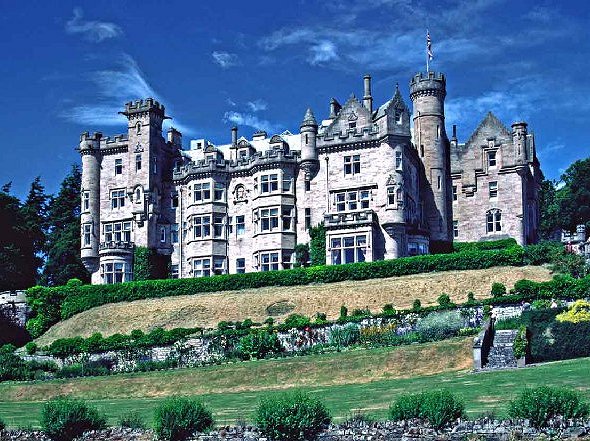
Balnagown Castle exhibits characteristics typical of a post-Renaissance Scottish country house, with significant Gothic Revival influences introduced during the 19th century. The castle’s architecture includes fortified elements reminiscent of its medieval origins, combined with romanticized Gothic details such as pointed arches, battlements, and ornamental stonework. The Italian gardens complement the castle’s architectural style by providing a formal and elegant landscape setting.
The castle’s evolution from a medieval stronghold to a refined country estate illustrates the changing functions and aesthetics of Scottish castles over several centuries. Its layered history is visible in the fabric of the building, which integrates defensive features with the comforts and stylistic preferences of later periods.
Frequently asked questions (FAQ)
- When was Balnagown Castle originally built?
- Balnagown Castle was originally established in the early 14th century, with the present building primarily dating from 18th and 19th century remodeling.
- What architectural styles are featured at Balnagown Castle?
- The castle features a mix of post-Renaissance architecture with significant Gothic Revival style alterations introduced in the 19th century.
- Who was the notable architect involved in the 19th-century renovations?
- James Gillespie Graham, a prominent architect, was consulted for the Gothic Revival style alterations during the 19th century.
- What is the historical significance of Balnagown Castle?
- Balnagown Castle is the ancestral home of Clan Ross and has connections to Scottish royal history through Hugh, Earl of Ross, and ties to King Robert the Bruce.
- Is Balnagown Castle open to the public?
- Currently, Balnagown Castle is privately owned and not generally open to the public, so visitors should check for any special events or tours in advance.
Information
Current owner
Private owner
Loading map...
Visitor reviews
No reviews yet. Been here? Write the first review and help other travelers!
Write the first reviewVisited this castle? Share your experience
Your review helps other travelers and adds first-hand knowledge to our encyclopedia.