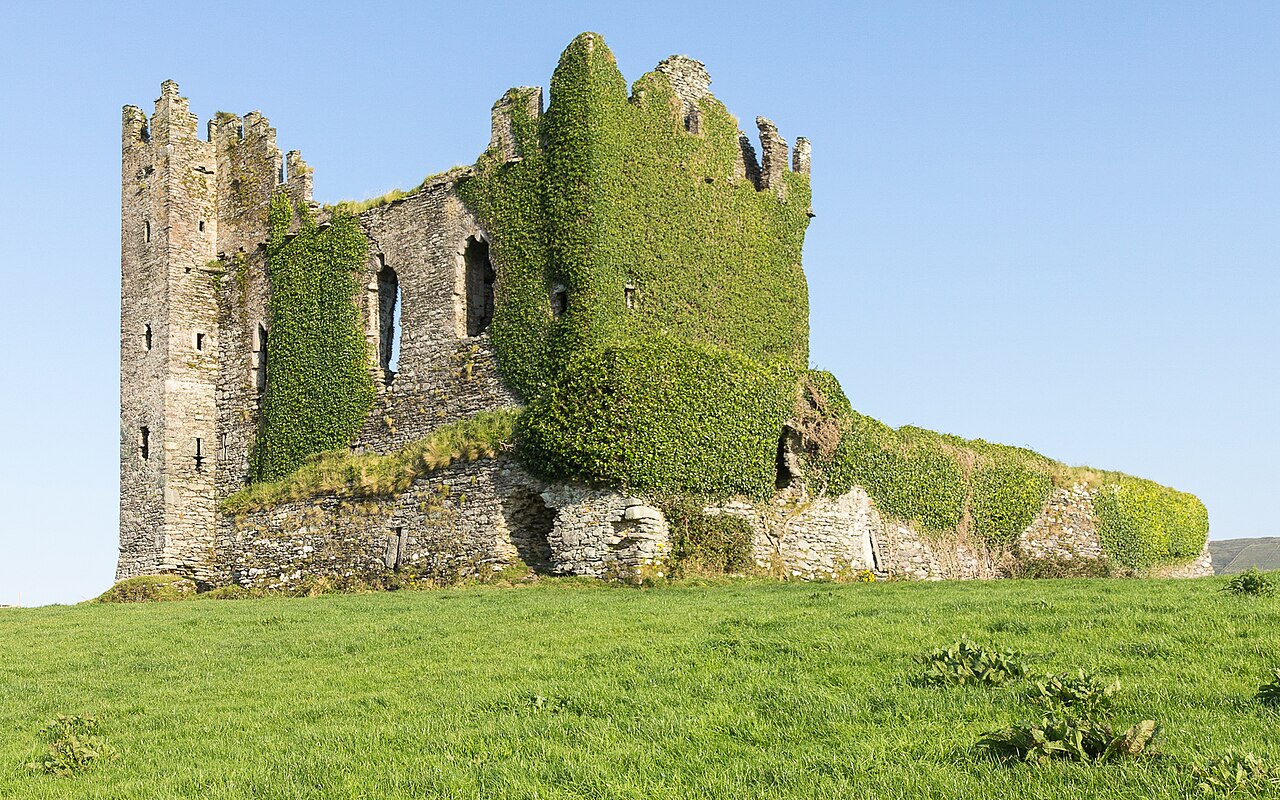
Ballycarbery Castle
Ballycarbery Castle is a notable 16th-century Renaissance tower house located in Ballycarbery East, near the town of Cahersiveen in County Kerry, Ireland. The castle stands as a significant example of Gaelic lordship architecture from the late medieval period transitioning into the Renaissance era in Ireland. Its remains lie in a field west of Cahersiveen, offering a glimpse into the turbulent history of the region and the shifting power dynamics of Gaelic and English rule.
Historical background and ownership
The site of Ballycarbery Castle has been associated with habitation since at least 1398, when records mention the death of Taghd MacCarthaigh at this location. Although tradition attributes the castle's construction to a figure named Carbery O'Shea, historical evidence confirms that it belonged to the McCarthy Mor, the Gaelic Lords of Desmond. The McCarthy Mor were a powerful dynasty in Munster, and Ballycarbery served as one of their important residences.
During the 16th century, the castle functioned as a tower house—a fortified residence typical of the Irish Renaissance period. The O'Connells, acting as wardens for the McCarthy Mor, occupied the castle for a time. In 1596, following the death of Daniel McCarthy Mor, possession of Ballycarbery Castle passed to Sir Valentine Browne, an English settler and figure of influence in Munster.
The castle's strategic importance was underscored during the Irish Confederate Wars and the subsequent Cromwellian conquest of Ireland. In 1651-52, Parliamentary forces captured Ballycarbery Castle as part of their campaign to secure Valentia Harbor and the surrounding region. The castle was deliberately slighted—partially demolished—to prevent its further military use.
Architectural features and layout
Ballycarbery Castle was originally constructed as a tower house, a common type of fortified dwelling for Gaelic and Anglo-Irish nobility during the late medieval and Renaissance periods. The surviving structure today exhibits an L-shaped plan, which was a typical design to provide additional defensive angles and living space.
The castle is enclosed within the remains of a bawn—a defensive walled courtyard used to protect livestock and provide an extra layer of defense. Unfortunately, much of the bawn was demolished in 1910, diminishing the overall defensive footprint of the site.
The stonework of Ballycarbery Castle reflects Renaissance influences, with features such as narrow slit windows for archers and thick defensive walls. The tower house would have contained multiple floors with living quarters, storage rooms, and defensive battlements. The L-shaped configuration allowed defenders to cover blind spots and provided a more complex interior layout compared to simple rectangular keeps.
Later history and current condition
After its slighting in the mid-17th century, Ballycarbery Castle fell into ruin. Unlike some other Irish castles that were restored or adapted, Ballycarbery remains a castle ruin, with much of its structure still standing but in a state of decay.
The castle is situated on private farmland and is not generally accessible to the public, limiting direct visitation. Despite this, the site remains an important cultural landmark in County Kerry, illustrating the region's Gaelic heritage and the impact of English colonization.
Nearby archaeological and historical sites
The area surrounding Ballycarbery Castle is rich in ancient and medieval heritage. Close by are the Cahergall Stone Fort and Leacanabuaile Stone Fort, both well-preserved examples of early medieval ringforts. Across the river lie The Old Barracks and the reconstructed Sive Stone Fort, adding to the historical landscape visitors can explore in the region.
These sites collectively provide insight into the defensive strategies and settlement patterns from the early medieval period through the Renaissance and beyond.
Visiting information and cultural significance
While Ballycarbery Castle itself is not open to the public due to its location on private land, the surrounding region offers a wealth of historical sites accessible to visitors. The castle's ruins contribute to the cultural narrative of County Kerry and the broader history of Gaelic Ireland during the Renaissance.
Scholars and enthusiasts of medieval Irish architecture regard Ballycarbery as a valuable example of a Renaissance tower house that illustrates the adaptation of traditional Gaelic fortifications to changing military and domestic needs in the 16th century.
Frequently asked questions (FAQ)
- How do I get to Ballycarbery Castle?
- Ballycarbery Castle is located in Ballycarbery East, United Kingdom of Great Britain and Northern Ireland. The castle is accessible by car, and there is parking available nearby. Public transport options may be limited, so planning your visit ahead is recommended.
- What is the historical significance of Ballycarbery Castle?
- Ballycarbery Castle dates back to the 15th century and is a notable example of a medieval tower house. It was built by the O'Connell family and played a significant role in the local history of the region. The castle's ruins provide insight into the architectural styles and defensive strategies of its time.
- When was Ballycarbery Castle built?
- Ballycarbery Castle was constructed in the 15th century, with its origins linked to the O'Connell family. Over the centuries, it has witnessed numerous historical events, contributing to its rich heritage. The castle remains a testament to the architectural ingenuity of its era.
- Can I visit Ballycarbery Castle year-round?
- Yes, you can visit Ballycarbery Castle throughout the year. However, it's advisable to check local weather conditions and any potential access restrictions before planning your visit. The open ruins can be explored at your leisure, providing a unique experience any time of year.
- Why is Ballycarbery Castle a popular tourist attraction?
- Ballycarbery Castle is popular for its stunning coastal views and well-preserved ruins. Visitors are drawn to its historical significance and the picturesque landscape surrounding the castle. It's an excellent spot for photography and a peaceful place to explore the history of the region.
- Is it possible to access the interior of the castle?
- Currently, the interior of Ballycarbery Castle is not fully accessible, as it is primarily in ruins. However, visitors can walk around the exterior and explore its grounds. The site provides a fascinating glimpse into medieval life and architecture without requiring extensive accessibility features.
- What are the best times to visit Ballycarbery Castle?
- The best times to visit Ballycarbery Castle are during the spring and summer months, when the weather is typically milder and more conducive to outdoor exploration. Additionally, the surrounding scenery is at its most vibrant during these seasons. Weekdays tend to be less crowded, allowing for a more peaceful experience.
- Are there any nearby attractions to visit?
- Yes, there are several nearby attractions, including beautiful coastal walks and charming villages that reflect the local culture. Visitors can also explore other historical sites in the region, enhancing their experience of the area's rich history. It's a great opportunity to make a day of exploring the scenic landscape.
- What are the ticket prices for visiting Ballycarbery Castle?
- Entry to Ballycarbery Castle is free, allowing visitors to enjoy the historic site without any cost. Donations are appreciated to help with the maintenance and preservation of the site. This makes it an accessible option for all visitors, including families and history enthusiasts.
- What are the opening hours for Ballycarbery Castle?
- Ballycarbery Castle is open to the public year-round, with no specific opening hours. Visitors can explore the site at their convenience, but it's advisable to visit during daylight hours for the best experience. Always check local information for any temporary access changes.
Loading map...
Visitor reviews
No reviews yet. Been here? Write the first review and help other travelers!
Write the first reviewVisited this castle? Share your experience
Your review helps other travelers and adds first-hand knowledge to our encyclopedia.