Baldenau Castle
Baldenau Castle, located near Morbach in the German region of the Hunsrück, is a remarkable example of a late medieval hill castle with a rich history tied to the Electorate of Trier. Constructed around 1320 by Archbishop Baldwin of Luxemburg, the castle originally served as a hunting lodge before evolving into a fortified residential seat. This transformation reflects the strategic and political ambitions of the Trier Electorate during the early 14th century, a time marked by territorial disputes and feudal rivalries.
Historical background and political significance
The castle’s founder, Archbishop Baldwin of Trier, was a prominent figure born in 1285, the youngest son of Count Henry VI of Luxemburg. Baldwin ascended to the archbishopric at a young age and sought to consolidate the Electorate’s power in the region. Baldenau Castle was strategically positioned to defend against the encroachments of neighboring powers, notably the Counts of Sponheim, underscoring its military and administrative importance.
The castle gave its name to the Amt Baldenau, an administrative district encompassing fifteen villages, highlighting its role as a local center of governance. In 1332, city rights were granted to a nearby settlement, although the planned town never fully materialized. This illustrates the castle’s intended function as a hub of regional control and development.
Architectural features and layout
Baldenau Castle is perched on a mountain ridge overlooking the upper valley of the Dhron River and its tributary, the Rebruchbach. The castle’s footprint is wedge-shaped, approximately 52 meters long and up to 20 meters wide, a compact design typical of hill castles built for defense and control.
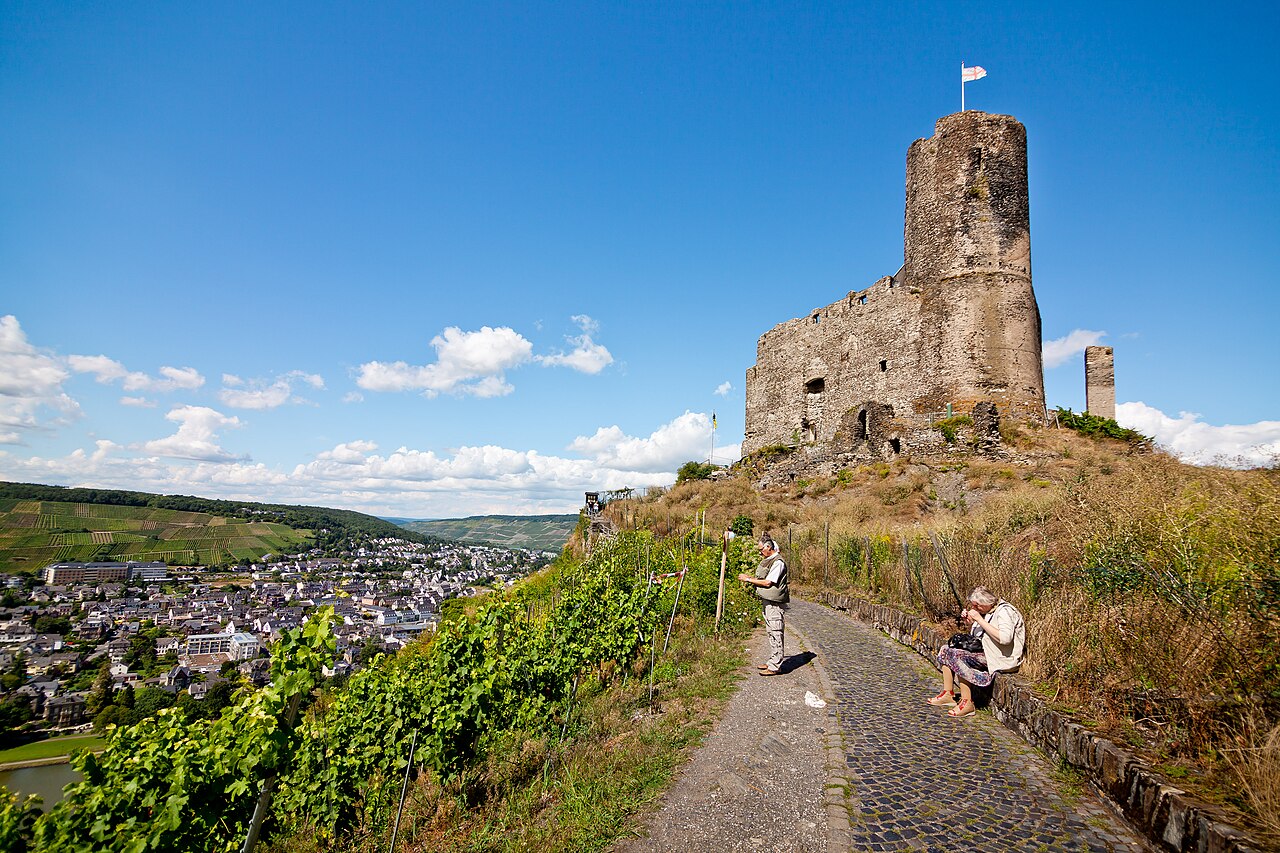
The most striking architectural feature is the round bergfried, a tall defensive tower standing about 24 meters high with a diameter of 10.5 meters. Its walls are exceptionally thick, up to 3.2 meters, reflecting its primary function as a watchtower and last refuge during sieges. The bergfried retains three stories, offering commanding views of the surrounding landscape.
Opposite the bergfried lie the remains of the main residential building, which once rose to at least three stories. Archaeological findings indicate access via an external wooden staircase tower. The ground floor housed the kitchen area, identifiable by a fireplace on the eastern side, demonstrating the castle’s residential and domestic functions.
The castle was surrounded by a ring wall equipped with embrasures for archers and topped by a battlemented wall walk, allowing defenders to patrol and defend the perimeter effectively. Within the courtyard, traces of smaller ancillary buildings suggest spaces for storage, workshops, or other support activities.
A key defensive feature was the moat, fed by the upper branch of the Dhron River, which encircled the castle. This moat, approximately 12 meters wide, was an uncommon but effective fortification in the Hunsrück region. The entrance was accessed via a ramp, and a well near the gate ensured a reliable water supply during sieges.
Damages, destruction, and restoration efforts
Baldenau Castle suffered significant damage during the Thirty Years' War (1618-1648) when Swedish troops inflicted serious destruction. Restoration efforts between 1649 and 1654 repaired much of the damage, allowing the castle to regain its defensive and residential functions temporarily.
However, in 1689, during the War of the Palatine Succession, the castle was devastated by French troops under King Louis XIV, leading to its permanent ruin. Since then, it has remained a ruin, reflecting the turbulent military history of the region.
In the late 20th century, stabilization work began in 1982 to preserve the remaining structures. Despite challenges such as stone removal and vandalism, ongoing conservation efforts aim to maintain the castle’s historical fabric and promote its cultural significance.
Strategic location and regional defenses
The castle’s location atop a ridge provided commanding views over the Dhron valley, enhancing its defensive capabilities. It worked in concert with the nearby Stumpfer Tower, located about one kilometer away on an ancient Roman road. Together, these fortifications formed a defensive network guarding the western boundaries of the Electorate of Trier and provided early warnings of enemy advances.
Cultural significance and modern use
Beyond its military and administrative roles, Baldenau Castle has cultural importance. The ruins served as a filming location for Edgar Reitz’s acclaimed Heimat film trilogy in the early 1980s, highlighting the castle’s evocative presence and historical resonance.
Today, the castle ruins attract visitors interested in medieval architecture, regional history, and scenic landscapes. The site offers insights into the construction techniques of the period, the life of the Electorate of Trier, and the complex feudal dynamics of medieval Germany.
Frequently asked questions (FAQ)
- How do I get to Baldenau Castle near Morbach?
- Baldenau Castle is located near Morbach in the Rhineland-Palatinate region of Germany. Visitors can reach the site by car or local public transport, followed by a hike up the mountain ridge where the ruins stand.
- What is the historical significance of Baldenau Castle?
- Baldenau Castle was built in the early 14th century by Archbishop Baldwin of Trier to strengthen territorial control and defend against regional rivals. It played a key role in local administration and military defense during the late medieval period.
- Can I explore the ruins of Baldenau Castle?
- Yes, visitors can explore the ruins of Baldenau Castle. While the site is largely in ruins, key features such as the bergfried, ring wall remains, and moat are visible. Caution is advised due to uneven terrain and partial preservation.
- When was Baldenau Castle destroyed?
- The castle was severely damaged during the Thirty Years' War and later destroyed in 1689 by French troops during the War of the Palatine Succession, after which it remained in ruins.
- Is there an entrance fee to visit Baldenau Castle?
- There is no official entrance fee to visit Baldenau Castle ruins, making it accessible to the public for self-guided exploration.
Photo gallery

Information
Loading map...
Visitor reviews
No reviews yet. Been here? Write the first review and help other travelers!
Write the first reviewVisited this castle? Share your experience
Your review helps other travelers and adds first-hand knowledge to our encyclopedia.