Ashford Castle
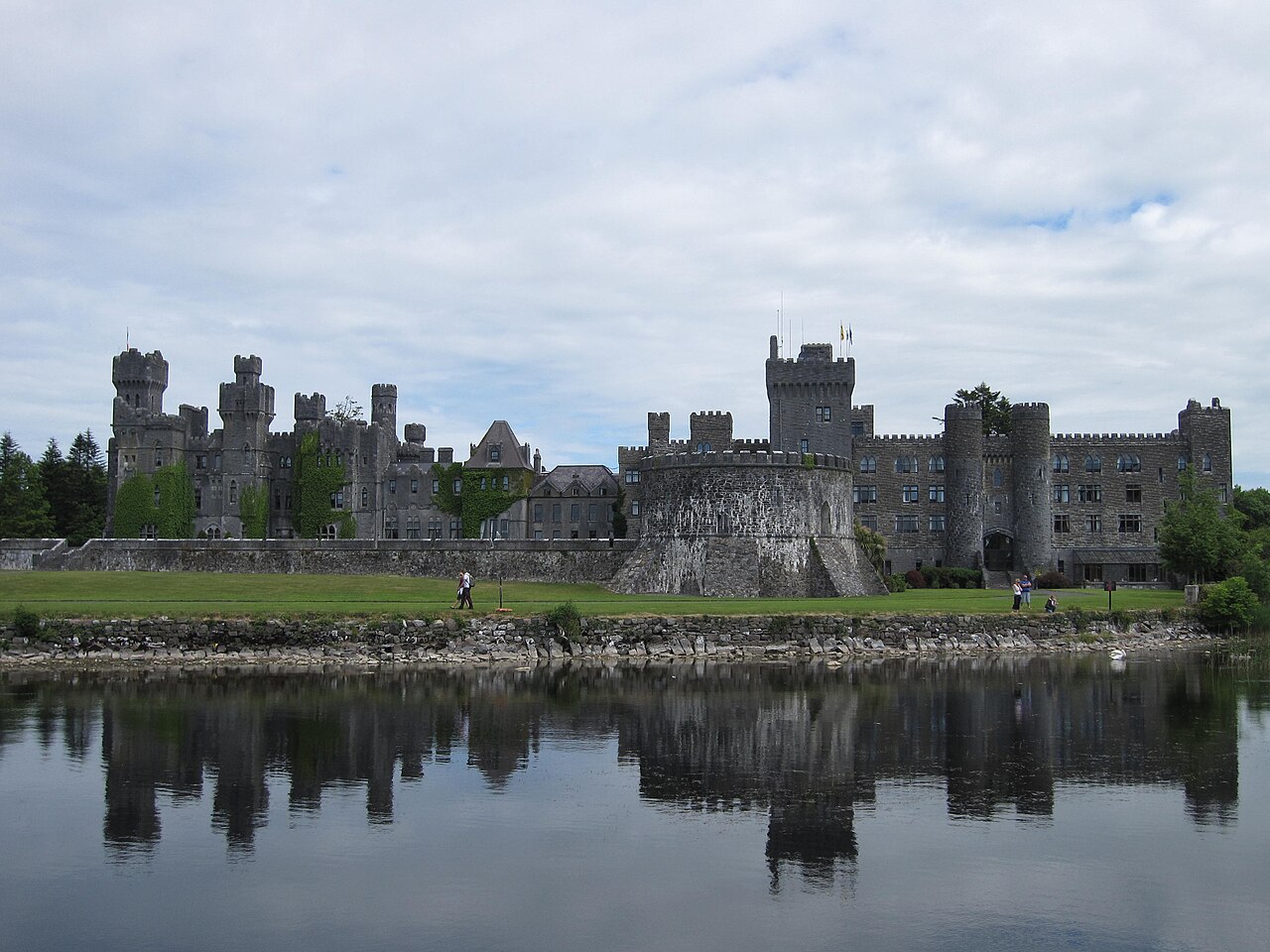
Ashford Castle stands as an iconic example of layered Irish castle architecture, blending medieval origins with Victorian and neogothic expansions. Located near the village of Cong on the border of County Mayo and County Galway, this castle has evolved over nearly eight centuries from a fortified Anglo-Norman stronghold into a renowned five-star luxury hotel. Its position on the scenic shores of Lough Corrib enhances its appeal as both a historic site and a premier destination.
The castle’s history begins in 1228 when it was constructed by the Anglo-Norman de Burgo family, also known as the House of Burke. This family held the castle for more than 350 years, establishing their dominance in the region. The original medieval structure included two robust towers on the western side, built from local stone, which served as defensive bastions typical of Anglo-Norman military architecture. These towers remain integral parts of the castle’s fabric, providing a tangible link to its early 13th-century origins.
The medieval origins and early history
Situated on the edge of an earlier monastic site, Ashford Castle’s strategic location near the Mayo-Galway border was significant for controlling local territories. The de Burgo family fortified the site, reflecting the turbulent political landscape of medieval Ireland. In 1589, the castle was captured by Sir Richard Bingham, the English Lord President of Connaught, after a fierce battle with the de Burgos. Bingham added a fortified enclave within the castle precincts, enhancing its defensive capabilities in line with late 16th-century military needs.
The Browne family era
Following the de Burgo tenure, the castle passed into the hands of the Browne family through a Royal Grant dated either 1670 or 1678. The Brownes, later titled Baron Oranmore and Browne, established the Ashford estate formally in 1715. They constructed a hunting lodge styled after a 17th-century French chateau, notable for its decorative double-headed eagle coat of arms displayed prominently on the roof. This emblem symbolizes the Browne family’s aristocratic status and influence in the region.
Members of the Browne family continued to occupy the castle into the late 18th century, with records from 1814 mentioning Thomas Elwood as their estate agent residing on-site. The Brownes’ stewardship maintained the estate’s prominence in local society and economy.
Victorian expansions and the Guinness ownership
In 1852, the estate was purchased by Sir Benjamin Lee Guinness, a member of the famous Guinness brewing family. His acquisition marked a new phase of significant enlargement and landscaping. Guinness expanded the estate to approximately 26,000 acres, built new roads, and planted thousands of trees, transforming the grounds into extensive woodlands and parklands.
Sir Benjamin added two large Victorian-style extensions to the castle, greatly increasing its size and grandeur. Upon his death in 1868, the estate passed to his son, Arthur Edward Guinness, known as Lord Ardilaun. Lord Ardilaun was an avid gardener and patron of local development projects. He commissioned architects James Franklin Fuller and George Ashlin to rebuild the west wing, linking the 18th-century eastern parts with the medieval western towers. This work was executed in the neogothic style, characterized by battlements added around the entire castle, evoking medieval grandeur and romantic revivalism.
Lord Ardilaun’s contributions and legacy
Lord Ardilaun’s tenure was marked by both architectural and economic initiatives. He supported steamboat services on Lough Corrib and attempted to develop the Cong Canal, though the latter was unsuccessful. During the Land Wars of the late 19th century, he was regarded as an "improving" landlord, balancing estate modernization with tenant relations. His extensive woodland plantings and castle renovations left a lasting imprint on the estate’s landscape and architectural character.
20th-century transformations and hotel conversion
After Lord Ardilaun, ownership passed to his nephew, Ernest Guinness. In 1939, the castle was sold to Noel Huggard, who converted Ashford Castle into a hotel specializing in country sports such as fishing and shooting. This marked the beginning of its modern role as a luxury hospitality venue.
In 1970, John Mulcahy acquired the property and undertook a comprehensive restoration, doubling the castle’s size and adding amenities including a golf course and enhanced grounds. This expansion solidified Ashford Castle’s reputation as a premier resort destination.
The castle changed hands again in 1985 when an Irish American consortium including Chuck Feeney and Tony O’Reilly purchased it. They later sold it in 2007 to developer Gerry Barrett for €50 million. Despite financial difficulties leading to receivership in 2011, the castle continued operations uninterrupted.
In 2013, Red Carnation Hotels acquired Ashford Castle and invested €47 million in an extensive refurbishment completed by 2015. This restoration included replacing all 820 windows, installing a new lead roof, and repointing the stone masonry, ensuring the castle’s preservation and continued function as a luxury hotel.
Architectural features and estate grounds
Ashford Castle is a complex architectural palimpsest, with elements spanning from the 13th century through the 19th century. The two medieval towers on the west side remain prominent defensive structures, constructed of local stone with thick walls and narrow openings for defense.
The 18th-century hunting lodge built by the Brownes reflects aristocratic tastes of the period, with its French chateau-inspired design and heraldic ornamentation. The Victorian expansions introduced large-scale residential wings and neogothic battlements, blending historicism with romantic architectural trends.
The castle sits within an extensive estate of approximately 26,000 acres featuring mature woodlands, formal gardens, and a golf course. The grounds were extensively developed during the Guinness era and later enhancements have maintained and improved the landscape’s aesthetic and recreational value.
Interior and guest experience
Today, Ashford Castle operates as a five-star hotel with 83 bedrooms, including six suites. Its interiors combine historic charm with modern luxury, offering guests an immersive experience in a setting rich with history. The castle’s location on Lough Corrib provides stunning natural views and opportunities for outdoor activities such as fishing, boating, and hiking.
Notable guests and cultural significance
Throughout its history as a residence and hotel, Ashford Castle has hosted an illustrious roster of guests. These include King George V and Queen Mary, John Lennon, George Harrison, Oscar Wilde (whose father owned an adjacent estate), President Ronald Reagan, Prince Edward, Earl of Wessex, US Senator Ted Kennedy, John Wayne, Brad Pitt, Pierce Brosnan, and Prince Rainier III and Princess Grace of Monaco.
The castle’s rich history, architectural diversity, and cultural connections make it a significant heritage site in Ireland. It exemplifies the evolution of Irish aristocratic residences from medieval fortifications to modern luxury hospitality venues.
Frequently asked questions (FAQ)
- How do I get to Ashford Castle?
- Ashford Castle is located near Cong on the Mayo-Galway border in Ireland. It is accessible by car via local roads, with parking available on site. The nearest major towns are Galway and Castlebar, each about a 45-minute drive away.
- What architectural styles are visible at Ashford Castle?
- Ashford Castle showcases a mix of architectural styles, including medieval Anglo-Norman towers, 18th-century French chateau-inspired elements, Victorian expansions, and 19th-century neogothic additions.
- When was Ashford Castle originally built?
- The original castle was built in 1228 by the Anglo-Norman de Burgo family. Significant expansions and renovations occurred during the 18th and 19th centuries.
- Is Ashford Castle open to the public?
- Ashford Castle operates as a luxury hotel and is generally open only to guests. Visitors can enjoy the grounds and facilities by booking accommodation or dining at the castle's restaurants.
- What notable guests have stayed at Ashford Castle?
- The castle has hosted many famous guests including King George V and Queen Mary, John Lennon, George Harrison, Oscar Wilde, President Ronald Reagan, and Prince Rainier III and Princess Grace of Monaco.
Information
Opening hours
10:00-18:00, daily
Ticket prices
Hotel guests only
Current owner
Red Carnation Hotels
Website
Visit websiteSources & official resources
Verify the information above using these authoritative references.
Loading map...
Visitor reviews
No reviews yet. Been here? Write the first review and help other travelers!
Write the first reviewVisited this castle? Share your experience
Your review helps other travelers and adds first-hand knowledge to our encyclopedia.