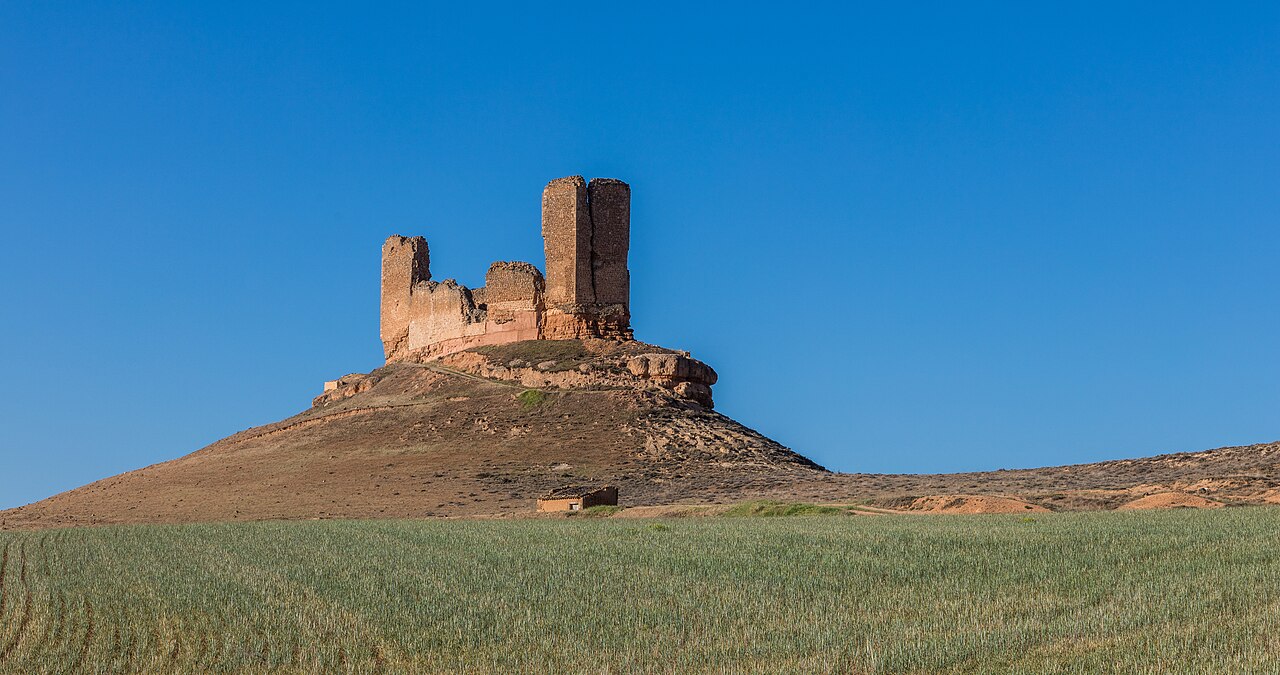
Arcos de Jalón Castle
Arcos de Jalón Castle is a late medieval fortress located in the town of Arcos de Jalón, Spain. Dating from the 14th century, this castle was built on the site of an earlier Arab fortress, reflecting the turbulent history of the region during the Reconquista and the power struggles within the Kingdom of Castile. The castle is notable for its strategic position atop a high and narrow hill that physically divides the town into two parts, providing a commanding view of the surrounding landscape and natural defense advantages.
The castle's rectangular floor plan is somewhat irregular, adapting to the rugged topography of the hill. Its thick stone walls incorporate horizontal rows of brick and finely cut ashlar stones, with visible stonecutter’s marks on the corners, demonstrating the skilled craftsmanship of its builders. A robust keep is attached directly to the castle walls, serving as the last defensive refuge and symbol of feudal authority.
Historical significance and conflicts
Arcos de Jalón Castle played a role in the political conflicts of the 14th century. It was besieged during the civil war between supporters of King Pedro I of Castile and the rebel forces led by Fernán Gómez de Albornoz, who supported Pedro's half-brother, Enrique de Trastamara. This siege highlights the castle's military importance in the power struggles that shaped medieval Spain.
Architectural features and construction techniques
Wall structure and materials
The castle's walls are remarkable for their double-lined brick construction, a technique primarily intended for structural stability but which also creates striking reddish lines contrasting with the stonework. This method is characteristic of Mudejar architecture, reflecting the influence of the Muslim artisans and builders who lived in the region during the Middle Ages. The presence of Mudejar elements in a military fortress is unusual and adds to the castle's architectural interest.
Keep and defensive elements
The keep attached to the walls was originally taller than the current remains suggest. Inside, traces of the internal structures that divided the tower into multiple floors can still be seen. The castle has only one entrance, positioned high above ground level for defensive purposes, along with two loophole windows designed for archers to defend the fortress while minimizing exposure.
Layout and fortifications
Along the perimeter of the fortress, the foundations of walls and several towers that once reinforced the castle's defenses are visible. These towers would have provided vantage points for surveillance and defense against attackers. The irregular shape of the castle allowed it to conform closely to the contours of the hill, maximizing the natural defenses provided by the terrain.
Mudejar influence and cultural context
The castle's construction technique, especially the use of brick lining within stone walls, is a clear indication of Mudejar influence. This style developed from the coexistence of Christian and Muslim cultures in medieval Spain, particularly in regions like Aragon where a significant Muslim population remained after the Reconquista. The castle stands as a testament to this cultural blending, combining traditional military architecture with decorative and structural elements derived from Islamic art and building methods.
Current condition and visitor experience
Today, Arcos de Jalón Castle is classified as partially preserved. While much of the original structure remains in ruins, key features such as the keep, walls, and foundations can still be explored. Visitors can appreciate the castle's unique architectural details and its dramatic setting overlooking the town. The site offers insight into the military and cultural history of the region during the late medieval period.
Access to the castle involves navigating the steep hill on which it stands, which adds to the sense of its historical defensive purpose. Interpretive signage and guided tours may be available locally to enhance understanding of the castle's historical context and architectural significance.
Frequently asked questions (FAQ)
- How do I get to Arcos de Jalón Castle?
- Arcos de Jalón Castle is located on a high hill in the town of Arcos de Jalón, Castile and León, Spain. Visitors can reach it by walking up from the town center; the path is steep but accessible with proper footwear.
- What is the historical significance of Arcos de Jalón Castle?
- The castle was a strategic fortress in the 14th century, involved in the civil war between King Pedro I and rebel forces supporting Enrique de Trastamara. It also reflects the Mudejar architectural influence in military construction.
- Can I explore the interior of the castle?
- Yes, visitors can explore the remains of the castle's walls, keep, and foundations. While much of the interior is in ruins, key structural elements and defensive features are visible.
- When is the best time to visit Arcos de Jalón Castle?
- The best time to visit is during spring and autumn when the weather is mild. Summers can be hot, and the steep hill may be challenging in wet conditions.
- Is there an entrance fee to visit the castle?
- Currently, there is no entrance fee to visit Arcos de Jalón Castle, making it accessible to all visitors interested in history and architecture.
Information
Current owner
Municipality
Loading map...
Visitor reviews
No reviews yet. Been here? Write the first review and help other travelers!
Write the first reviewVisited this castle? Share your experience
Your review helps other travelers and adds first-hand knowledge to our encyclopedia.