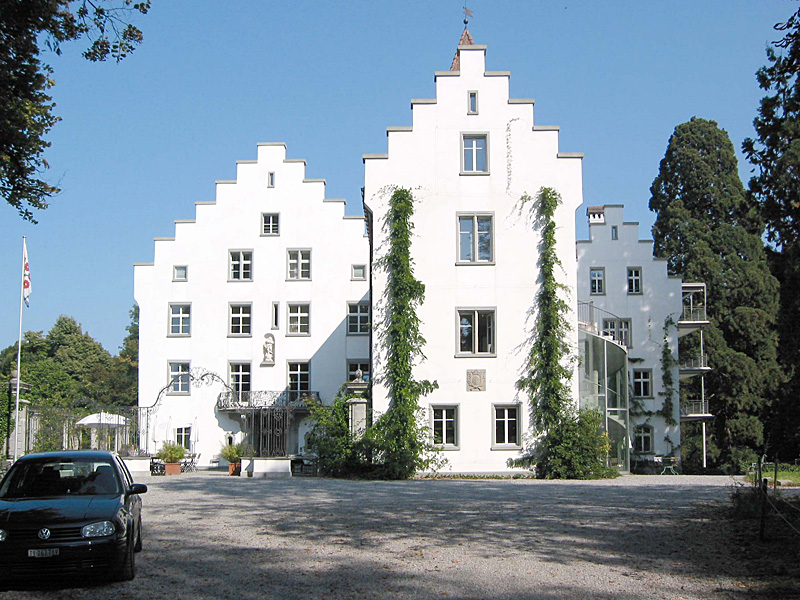
Arbon Castle
Arbon Castle stands as a remarkable historical monument in the town of Arbon, Switzerland, embodying a rich legacy that spans from the Roman era through the medieval period to modern times. The castle's origins are intricately linked to the ancient Roman fortress known as Arbor Felix, established around 250 AD. This fortress served as a strategic military stronghold during the height of the Roman Empire's presence in the region. Following the Roman withdrawal south of the Alps circa 400 AD, the site was abandoned but later reoccupied and transformed during the early medieval period.
By the early 8th century, the site had become part of the Frankish realm, with a castle likely constructed for the Frankish royal family. Around 700 AD, the ownership of Arbon and its castle transferred to the Diocese of Constance, marking the beginning of ecclesiastical oversight. The castle was managed by a bailiff, reflecting its role as an administrative center within the church's territorial domain.
Medieval architectural evolution
The most ancient part of the extant Arbon Castle is a 13th-century residential tower, which may have been erected upon much older foundations potentially dating back to the Frankish or Roman periods. The tower's lower walls are notably thick, reaching up to 3.2 meters, underscoring its defensive purpose and robust construction. Inside, visitors can find two Romanesque fireplaces, exemplifying the architectural style prevalent in medieval Europe between the 11th and 13th centuries, characterized by rounded arches and solid, functional design.
Early 16th-century transformation
Between 1515 and 1520, the castle underwent significant renovation under the direction of Bishop Hugo von Hohenlandenberg. This reconstruction transformed the original tower into a U-shaped building, adding an upper story, decorative gables, and a hip roof with slopes on all sides. Importantly, the outer walls were realigned to rest precisely on the northwest corner of the ancient Roman fortress, symbolically and physically connecting the medieval structure to its Roman predecessor. This phase of construction reflects the late medieval architectural sensibilities, blending functionality with aesthetic enhancements.
Industrial adaptation and modern preservation
In the 19th century, Arbon Castle shifted from a feudal residence to an industrial site. From 1822 to 1907, it housed the Stoffel silk ribbon weaving company, illustrating the adaptive reuse of medieval structures during the industrial revolution. Subsequently, in 1911, the castle became part of the enterprise of Adolph Saurer, founder of Adolph Saurer AG, who utilized the castle and its surroundings for workshops dedicated to mechanical experimentation and production of motors, trucks, and machinery.
In 1944, the city of Arbon acquired the castle, initiating renovations and expansions that preserved its historical fabric while adapting it for public use. Since 1967, the castle has housed the Historisches Museum Arbon (Arbon History Museum), serving as a cultural and educational center that showcases the region's rich history from Roman times through the modern era.
Architectural features and historical significance
The castle's enduring 13th-century tower remains a focal point, with its thick masonry walls and Romanesque interior elements providing tangible links to the medieval past. The deliberate alignment of the castle's walls over the Roman fortress foundations highlights the site's continuous strategic importance over centuries. The castle's transformation from a military stronghold to an ecclesiastical center, then to an industrial hub, and finally to a museum encapsulates the dynamic history of Arbon itself.
Visitors to Arbon Castle can explore a site where multiple layers of history converge, from the Roman military architecture of Arbor Felix to the medieval residential and defensive structures, and later industrial adaptations. The castle stands as a testament to the region's evolving political, economic, and cultural landscape.
Preservation and current condition
Today, the castle is well preserved, with significant restoration efforts maintaining its structural integrity and historical character. The integration of the castle into the museum complex ensures ongoing conservation and public engagement, allowing visitors to appreciate both its architectural grandeur and its historical narratives.
Visiting arbon castle
The Historisches Museum Arbon offers a unique opportunity to experience the castle's storied past firsthand. Exhibits cover the Roman origins of the site, the medieval transformations, and the industrial era, providing a comprehensive understanding of the castle's role in regional history. The museum's location within the castle walls enhances the visitor experience, immersing guests in the authentic atmosphere of this historic hill castle.
Arbon Castle's location in the picturesque town of Arbon, near Lake Constance, makes it accessible for tourists interested in Swiss history, medieval architecture, and cultural heritage. The castle's hilltop position offers scenic views and a tangible connection to centuries of European history.
Frequently asked questions (FAQ)
- What is the historical significance of Arbon Castle?
- Arbon Castle is historically significant for its continuous occupation from Roman times through the medieval period and its role as an ecclesiastical and industrial site in Arbon, Switzerland.
- When was Arbon Castle originally built?
- The oldest part of Arbon Castle dates back to the 13th century, built atop earlier Roman and Frankish foundations.
- Can visitors tour Arbon Castle today?
- Yes, Arbon Castle is open to the public as the Historisches Museum Arbon, offering exhibits on its Roman origins, medieval history, and industrial past.
- How did the 16th-century renovations change the castle?
- Bishop Hugo von Hohenlandenberg transformed the original tower into a U-shaped building with an upper story, gables, and a hip roof, aligning the outer walls with the Roman fortress foundations.
- What architectural styles are visible in Arbon Castle?
- The castle features Romanesque elements such as fireplaces from the 13th century and late medieval architectural features from the 16th-century renovations.
Information
Sources & official resources
Verify the information above using these authoritative references.
Loading map...
Visitor reviews
No reviews yet. Been here? Write the first review and help other travelers!
Write the first reviewVisited this castle? Share your experience
Your review helps other travelers and adds first-hand knowledge to our encyclopedia.