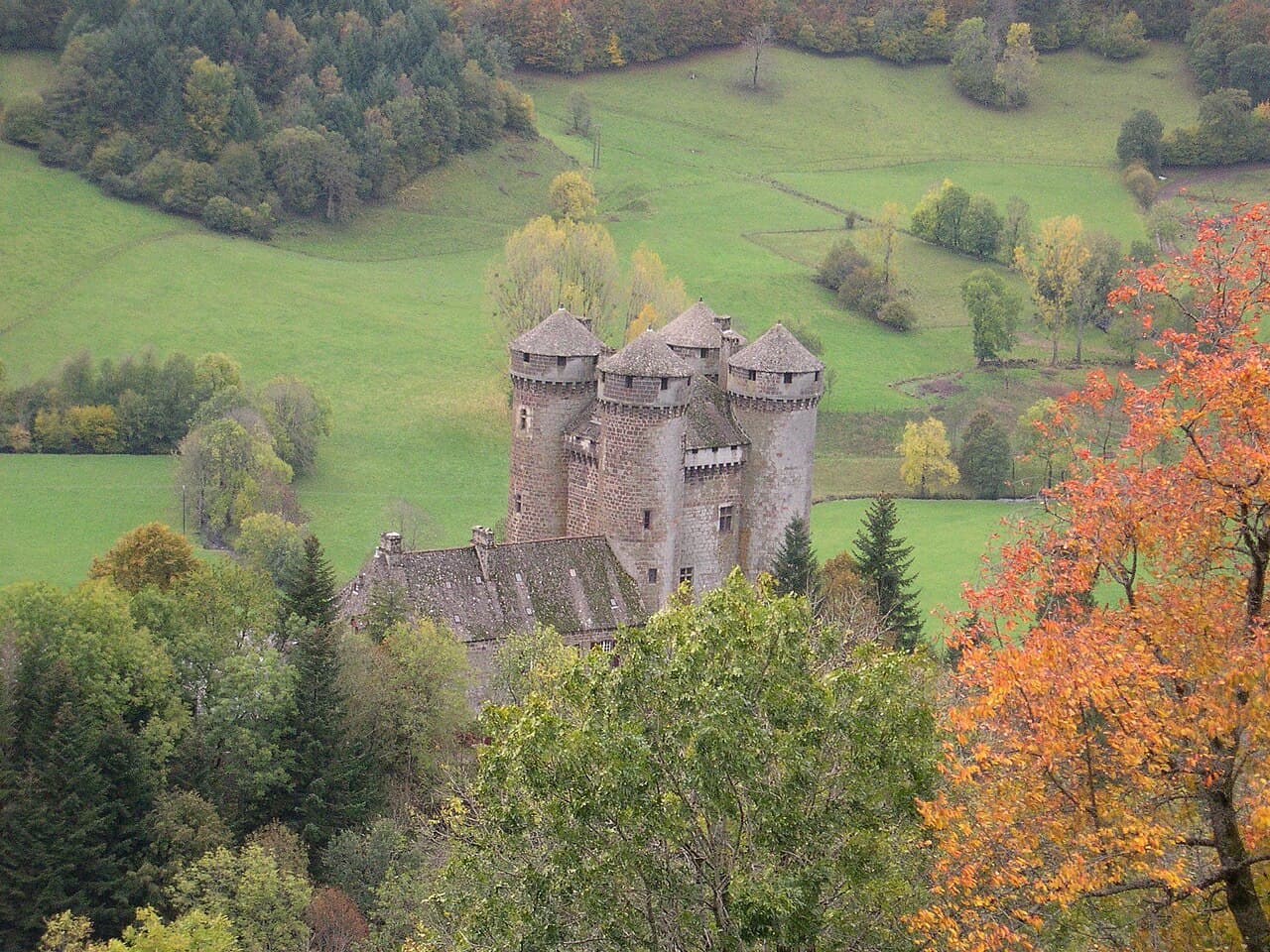
Anjony Castle
Anjony Castle, also known as Château d’Anjony, is a remarkable example of a well-preserved 15th-century fortress located near the village of Tournemire, in the Cantal department of France. Built primarily of dark volcanic basalt rock, the castle stands as a testament to medieval military architecture and noble lineage, having been constructed in the early 1400s by the noble Louis I d'Anjony, a supporter of Jeanne d'Arc and ally of King Charles VII. Its strategic position on a rocky outcrop overlooking the valley of the Doire river underscores its role as a defensive stronghold and symbol of territorial control during a turbulent period in French history.
The castle was erected during the late medieval period, specifically in the 15th century, amidst the backdrop of the Hundred Years' War and the subsequent consolidation of royal power. The Anjony family, originally from the Quercy region and ennobled in 1360, acquired the fief of Tournemire in 1351. The decision to build the castle without the consent of the neighboring Tournemire family ignited a fierce and prolonged rivalry that lasted nearly two centuries, marked by violent episodes including exhumations and fatal duels. This feud ultimately ended in the early 17th century through a strategic marriage alliance, uniting the two rival houses and stabilizing the region.
Architectural features and design
The castle’s design centers on a square keep or donjon, a hallmark of medieval fortifications, surrounded at each corner by massive round towers approximately 40 meters tall. These towers are capped with steep, conical roofs often described as pepperpot-shaped, enhancing both the castle’s defensive capabilities and its distinctive silhouette against the landscape. Constructed from durable basaltic lava stone, the fortress exhibits exceptional longevity and resistance to the elements, contributing to its restored condition today.
Encircling the upper walls is a machicolated chemin de ronde or wall-walk, featuring openings through which defenders could observe and repel attackers at the base of the walls. This defensive feature is characteristic of late medieval military architecture and reflects the castle’s primary function as a fortified residence and stronghold.
Unlike many contemporaneous castles, Anjony Castle was never subjected to siege or deliberate demolition, allowing it to retain much of its original exterior and structural integrity. Adjacent to the medieval fortress stand 18th-century residential wings built in the same volcanic stone, showcasing Louis XV style interiors with elegant parquet flooring, carved wood paneling, and grand fireplaces. These later additions reflect the evolving needs and tastes of the castle’s inhabitants over time.
Historical context and family legacy
The Anjony family’s prominence in the region was solidified through their loyalty to the French crown during the Hundred Years' War, contrasting with the opposing Tournemire family’s allegiance to the Plantagenets. This political and familial rivalry shaped much of the castle’s early history. Notable incidents include the 1523 desecration of a priest’s remains associated with the Anjony family by Jean de Tournemire, and a deadly duel in 1623 resulting in multiple fatalities on both sides. The feud’s resolution came with the marriage of Michel II d’Anjony to the Tournemire heiress around 1610, symbolizing reconciliation and the merging of estates.
Ownership transitioned through marriage to the Léotoing family in the 17th century, who expanded the castle with new wings in the 18th century to improve residential comfort. However, the upheavals of the French Revolution forced the family into exile, and the castle was confiscated and sold as national property in 1791. It was later restored to the family and passed by marriage to the Pellissier de Féligonde family in the 19th century, who undertook preservation efforts that continue to this day.
Notable historical figures
- Louis I d'Anjony: Builder of the castle and companion of Jeanne d’Arc.
- Charles VII of France: Monarch who authorized the castle’s construction.
- Michel I d'Anjony: Commissioned Renaissance frescoes in the great hall.
- Robert IV de Léotoing d'Anjony: Added an 18th-century wing to the castle.
- Prosper Mérimée: 19th-century historian who documented the castle.
Artistic and cultural significance
The castle houses exceptional Renaissance frescoes dating to circa 1575, depicting the Nine Worthies, a group of historical and legendary figures celebrated for their virtues. These frescoes were rediscovered in the early 20th century behind wood paneling and remain a highlight of the castle’s interior decoration. Unfortunately, the section illustrating Julius Caesar was lost due to later architectural modifications.
The private chapel located in one of the corner towers contains vivid 16th-century frescoes portraying scenes from the Passion of Christ, likely painted by itinerant Italian artists influenced by Renaissance religious art. The chapel also features a gilded Black Madonna statue, known as the "Dame d’Anjony," which holds religious and cultural importance for the family and local community.
Additional Renaissance paintings and historic furnishings complement the castle’s architectural features, providing insight into the cultural tastes and spiritual life of its noble occupants. These artistic treasures contribute to the castle’s designation as a heritage site and its appeal as a museum today.
Visitor experience and preservation
Today, Anjony Castle operates as a museum open to the public by guided tour only, allowing visitors to explore its rich history, architecture, and art in a carefully preserved setting. The castle’s restored condition offers a rare opportunity to witness a medieval fortress largely intact, including its defensive structures and elegant residential additions.
The surrounding landscape, with its dramatic volcanic rock formations and views over the Doire valley, enhances the visitor experience. The castle’s blend of military and residential architecture, combined with its storied family history and artistic heritage, makes it a highly recommended destination for those interested in medieval fortifications, French history, and Renaissance art.
Frequently asked questions (FAQ)
- How do I get to Anjony Castle?
- Anjony Castle is located in Tournemire, France, easily accessible by car or public transportation. If you're driving, you can find parking nearby. For public transport, check local bus schedules that connect to Tournemire from larger cities.
- What is the historical significance of Anjony Castle?
- Anjony Castle, built in the 15th century, is a remarkable example of medieval architecture and served as a stronghold for the powerful Mercœur family. It played a strategic role during various conflicts in the region, showcasing the rich history of the Auvergne area. Today, it stands as a testament to the feudal past of France.
- When was Anjony Castle built?
- Construction of Anjony Castle began in 1445 and was completed in 1480. It was commissioned by the nobleman Bernard de Languedoc, reflecting the architectural styles of the late medieval period. The castle has been well-preserved, allowing visitors to experience its historical grandeur.
- Can I visit Anjony Castle year-round?
- Yes, Anjony Castle is open to visitors throughout the year, though hours may vary by season. It is advisable to check the official website for specific opening times and any seasonal events. Guided tours are available, providing deeper insights into the castle’s history and architecture.
- Why is Anjony Castle considered an architectural gem?
- Anjony Castle is celebrated for its impressive defensive features, including tall towers and thick walls that exemplify medieval military architecture. The castle's elegant design and well-preserved interior showcase the artistry of the period, making it a must-see for architecture enthusiasts. Its stunning views of the surrounding landscape add to its appeal.
- Is it possible to take guided tours of Anjony Castle?
- Yes, guided tours are offered at Anjony Castle, providing a comprehensive understanding of its history and architecture. Knowledgeable guides lead visitors through the castle, sharing fascinating stories and insights. Tours are available in multiple languages, ensuring a rich experience for all visitors.
- What are the ticket prices for Anjony Castle?
- Ticket prices for Anjony Castle are generally modest, making it an affordable destination for visitors. Discounts may be available for students, seniors, and groups, so be sure to inquire at the ticket counter. It's recommended to check the official website for the most current pricing and any special promotions.
- What is the best time to visit Anjony Castle?
- The best time to visit Anjony Castle is during the spring and early autumn when the weather is pleasant and the surrounding landscape is vibrant. Summer can be quite busy with tourists, but the castle's charm remains intact year-round. Special events and activities often take place in these seasons, enhancing the visitor experience.
- Are there any nearby attractions to visit along with Anjony Castle?
- Yes, there are several attractions near Anjony Castle, including the picturesque village of Tournemire itself, which is classified as one of France's "Les Plus Beaux Villages." The nearby Salers and the stunning landscapes of the Cantal region offer additional opportunities for exploration and outdoor activities. Visitors can enjoy local cuisine and culture while discovering these charming surroundings.
Photo gallery

Photo by Béa•Public domain
Information
Website
Visit websiteSources & official resources
Verify the information above using these authoritative references.
Loading map...
Visitor reviews
No reviews yet. Been here? Write the first review and help other travelers!
Write the first reviewVisited this castle? Share your experience
Your review helps other travelers and adds first-hand knowledge to our encyclopedia.



