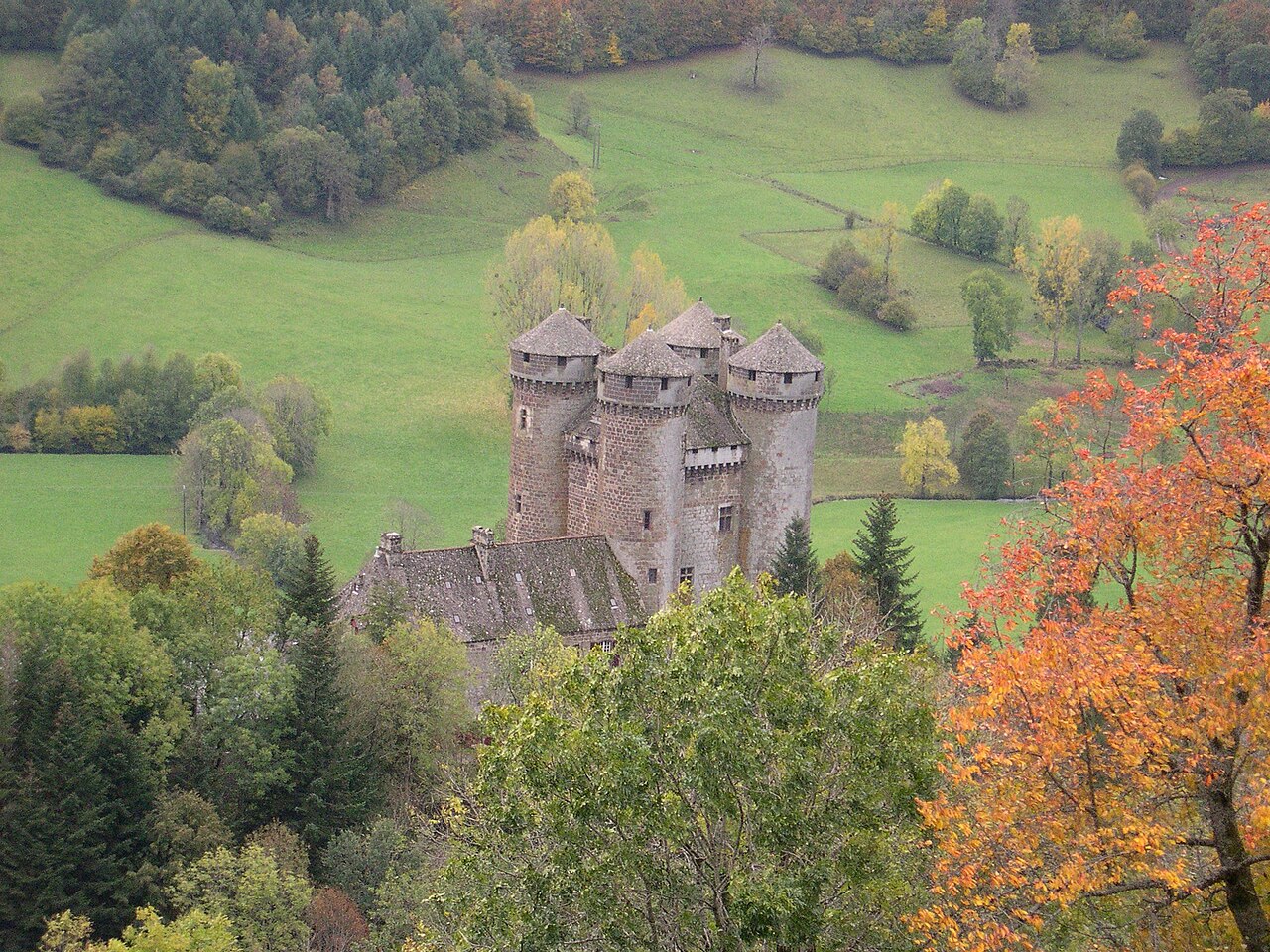
The Château de Saint-Chamant is a notable medieval hill castle located in the Hauts-de-France region of France. Its origins trace back to the 14th century, when the initial fortified donjon was constructed, serving as a defensive stronghold overlooking a valley with views of the Cantal mountains. This castle exemplifies the feudal architecture and social history of the region, having evolved through centuries of ownership and architectural transformation.
Early history and medieval origins
The earliest part of the château, the 14th-century donjon, was built primarily of local stone and served as the central defensive tower. This original structure includes a distinctive three-sided tower containing a staircase that provided access between floors. The northern round tower, once standing as part of the fortifications, has partially disappeared and now remains only in its foundations, having been integrated into later constructions.
The château entered a significant phase of ownership under Robert de Balzac, who gained control of the seigneurie of Saint-Chamant in 1473. Demonstrating both his social status and religious devotion, Robert founded a collegiate church in the area in 1484. His burial in this church upon his death in 1503 underscores the family's prominence. The Balzac family retained ownership of the estate until the late 16th century.
17th-century expansions and the Lignerac family
In 1589, the château passed to the Robert de Lignerac family, likely through marriage. François Robert de Lignerac, born in 1535 and a captain and royal guard, acquired the property around 1564. The Lignerac family, later elevated to the dukedom of Caylus, undertook major expansions during the 17th century, which significantly shaped the château's present form.
These expansions included the construction of a large corps de logis, the main residential block of the château, featuring timber paneling and a grand staircase. The interiors were richly decorated, including a notable collection of Aubusson tapestries and Flemish tapestries from the same century. The estate chapel was also enhanced with a 17th-century altarpiece, reflecting the family's continued religious patronage and artistic refinement.
Architectural features and layout
The château's layout is centered on the original fortified donjon, with the three-sided tower and remnants of the northern round tower. The 17th-century corps de logis extends from the donjon, creating a harmonious blend of medieval fortification and early modern residential architecture.
Additional structures include outbuildings arranged in two wings, mostly dating from the 17th century, surrounding courtyards, terraced gardens, an orchard, and a vegetable garden. These elements form a coherent historic ensemble that reflects the château's evolution as a noble residence and working estate.
A smaller corps de logis was added around 1820 using stones from the dismantled round tower, demonstrating practical reuse of materials. Further modifications include a front section added in 1905, showing the château's continued adaptation over centuries.
Ownership and preservation
After the Lignerac family sold the estate in 1783 due to financial difficulties, the château came under the stewardship of the Couderc family. François Couderc, active in the 19th century as a receiver-general of the Cantal department and a member of regional Masonic lodges, played a significant role in local society and the château's preservation.
The château remains privately owned by the Couderc family, who have maintained its historic character. Its architectural and historic significance has been recognized through official historic monument protection, covering the château, its grounds, and ancillary buildings.
Cultural and historical significance
The Château de Saint-Chamant is an important example of a hill castle that evolved from a medieval fortress into a noble residence with significant 17th-century enhancements. Its combination of defensive features, such as the donjon and towers, with refined residential elements like the corps de logis and richly decorated interiors, illustrates the architectural and social changes in French aristocratic life from the Middle Ages through the early modern period.
The presence of Aubusson and Flemish tapestries highlights the château's cultural connections and wealth, while the preserved chapel altarpiece reflects the religious devotion of its owners. The terraced gardens and agricultural grounds surrounding the château contribute to its historic landscape setting.
Frequently asked questions (FAQ)
- How do I get to Château de Saint-Chamant?
- Château de Saint-Chamant is located in the Auvergne region of France, easily accessible by car. The nearest major city is Aurillac, which is about 30 kilometers away. Public transportation options are limited, so driving is recommended for the most convenient visit.
- What is the historical significance of Château de Saint-Chamant?
- Château de Saint-Chamant dates back to the 15th century and has played a pivotal role in the region's history. It was originally built as a defensive fortress and has witnessed various historical events, including local conflicts and noble gatherings. Today, it stands as a testament to the architectural styles of the period.
- When was Château de Saint-Chamant built?
- The construction of Château de Saint-Chamant began in the late 15th century, with its completion occurring in the early 16th century. The castle showcases a blend of medieval and Renaissance architectural styles, reflecting the evolution of design during that era. Its rich history can be explored through its well-preserved structures.
- Can I visit Château de Saint-Chamant year-round?
- Yes, Château de Saint-Chamant is open for visitors throughout the year, although the best time to visit is from spring to early autumn. During the warmer months, the gardens and surrounding landscapes are particularly beautiful. It's advisable to check the official website for any seasonal events or maintenance closures.
- Why is Château de Saint-Chamant considered an architectural gem?
- Château de Saint-Chamant is renowned for its unique architectural features, including its imposing towers and intricate stonework. The castle's design reflects the transition from medieval fortified structures to more elegant Renaissance aesthetics. Visitors can appreciate its stunning facades and the craftsmanship of the period.
- Is it possible to take a guided tour of Château de Saint-Chamant?
- Yes, guided tours are available at Château de Saint-Chamant, offering visitors an in-depth understanding of its history and architecture. Tours typically include access to various rooms and explanations about the castle's significance. It is recommended to book in advance, especially during peak tourist seasons.
- What are the opening hours for Château de Saint-Chamant?
- Château de Saint-Chamant generally opens its doors from 10 AM to 6 PM, with extended hours during the summer months. However, it’s best to check the official website for the most current information, as hours can vary depending on the season or special events. Arriving early can help you avoid crowds and enjoy a more leisurely visit.
- What are the ticket prices for visiting Château de Saint-Chamant?
- Ticket prices for Château de Saint-Chamant are quite reasonable, typically ranging from €8 to €12 for adults, with discounts available for students and seniors. Children under a certain age often enter for free. It's advisable to purchase tickets online in advance to secure your visit and avoid long queues.
- Are there any nearby attractions to visit while at Château de Saint-Chamant?
- Yes, visitors to Château de Saint-Chamant can explore several nearby attractions, including the picturesque village of Salers and the stunning landscapes of the Volcans d'Auvergne Regional Park. These locations offer excellent hiking opportunities, local cuisine, and charming shops. Combining these visits can create a delightful day trip in the Auvergne region.
Information
Website
Visit websiteSources & official resources
Verify the information above using these authoritative references.
Loading map...
Visitor reviews
No reviews yet. Been here? Write the first review and help other travelers!
Write the first reviewVisited this castle? Share your experience
Your review helps other travelers and adds first-hand knowledge to our encyclopedia.