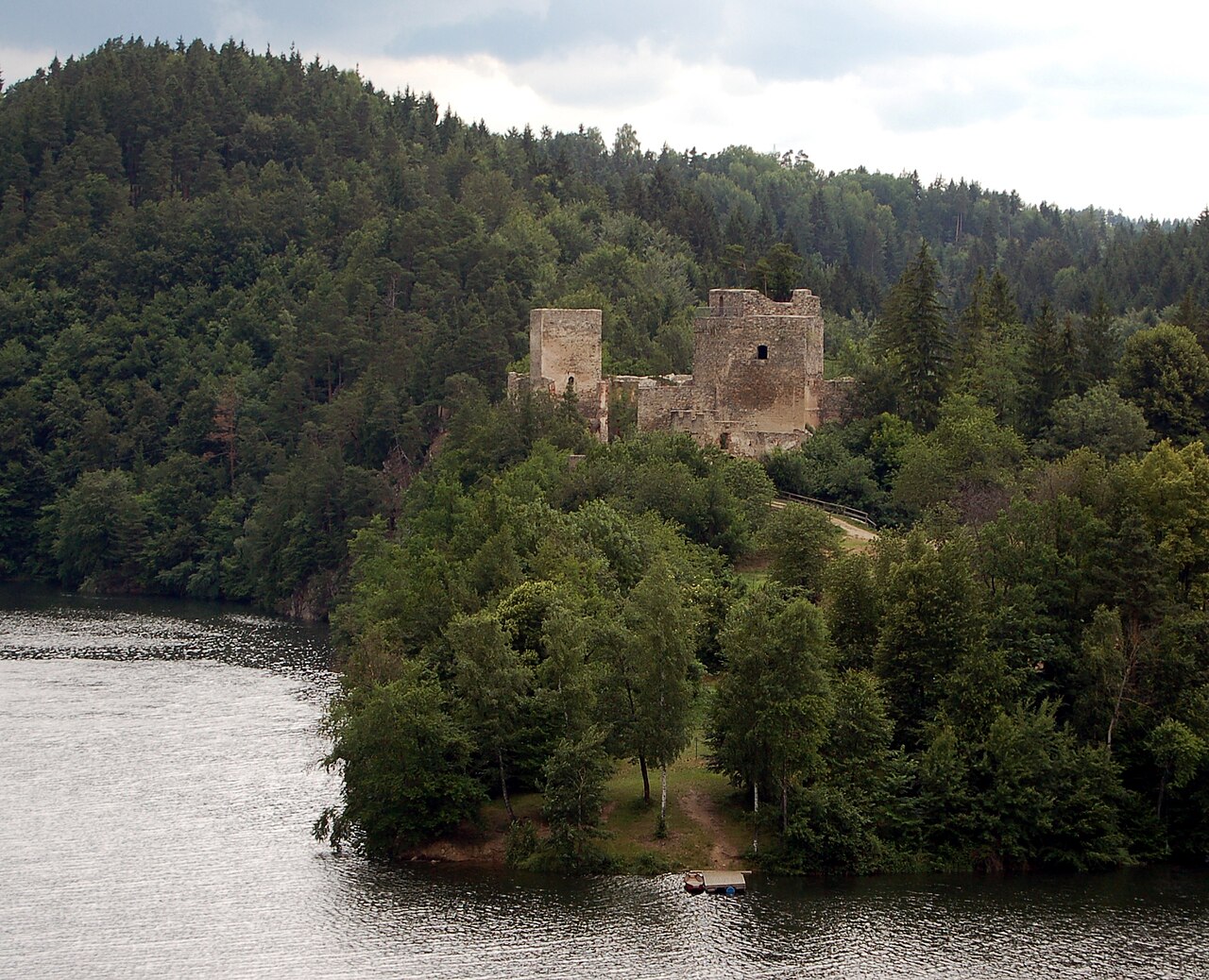
Allentsteig Castle
Allentsteig Castle stands prominently on a rocky outcrop north of the town of Allentsteig in Austria. Founded around 1000 AD by the noble Kuenringer family, this castle has witnessed over a millennium of European history, evolving architecturally and politically through the High Medieval period into the Renaissance era and beyond. Its strategic position, bordered by a former moat to the east, underscores its original defensive purpose and enduring military significance.
The castle’s origins as a hill castle reflect the medieval preference for elevated sites offering natural defense advantages. Over the centuries, it passed through the hands of several aristocratic families, each leaving architectural and historical imprints. The Lords of Kamegg-Kaya held it until about 1390, after which the estate changed ownership multiple times, including the Maissau, Hager, Sonderndorf, Rappach, and eventually the Liechtenstein families, illustrating the complex feudal and political landscape of Austria through the Middle Ages and Early Modern period.
Medieval origins and early history
The castle’s foundation by the Kuenringers around 1000 AD places it among the earlier fortifications in the region. The Kuenring family was influential in the development of Lower Austria’s noble structure, and their establishment of Allentsteig Castle served both as a defensive stronghold and a symbol of territorial control.
Throughout the 14th century, the castle’s ownership reflected shifting alliances and feudal disputes. Notably, in 1332, Eberhard V. von Walsee briefly held the castle before it reverted to the Kuenring family in 1367. The Maissau family acquired it in 1380, with Otto IV Maissau leasing it to Hans Hager in 1409. The castle’s status as a landfief after Otto’s fall from grace in treason accusations highlights the volatile nature of medieval noble estates.
Military significance in the late medieval period
In 1486, the castle’s strategic importance was underscored when the mercenary leader Spanowsky seized it on behalf of King Matthias Corvinus of Hungary during the regional conflicts that shaped Central Europe. This event demonstrates Allentsteig’s role not just as a noble residence but as a military asset contested by powerful rulers.
Renaissance transformation and religious influence
Between 1544 and 1570, the castle underwent a significant architectural transformation under the ownership of the Hager family, who converted the medieval fortress into a Renaissance palace. This period introduced characteristic Renaissance features such as symmetrical layouts, arcaded courtyards, and classical column styles, marking a shift from purely defensive architecture to a residence emphasizing status and comfort.
The Hagers were notable Protestants, with Sigmund Hager maintaining correspondence with Martin Luther in Wittenberg. This religious affiliation placed the castle at the crossroads of the Reformation’s cultural and political upheavals. During the Thirty Years' War, the castle suffered plundering and occupation due to the Hagers’ opposition to imperial Catholic forces, reflecting the broader sectarian conflicts of the era.
Architectural features from the renaissance period
The castle’s five-sided Renaissance structure retains much of its medieval outer walls, integrating them with new elements. The massive bergfried (keep), dating from the late 12th century, remains a dominant feature, notable for its Romanesque portal and precisely cut ashlar masonry in the adjacent eastern wall.
Added in 1904, the turreted top floor with a tent roof crowns the keep, blending historic medieval forms with early 20th-century architectural additions. The main entrance is through a two-story gate hall from the 16th century, distinguished by a wide bay window (oriel) above a rusticated Renaissance portal. The inner gate wall, dating from around 1300, features a Gothic pointed arch from the early 14th century, illustrating the layering of architectural styles over time.
The castle’s windows on the outer front bear profiled stone frames characteristic of the late 16th and early 17th centuries. At the heart of the complex lies a three-story rectangular arcade courtyard dated 1576, with flat arches supported by Tuscan columns on three sides, reflecting Renaissance classicism inspired by Roman architectural orders.
Later history and modern use
The castle endured further trials in the Early Modern period, including damaging fires in 1682 and 1752 that necessitated repairs and partial restorations. Ownership shifted multiple times, passing to the Rappach family, Count Ernst August von Falkenhayn by marriage, and later to Baron Leopold von Hahn in 1804, followed by the Pereira-Arnstein family and the Princes of Liechtenstein.
In 1918, the estate was inherited by Baroness Maria von Preuschen. The castle’s military significance was renewed in the 20th century when the German Reich established the Allentsteig military training area in 1938, repurposing the castle as the command center. This role continued through the Soviet occupation after World War II (1945–1955) and remains under Austrian administration today, housing the command of the training area and the 4th Reconnaissance and Artillery Battalion.
Interior and preservation
The castle’s interior was largely remodeled in the late 19th century, incorporating historicist tile stoves and other period features that reflect a revivalist interest in historical styles. Despite these modifications, many original architectural elements survive, offering insight into the castle’s layered history.
Today, Allentsteig Castle exemplifies a successful blend of medieval fortification and Renaissance residential architecture, preserved through centuries of conflict, ownership changes, and adaptation to modern military use. Its continued function as a military command center underscores the enduring strategic value of this historic site.
Architectural significance and heritage value
Allentsteig Castle is an important example of a hill castle that evolved from a medieval stronghold into a Renaissance palace, illustrating broader architectural trends in Central Europe. The integration of Romanesque, Gothic, and Renaissance elements within its fabric provides a tangible narrative of changing styles and functions over nearly a millennium.
The castle’s preservation of its massive bergfried with a Romanesque portal, alongside Renaissance arcades and Tuscan columns, offers valuable insight into the transition from fortified medieval castles to more comfortable and stylistically refined noble residences. The layering of architectural features, including the 16th-century gatehouse and the 14th-century Gothic arch, exemplifies how castles were adapted to meet evolving defensive and domestic needs.
As a heritage site still in active use, Allentsteig Castle bridges historical legacy with contemporary relevance, making it a significant cultural landmark in Lower Austria.
Information
Loading map...
Visitor reviews
No reviews yet. Been here? Write the first review and help other travelers!
Write the first reviewVisited this castle? Share your experience
Your review helps other travelers and adds first-hand knowledge to our encyclopedia.