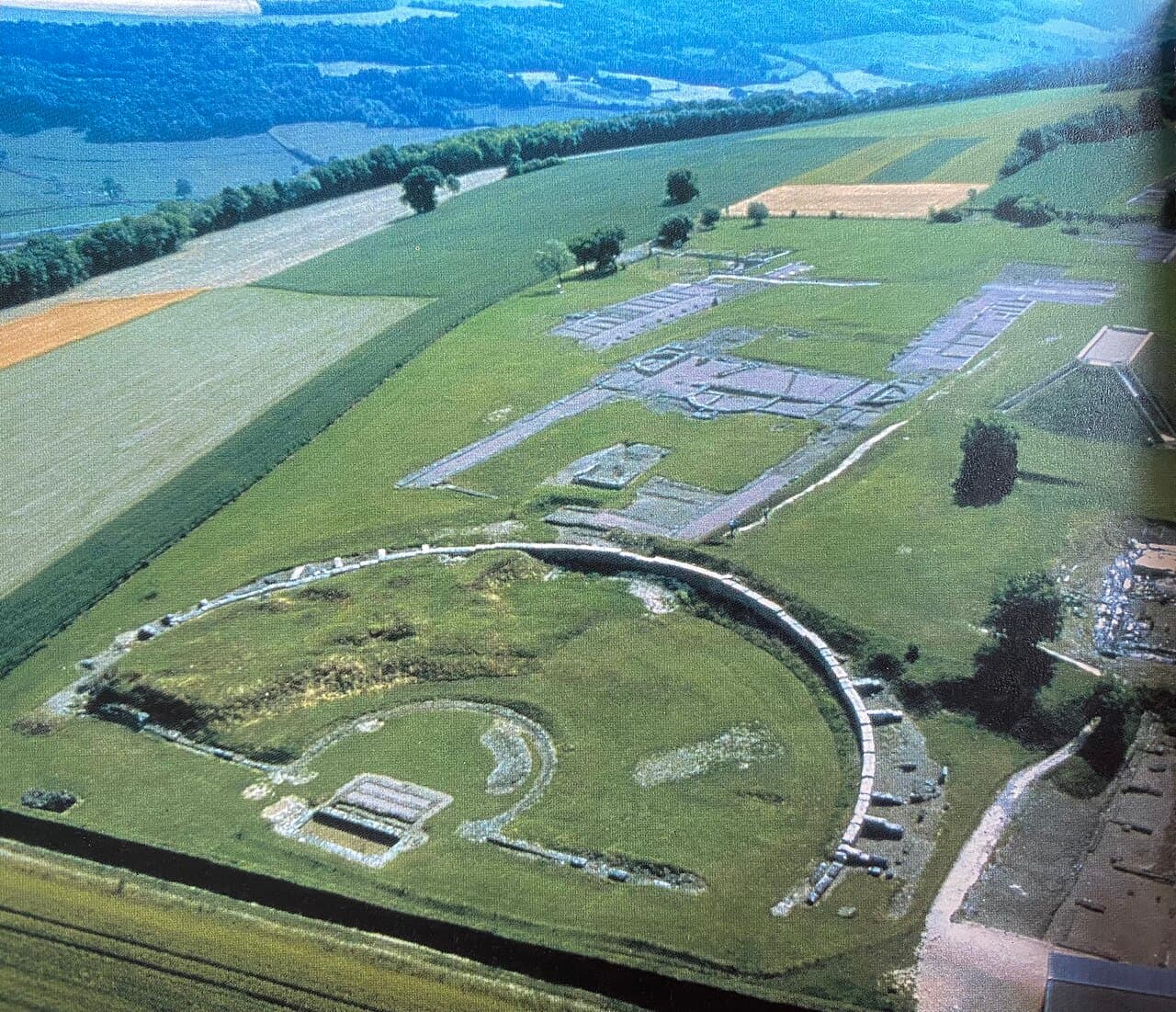
Alesia
Alesia was the capital of the Mandubii, a Gallic tribe allied with the Aedui. This ancient settlement functioned as a Celtic oppidum—a fortified hilltop town—before becoming a significant site during the Gallic Wars. The oppidum was famously besieged and conquered by Julius Caesar in 52 BCE, a decisive event that marked the Roman conquest of Gaul and the decline of Gallic independence.
For centuries, the exact location of Alesia was debated among historians and archaeologists. Modern scholarship and archaeological excavations have largely confirmed that Alesia was situated on Mont-Auxois, near the village of Alise-Sainte-Reine in the Burgundy region of eastern France. This site is characterized by its commanding vantage point over the surrounding landscape, typical of hill castles or hillforts designed for defense and control.
Historical significance of Alesia
The siege of Alesia in 52 BCE is among the most famous military engagements of the ancient world. The Roman forces, led by Julius Caesar, faced a large Gallic army under the leadership of Vercingetorix, the chieftain of the Arverni tribe. The Romans constructed extensive fortifications around the hillfort, including double lines of walls and ditches, to encircle and isolate the defenders. This siege engineering feat demonstrated advanced Roman military tactics and engineering skills, ultimately forcing the Gallic surrender.
Following the conquest, Alesia transitioned from a purely military stronghold to a Gallo-Roman town. The settlement adopted Roman urban features such as organized streets, public buildings, and baths, reflecting the integration of Gallic peoples into the Roman Empire. Although the town declined in later centuries, its archaeological remains provide valuable insight into the cultural and military history of the region.
Archaeological discoveries and site features
Extensive excavations at Mont-Auxois have uncovered remnants of the fortification walls, trenches, and other defensive structures attributed to Caesar's siege works. Archaeologists have also identified evidence of Roman camps and siege lines, which illustrate the scale and complexity of the military operations conducted during the siege.
The oppidum itself shows typical characteristics of a hill castle or hillfort, with steep slopes enhancing its natural defenses. The strategic location allowed control over key routes and the surrounding territory, which was crucial for both the Mandubii tribe and later Roman authorities.
Fortifications and layout
The fortifications consisted of multiple layers of earthworks and palisades, designed to withstand assaults and sieges. The Romans augmented these defenses with their own siege works, including circumvallation and contravallation lines—fortified walls encircling both the town and the Roman camps. These features are among the best-preserved examples of Roman siege engineering.
Legacy and cultural importance
Alesia holds a prominent place in both French national history and the study of ancient military tactics. The site symbolizes the transition from Gallic independence to Roman rule and is commemorated by monuments and a museum near Alise-Sainte-Reine. The archaeological park offers visitors a chance to explore the remains and learn about the historical context of the siege and the broader Gallic Wars.
Today, Alesia is recognized as a key heritage site in Burgundy, attracting historians, archaeologists, and tourists interested in ancient history and Roman military architecture. The site's preservation and interpretation contribute to understanding the complex interactions between Roman and Gallic cultures during a transformative period in European history.
Frequently asked questions (FAQ)
- Where is Alesia located?
- Alesia is located on Mont-Auxois near the village of Alise-Sainte-Reine in the Burgundy region of France.
- What was the historical importance of Alesia?
- Alesia was the site of a decisive siege in 52 BCE where Julius Caesar defeated the Gallic chieftain Vercingetorix, marking the Roman conquest of Gaul.
- Can visitors see the remains of the Roman siege works at Alesia?
- Yes, archaeological excavations have uncovered fortification walls, trenches, and siege lines that visitors can explore at the site.
- Is there a museum or visitor center at Alesia?
- Yes, there is a museum near Alise-Sainte-Reine that provides historical context and exhibits related to the siege and the ancient town.
- What type of castle is Alesia?
- Alesia is classified as a hill castle, built on a naturally defensible hilltop known as an oppidum.
Photo gallery

Information
Current owner
French government
Loading map...
Visitor reviews
No reviews yet. Been here? Write the first review and help other travelers!
Write the first reviewVisited this castle? Share your experience
Your review helps other travelers and adds first-hand knowledge to our encyclopedia.


