Alcazaba of Mérida
The Alcazaba of Mérida stands as a monumental testament to the city's rich historical tapestry, blending Islamic military architecture with later Christian modifications. Located in Mérida, Spain, this fortress was originally constructed in 835 AD under the rule of Emir Abd al-Rahman II of Córdoba during the early medieval period. Its primary purpose was to establish and maintain Muslim control over the strategically important urban center of Mérida, which had experienced resistance to emirate authority since 805 AD.
The fortress's design reflects the typical characteristics of an early Islamic alcazaba, a fortified enclosure meant to serve both defensive and administrative functions. The alcazarejo, a fortified inner enclosure, separated the military garrison from the civilian population, effectively regulating access and movement within the city. This separation was crucial for maintaining order and control during a period marked by political unrest and military threats.
Historical context and transformations
The Alcazaba was built atop a site with a long history of occupation, including significant Roman and Visigothic remains. Archaeological excavations have uncovered urban structures and fortifications from these earlier periods beneath the fortress, underscoring Mérida's enduring strategic importance through successive civilizations.
Following the Christian reconquest of Mérida in 1230, the fortress underwent significant functional and architectural changes. The Knights of the Order of Santiago established their command post within the northern section, marking the Alcazaba's transition from a purely military fortress to a center of religious and administrative power. Between 1563 and 1600, parts of the complex were adapted to house the Priory of San Marcos of León, introducing religious buildings such as a church and a cloister. The cloister is notable for its double gallery of semicircular arches supported by columns, a distinctive architectural feature that reflects Renaissance influences and the site's evolving role.
In the late 20th century, the Alcazaba was restored and repurposed as the headquarters for the Presidency of the Junta of Extremadura, demonstrating its continued civic significance in modern times.
Architectural features and fortifications
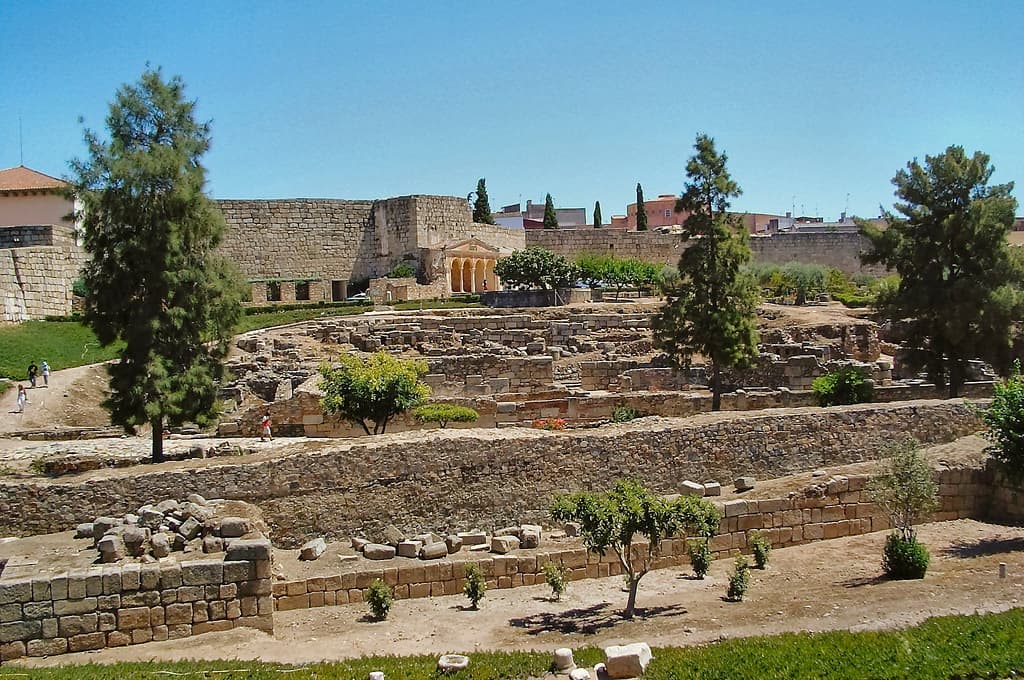
The fortress is constructed as a near-square enclosure approximately 130 meters on each side, with a total wall length of about 550 meters. The fortification walls rise to roughly 10 meters in height and have a thickness of around 2.7 meters. Built primarily from large granite blocks, many of which were recycled from Roman and Visigothic buildings, the walls feature a core of earth, stones, and mortar, combining traditional construction methods with material reuse.
Each corner of the main enclosure was originally fortified with four substantial square towers, supplemented by two large towers within the alcazarejo controlling access between military and civilian areas. Along the curtain walls, twenty-two smaller square towers are spaced regularly, some dating to the Christian period, highlighting architectural adaptations after the reconquest.
A remarkable feature within the fortress is the subterranean cistern (aljibe), designed to store water drawn from the nearby Guadiana River. Accessed via a double staircase descending from an adjacent tower, this cistern ensured the fortress's self-sufficiency during sieges, a critical aspect of medieval military architecture.
Decorative and reused elements
The fortress incorporates numerous decorative elements and building materials repurposed from earlier periods. Among these are Visigothic pilasters adorned with relief carvings of columns and circular plant motifs featuring bunches and palmettes. These elements illustrate the cultural continuity and layering of influences that characterize the Alcazaba's fabric.
The main entrance is framed by two towers and features a distinctive horseshoe-shaped arch bearing an original inscription from the fortress's foundation. This arch exemplifies the artistic and architectural style of the early Islamic period on the Iberian Peninsula.
Embedded within the walls are numerous granite funerary blocks known as cupae and Visigothic stones, particularly near the area associated with the Order of Santiago. Some inscriptions reference a Visigothic church dedicated to Santa María near the water cistern, supported by historical documents from the Knights of Santiago.
Later additions and stylistic influences
Later architectural additions include a 19th-century pergola and a neo-Gothic portico, both incorporating Visigothic columns reused from earlier structures. These elements demonstrate the ongoing transformation and reuse of materials across centuries, blending medieval military architecture with religious and stylistic influences from subsequent periods.
Cultural and historical significance
The Alcazaba of Mérida is a rare example of a fortress that encapsulates the complex history of the Iberian Peninsula, showcasing layers of Roman, Visigothic, Islamic, and Christian heritage. Its architecture reflects the military, religious, and administrative functions it has served over more than a millennium.
Today, the Alcazaba remains a well-preserved monument that offers valuable insights into medieval fortification techniques and the cultural syncretism that shaped Spain's historical landscape. It continues to be a focal point for archaeological study and a symbol of Mérida's enduring historical importance.
Frequently asked questions (FAQ)
- When was the Alcazaba of Mérida built?
- The Alcazaba of Mérida was constructed beginning in 835 AD under Emir Abd al-Rahman II of Córdoba during the early medieval period.
- What architectural styles are visible in the Alcazaba of Mérida?
- The fortress exhibits a mix of architectural styles including early Islamic military architecture, Visigothic decorative elements, and later Christian Renaissance and neo-Gothic additions.
- Can visitors explore the interior of the Alcazaba?
- Yes, the Alcazaba of Mérida is well-preserved and open to visitors, allowing exploration of its towers, walls, cistern, and cloisters.
- What is the significance of the subterranean cistern in the Alcazaba?
- The subterranean cistern, or aljibe, was crucial for storing filtered water from the Guadiana River, ensuring the fortress's self-sufficiency during sieges.
- How did the Christian reconquest affect the Alcazaba?
- After the Christian reconquest in 1230, the fortress was adapted to serve as a residence and command post for the Knights of the Order of Santiago, and later housed religious buildings including a church and cloister.
Photo gallery

Information
Website
Visit websiteSources & official resources
Verify the information above using these authoritative references.
Loading map...
Visitor reviews
No reviews yet. Been here? Write the first review and help other travelers!
Write the first reviewVisited this castle? Share your experience
Your review helps other travelers and adds first-hand knowledge to our encyclopedia.