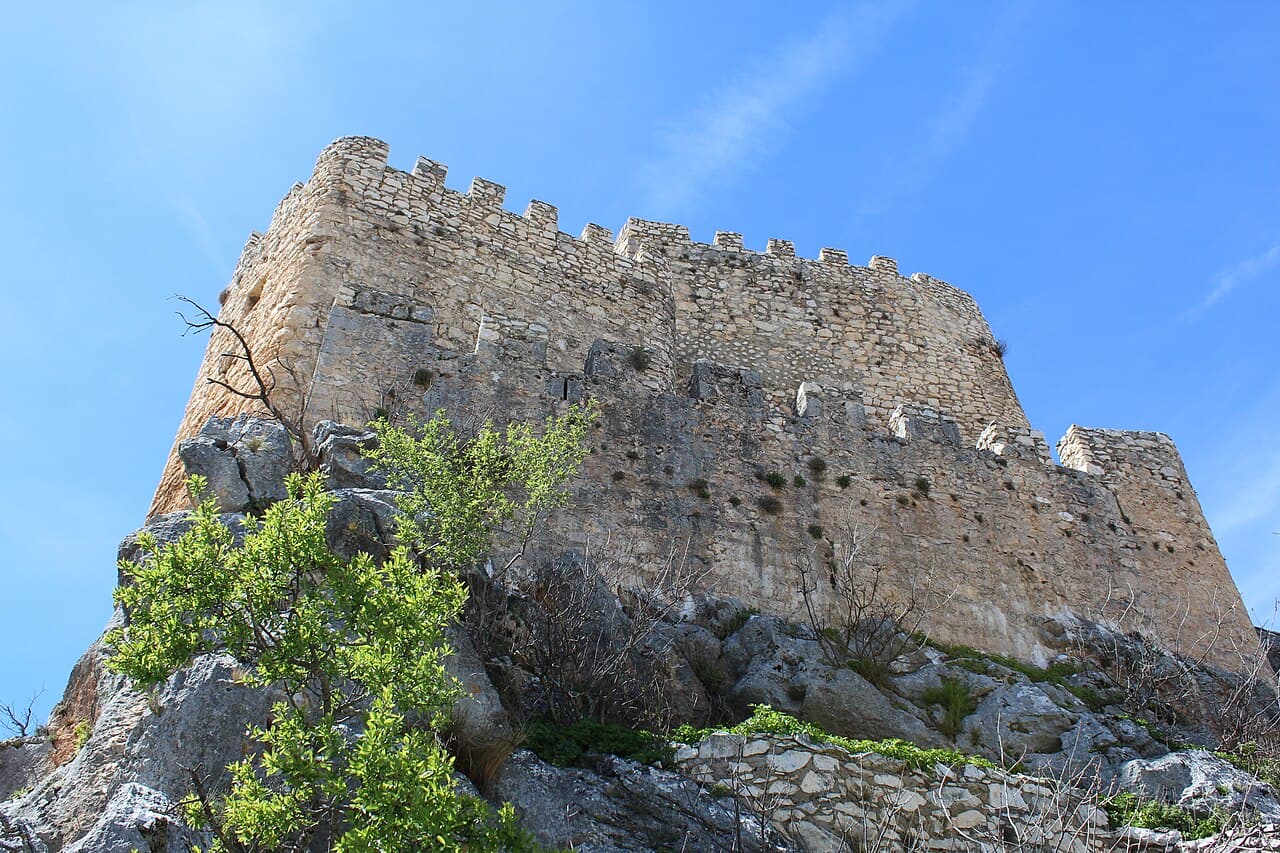
Albanchez de Mágina Castle
Albanchez de Mágina Castle is a notable hill castle perched on the first crag of the Sierra de los Castillejos Mountains in the town of Albanchez de Mágina, located in the Province of Jaén, Spain. This medieval fortress commands a strategic position at an elevation of approximately 950 meters (3,120 feet) on the eastern slope of La Serrezuela, overlooking a vast valley below. Its commanding location provided natural defensive advantages and control over the surrounding rugged terrain, a common feature for castles built during the Late Medieval period.
The castle's origins are believed to be Christian, constructed likely at the beginning of the 14th century as a response to the nearby Moorish castle, of which only scant remains survive today. This reflects the shifting power dynamics during the Reconquista, when Christian forces sought to consolidate control over territories previously held by Muslim rulers. Albanchez de Mágina Castle was commissioned by the influential noble families of Bedmar and Albanchez and was closely associated with the Order of Saint James (Orden de Santiago), a military and religious order active in the defense and administration of frontier lands in medieval Spain.
Architectural features and construction techniques
The castle exhibits a combination of construction materials and techniques characteristic of its era and location. The lower parts of the fortress, those nearest the town, were built using rammed earth (tapial), a traditional method involving compacted soil stabilized with lime or other binders. This technique was common in southern Spain due to the availability of materials and the expediency it afforded in construction.
Above this, the more defensible sections, including the alcazarejo (the small inner citadel or keep), were constructed in masonry, providing greater durability and resistance to siege weaponry. The alcazarejo comprises two small groups of buildings or towers that present an imposing silhouette from the exterior, enhanced by the walls perched on the crag. These structures were not designed to accommodate large garrisons or extensive armaments but rather served as a stronghold for local defense and control.
Defensive elements
The castle originally featured a small triangular parade ground surrounded by a crenellated parapet and equipped with arrow-slit windows for archers. This design allowed defenders to cover multiple angles while providing protection from incoming projectiles. Adjacent to this was a square terrace with a wall tower positioned to defend the precipitous drop below, a critical point of vulnerability.
Surrounding the castle were protective walls, now largely destroyed, which once enclosed the site and added layers of defense. The exterior corners of the fortress were rounded, a feature typical of castles associated with the Order of Calatrava, another prominent military order in medieval Spain. These rounded corners helped deflect projectiles and reduced blind spots for defenders.
Historical context and significance
Albanchez de Mágina Castle played a role in the complex military and political landscape of medieval Spain, particularly during the Reconquista, when Christian kingdoms sought to reclaim territory from Muslim rule. The castle's position in the rugged terrain of the Sierra de los Castillejos provided a valuable vantage point for monitoring movements and securing the region.
The castle's association with the Order of Saint James highlights its strategic importance within the network of fortifications managed by military orders tasked with defending frontier zones and supporting Christian expansion. These orders combined religious zeal with military discipline, often constructing castles that served both as fortresses and administrative centers.
Relation to nearby fortifications
Albanchez de Mágina Castle was constructed as an alternative to a nearby Moorish castle whose remains are now minimal. This replacement reflects the transition of power and architectural styles from Islamic to Christian control in the region. The castle's design and construction techniques also illustrate the adaptation of military architecture to local conditions and resources.
Preservation and current condition
Today, Albanchez de Mágina Castle is recognized as a Bien de Interés Cultural landmark, a designation that protects its historical and cultural value in Spain. While much of the castle's protective walls have been lost over time, significant portions of the alcazarejo and the main structural elements remain visible.
The castle's partially preserved state allows visitors to appreciate its medieval military architecture and its commanding setting amidst the rugged landscape. Efforts to maintain and study the site contribute to understanding the region's medieval history and the role of military orders in shaping Spain's frontier territories.
Visiting Albanchez de Mágina Castle
Visitors to the castle can explore the remains of the fortress and enjoy panoramic views of the surrounding valley and mountains. The site's elevated position offers insight into the strategic considerations of medieval fortification builders. While facilities may be limited due to the castle's remote and rugged location, the site attracts those interested in medieval history, military architecture, and natural scenery.
The castle is accessible from the town of Albanchez de Mágina, which provides a starting point for hikes or drives to the site. Its status as a cultural landmark ensures ongoing preservation efforts and public interest in its historical significance.
Frequently asked questions (FAQ)
- What is the best time to visit Albanchez de Mágina Castle?
- The best time to visit Albanchez de Mágina Castle is during the spring and autumn months when the weather is mild and the natural surroundings are particularly scenic. Summer can be hot, and winter may bring colder temperatures, so plan accordingly.
- Is Albanchez de Mágina Castle accessible to visitors year-round?
- Yes, Albanchez de Mágina Castle is generally accessible throughout the year, although weather conditions may affect access during winter months. Visitors should check local information before planning their trip.
- Can I explore the interior of Albanchez de Mágina Castle?
- Visitors can explore the remains of the castle's main structures, including the alcazarejo and parts of the defensive walls. However, some areas may be restricted for safety reasons due to the castle's partially preserved condition.
- Are there guided tours available at Albanchez de Mágina Castle?
- Guided tours may be available through local tourism offices or cultural heritage organizations, providing detailed historical and architectural insights. It is advisable to inquire locally for current tour options.
- What architectural styles are evident in Albanchez de Mágina Castle?
- The castle features elements typical of <strong>Late Medieval military architecture</strong> with construction techniques such as <strong>rammed earth</strong> and <strong>masonry</strong>. Rounded corners and crenellated parapets reflect influences from the <strong>Order of Calatrava</strong> and the <strong>Order of Saint James</strong>.
Photo gallery

Information
Current owner
State museum
Loading map...
Visitor reviews
No reviews yet. Been here? Write the first review and help other travelers!
Write the first reviewVisited this castle? Share your experience
Your review helps other travelers and adds first-hand knowledge to our encyclopedia.


