Aigle Castle
Aigle Castle stands prominently in the town of Aigle, nestled within the picturesque Vaud region of Switzerland. This hill castle dates back to the high medieval period, specifically the 13th century, and has evolved through centuries of strategic military and administrative use. Today, it is celebrated not only as an exceptional example of medieval fortification but also as a cultural hub dedicated to the region's rich viticultural heritage.
The castle's origins trace to the late 12th century when the Barons of Aigle first established a small fortification to oversee vital mountain passes such as the Col du Pillon and Col des Mosses. These passes were crucial routes through the Rhone Valley, making the site strategically significant for controlling trade and military movements. The earliest structures included two large towers, one dating to the 12th century, which formed the core of the initial defensive complex.
Medieval expansion and savoyard influence
By the early 13th century, the powerful House of Savoy had acquired rights over Aigle, incorporating it into their expanding domain that bridged present-day Italy and Switzerland. Count Thomas of Savoy played a pivotal role in this transition, granting the castle as a fief in 1232 to the brothers Jacob and Peter of Saillon. This family was closely connected to the original barons and undertook significant rebuilding efforts, including the construction of a fortified donjon and imposing curtain walls.
The late 13th century also saw the granting of a city charter to Aigle, reflecting its growing importance as a settlement and defensive stronghold. The castle's fortifications were enhanced to protect the burgeoning town and secure the trade routes linking the fairs of Turin and Lyon via the Mont Cenis Pass and later the Great St. Bernard Pass. This network underscored the castle's role in controlling alpine crossings and facilitating commerce between northern and southern Europe.
Lords of compey and architectural developments
In the 14th century, the Lords of Compey inherited the castle and transformed it into their principal residence. Their tenure marked a period of architectural refinement, including the addition of turrets and a massive square tower built around 1450 at the castle's southern corner. This tower exemplifies the late French donjon architectural style, characterized by its robust rectangular form designed to serve both defensive and residential purposes.
The castle's military significance was tested during the Burgundian Wars (1474–1477). The conflict pitted the Swiss Confederation against Duke Charles the Bold of Burgundy, with the House of Savoy siding with Burgundy. In 1475, Bernese forces attacked and devastated Aigle Castle, ending Savoyard control and forcing the Compey family into exile. Following the war, Bern undertook a comprehensive reconstruction in 1488, reinforcing the castle as a provincial administrative center.
Bernese administration and later uses
Under Bernese rule, Aigle Castle became the seat of a provincial governor and the administrative heart of one of Bern's first French-speaking districts. The castle functioned as a government center until the upheavals of the French invasion in 1798, which led to the establishment of the Helvetic Republic and the end of Bernese dominance.
In the 19th century, the castle adapted to various civic roles, including serving as a court and prison. The prison cells, known as casemates, bear inscriptions from former inmates, providing a poignant glimpse into this chapter of the castle's history. The castle also functioned as a hospital until 1832 and offered refuge to the poor during difficult times.
Restoration and cultural significance
Restoration efforts commenced in the 1970s to preserve the castle's structural integrity and historical features. Since 1975, the castle has housed the Musée de la Vigne et du Vin (Vine and Wine Museum), celebrating the region's long-standing tradition of viticulture. The museum's exhibits include large wooden wine presses, an oak-barrel-lined wine cellar, and displays of historical wine-making tools and bottles. Interactive exhibits educate visitors on the process of transforming grapes into wine.
Adjacent to the castle gates stands the Maison de la Dîme, a historic tithe barn dating from 1587. This building now hosts the Musée de l’Étiquette (Wine-Labels Museum), which features nearly 800 wine labels from 52 countries spanning almost two centuries. Since 2009, it has also served as a venue for art exhibitions.
Architectural features and layout
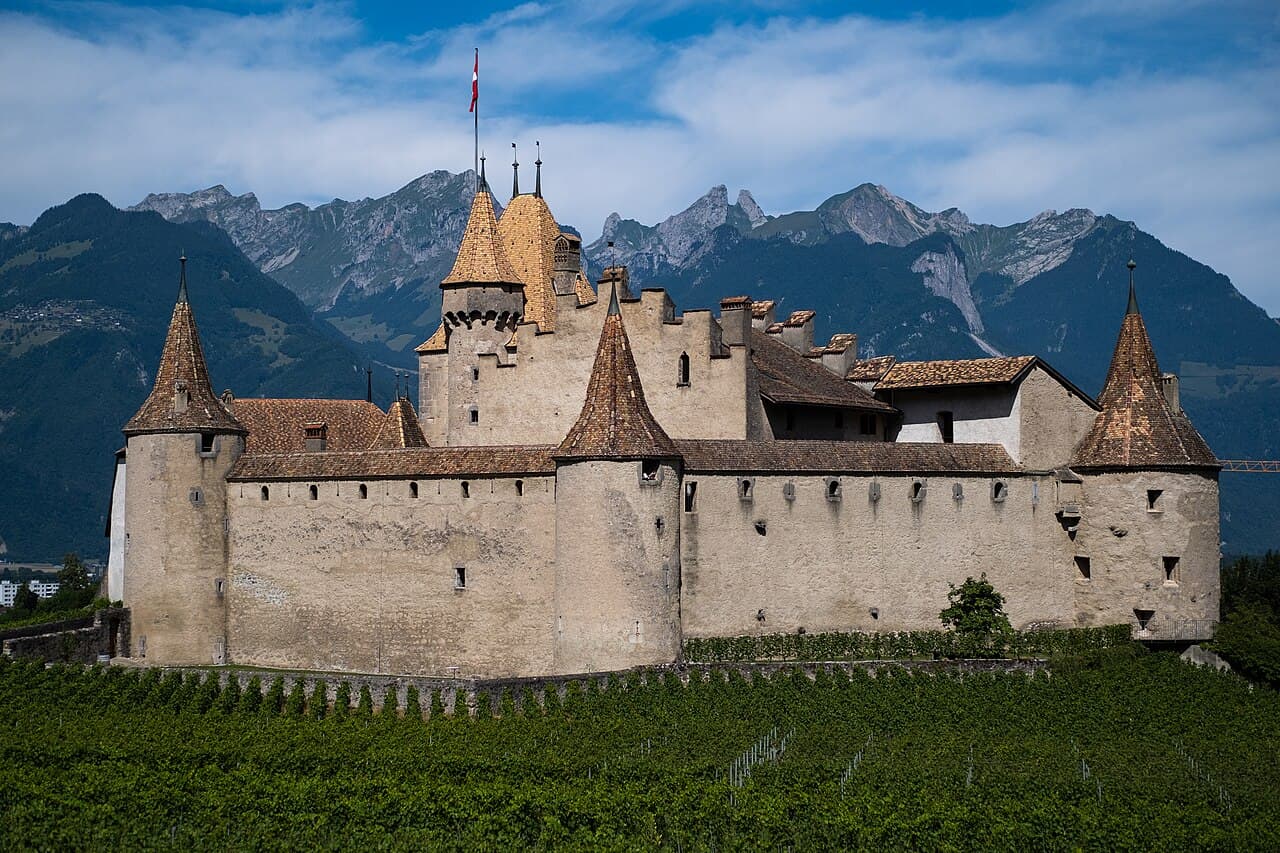
The castle's layout reflects its layered history, evolving from a modest medieval fortification to a formidable fortified residence. The original square tower, akin to structures found on nearby Saint-Triphon hill, anchors the complex. Surrounding curtain walls and turrets were added in the 14th and 15th centuries, enhancing defense and residential comfort.
The imposing 15th-century square tower in the southern corner stands as a testament to the castle's strategic and architectural evolution. Its design embodies the principles of late medieval military architecture, balancing the needs for defense, surveillance, and habitation.
Surrounding the castle, the vineyards underscore the area's historic connection to wine production, a tradition that continues to this day. The castle's preservation as a museum and cultural site ensures that both its architectural grandeur and its role in regional history remain accessible to the public.
Visiting aigle castle today
Today, Aigle Castle is a well-preserved monument open to visitors interested in medieval architecture, Swiss history, and viticulture. The castle and its museums offer a unique combination of historical insight and cultural experience. Visitors can explore the castle's fortified walls, towers, and prison cells, as well as enjoy extensive exhibits on wine-making traditions.
The castle's location amidst the vineyards provides a scenic backdrop that enhances the visitor experience. The adjacent museums, including the Wine-Labels Museum, add depth to the understanding of the region's wine heritage.
Frequently asked questions (FAQ)
- What are the opening hours of Aigle Castle?
- Aigle Castle is open to visitors from April to October, typically from 10 AM to 6 PM. During the winter months, the castle may have reduced hours, so it's best to check the official website for specific times before your visit.
- How do I get to Aigle Castle?
- Aigle Castle is easily accessible by public transport, with Aigle train station located just a short walk away. If you're driving, there is parking available nearby, making it convenient for visitors traveling by car.
- What is the historical significance of Aigle Castle?
- Aigle Castle dates back to the 12th century and was originally built as a fortress to protect the region. It has a rich history, serving as a residence for local nobility and playing a key role in the defense of the area throughout the centuries.
- Can I take guided tours of Aigle Castle?
- Yes, guided tours are available at Aigle Castle, providing visitors with in-depth knowledge of its history and architecture. These tours are often conducted in multiple languages, ensuring that all guests can enjoy the experience.
- Is Aigle Castle accessible for visitors with mobility issues?
- Aigle Castle strives to accommodate all visitors, with some accessible pathways and facilities. However, due to its historical structure, certain areas may still present challenges for those with mobility impairments, so it's advisable to inquire ahead of your visit.
- When is the best time to visit Aigle Castle?
- The best time to visit Aigle Castle is during the spring and summer months when the weather is pleasant and the gardens are in full bloom. Additionally, many cultural events and exhibitions take place during these months, enhancing the visitor experience.
- What are the ticket prices for Aigle Castle?
- Ticket prices for Aigle Castle vary based on age and group size, with discounts often available for students and seniors. It's recommended to check the official website for the most current pricing and any special offers.
- Are there any nearby attractions to visit along with Aigle Castle?
- Yes, there are several attractions near Aigle Castle, including the beautiful vineyards of the Lavaux region and the charming town of Aigle itself. Visitors can also explore the nearby Aigle Museum, which showcases local history and culture.
Photo gallery

Information
Website
Visit websiteSources & official resources
Verify the information above using these authoritative references.
Loading map...
Visitor reviews
No reviews yet. Been here? Write the first review and help other travelers!
Write the first reviewVisited this castle? Share your experience
Your review helps other travelers and adds first-hand knowledge to our encyclopedia.