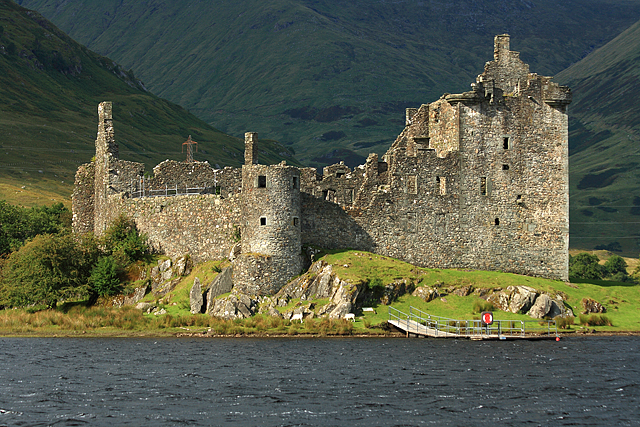
Achallader Castle Ruins
Achallader Castle is a ruined 16th-century tower house located in Argyll and Bute, Scotland. It stands as a significant relic of the turbulent clan history of the Scottish Highlands during the Renaissance period. Originally a stronghold of the Fletcher clan, the castle later came under the control of Sir Duncan Campbell of Glen Orchy in 1587 through a combination of treachery and political maneuvering. This transfer of ownership marked the beginning of a series of violent episodes that shaped the castle's fate.
Historical context and clan conflicts
The castle's history is deeply intertwined with the rivalries between Highland clans. The Fletchers, original owners of Achallader, were dispossessed after an incident involving Sir Duncan Campbell, known as Black Duncan. According to tradition, Black Duncan sent an English servant or soldier to graze a horse in the Fletchers' cornfield. When warned off in Gaelic, the servant did not understand and was subsequently shot by the Fletchers. Black Duncan advised the Fletcher laird to flee to France to avoid punishment, and in his absence, the property was transferred to Campbell control. The Fletchers never regained the castle.
In 1603, the castle was burnt by the MacGregors, further destabilizing its status. The castle later served as a meeting place for significant Highland political events. In the summer of 1683, a Commission for the settlement of the Highlands, led by Sir William Drummond of Cromlix, stayed at the castle. Among the guests was McIain, who would later be a victim of the infamous massacre of Glencoe.
Destruction and decline
Following the political upheavals of the late 17th century, the castle suffered further damage. In 1689, after the victory at Killiecrankie and the repulse at Dunkeld, the returning McIains pulled down what remained of the castle, which was never restored. In 1691, John, Earl of Breadalbane, empowered by King William III, used the ruins of Achallader Castle as a venue to negotiate with Highland chiefs. Through a mix of threats, promises, and duplicity, he secured treaties with most clans except the McIains. These agreements included secret clauses that were later denied, reflecting the complex and often treacherous nature of Highland politics.
Architectural features and current state
Originally, Achallader Castle was a three-storey tower house with a garret. It was well fortified with shot-holes for defense. Today, only two walls remain standing, one of which shows traces of corbelling, a medieval architectural feature used to support parapets or upper floors. These surviving walls now shelter the farm buildings of Achallader Farm, integrating the ruins into the rural landscape.
The castle is classified as a tower house, a common type of fortified residence in Scotland during the Renaissance period. Its design reflects the dual purpose of such structures: defense and domestic habitation. The use of shot-holes indicates a concern for protection against armed assault, while the presence of multiple storeys and a garret suggests accommodation for a family and retainers.
Significance in Highland heritage
Achallader Castle's ruins bear witness to the violent history of clan rivalries and political machinations in the Scottish Highlands. The castle's association with notable figures such as Black Duncan Campbell and its role in key historical events, including the Glencoe massacre context and the post-Jacobite settlements, highlight its importance. The castle's decline following destruction and its current state as ruins encapsulate the shifting power dynamics and the eventual decline of traditional clan strongholds in Scotland.
Visitors to the site can appreciate the rugged beauty of the surrounding landscape and reflect on the castle's storied past. Although only fragments remain, Achallader Castle continues to be a point of interest for those studying Scottish history, architecture, and clan culture.
Frequently asked questions (FAQ)
- What is the historical significance of Achallader Castle?
- Achallader Castle is historically significant due to its association with the Fletcher clan, the Campbell takeover, and its role in Highland clan conflicts during the Renaissance period. It also served as a meeting place for key events like the 1683 Highland settlement commission and the 1691 clan treaty negotiations.
- Can I visit the ruins of Achallader Castle today?
- Yes, the ruins of Achallader Castle are accessible to visitors. However, as a ruin integrated with farm buildings, there are no formal visitor facilities or opening hours, so visitors should plan accordingly and respect private property.
- What architectural features remain at Achallader Castle?
- Only two walls of the original three-storey tower house survive, one showing traces of corbelling. The castle was originally fortified with shot-holes, reflecting its defensive purpose during the Renaissance period.
- When was Achallader Castle destroyed?
- The castle was burnt by the MacGregors in 1603 and further pulled down by the McIains in 1689. It was never restored after these events.
Information
Loading map...
Visitor reviews
No reviews yet. Been here? Write the first review and help other travelers!
Write the first reviewVisited this castle? Share your experience
Your review helps other travelers and adds first-hand knowledge to our encyclopedia.