Aarwangen Castle
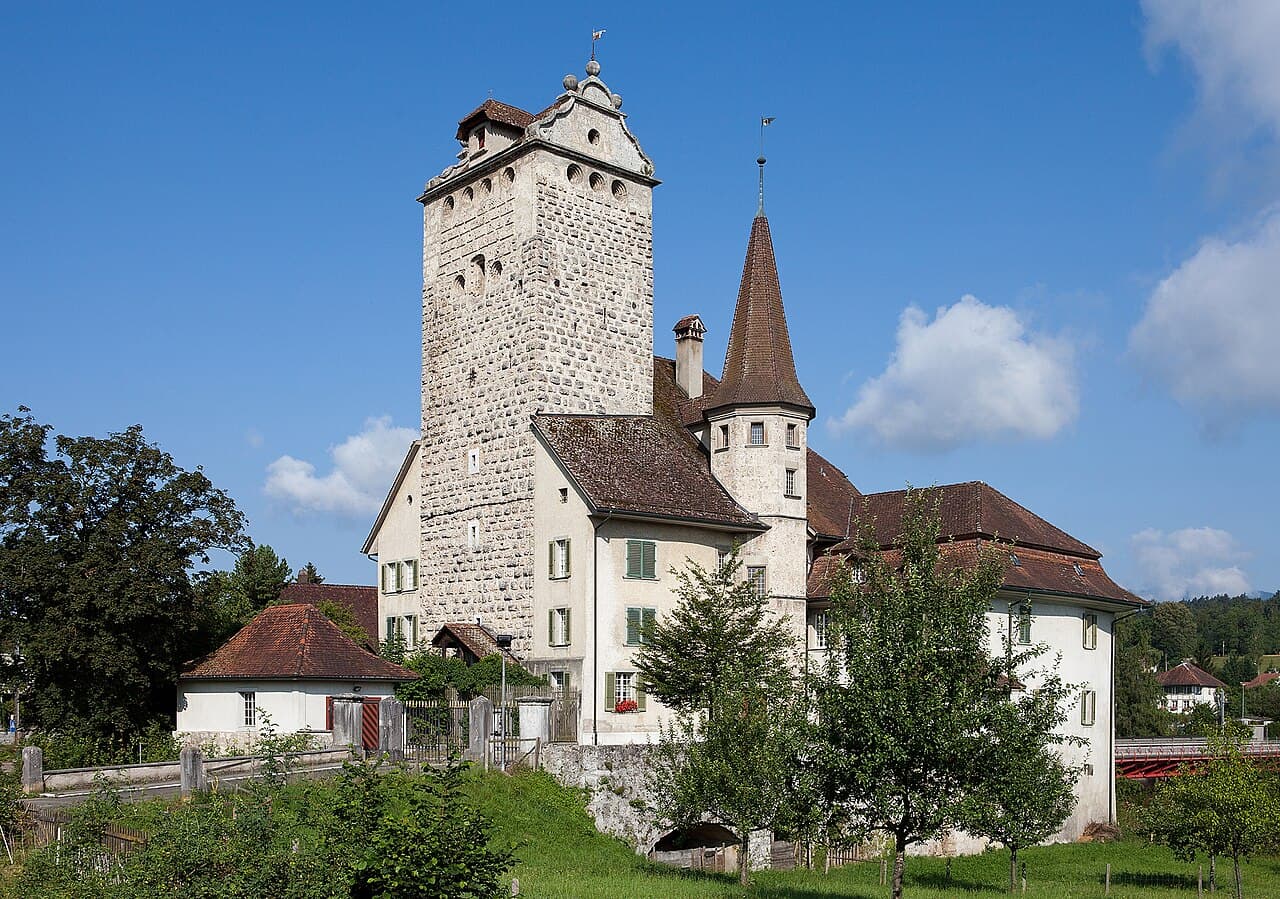
Aarwangen Castle is a remarkable example of a late-medieval hill castle located in the town of Aarwangen, Switzerland. Constructed around the 14th century, it stands near a crucial crossing over the Aare River, a strategic position that shaped its historical significance. Originally built by the lords of Aarwangen, a family of ministeriales (unfree knights serving feudal overlords) under the Kyburg dynasty, the castle's primary role was to control the river crossing and oversee the surrounding lands. Its imposing nine-story main tower, constructed from finely dressed bossage stone blocks, reflects its defensive purpose rather than residential comfort.
Early history and construction
The lords of Aarwangen first appeared in historical records between 1194 and 1212. Walter of Aarwangen notably served the future King of the Romans, Rudolph I, from 1266. Around 1300, the family built the castle's central tower on the southern bank of the Aare River, near the river crossing they controlled. In 1313, Rudolf III of Neuenburg-Nidau granted them the bridge over the Aar river as a fief, cementing their regional influence.
After Walter's death in 1320, his son Johann inherited the castle and family leadership. Johann was a patron of the Cistercian Abbey of St. Urban and joined the Abbey in 1341, remaining there until his death in 1350. His passing marked the end of the Aarwangen noble line, and ownership of the castle passed to the Grünenberg family.
Bernese acquisition and administrative role
In 1432, the castle and its lordship were sold to the city of Bern by Wilhelm von Grünenberg. This acquisition was part of Bern's territorial expansion following its earlier acquisitions of Burgdorf in 1384 and the Aargau region in 1415. Aarwangen Castle became the seat of a Bernese bailiwick, an administrative district governed by a bailiff. Over the centuries, 75 bailiffs resided here, overseeing the region until 1798.
During the 1653 Peasants’ War, Aarwangen Castle served as a crucial horse-changing station for Bernese couriers and functioned as an armory, supporting military communication and defense. After the fall of Bern's city-state in 1798, the castle briefly passed to private ownership before Bern repurchased it in 1805, reinstating its administrative functions including housing the chancery, court, and prison.
Architectural features and layout
The castle's core is the nine-story main tower, originally built as a defensive structure with walls up to 2.5 meters thick. The tower's construction with bossage stone blocks is characteristic of medieval fortifications designed to resist siege. In 1624, an upper floor and Baroque-style volute gables were added, blending later architectural styles with the medieval core.
Aarwangen Castle was initially a water castle, situated on the south bank of the Aare River near the bridge. It featured a horseshoe-shaped ring wall and a moat open toward the river. Today, remnants of the southern and western ring walls and a corner tower near the bridge remain visible, illustrating its original defensive perimeter.
Surrounding the main tower on three sides are residential buildings whose medieval cores have been altered multiple times through the centuries, including a stair tower added in 1643. Interior furnishings include elements from the 17th and 18th centuries, reflecting the castle's long use as both a residence and administrative center.
The castle's defenses included a moat approximately 15 meters wide, separating the ring wall from the foreland, and a series of large ponds on the uphill side for additional protection. Originally, the castle was open to the east, where a square tower guarded the entrance. The palas, or main residential building, stood parallel to the river north of the tower, separated by a narrow courtyard later roofed over in the 18th century.
Modern history and preservation
In the 20th and early 21st centuries, judicial reforms led to the consolidation of courts, and the Aarwangen court was moved to Burgdorf in 2012. This left the castle vacant until the establishment of the Stiftung Schloss Aarwangen (Aarwangen Castle Foundation) in 2020. The foundation aims to preserve the castle and promote its use as a cultural and public meeting place.
Renovations began in 2023 with plans to reopen the castle in 2025, featuring exhibitions, educational programs, and cultural events. The former prison cells have been creatively converted into escape rooms, blending the castle's historical function with modern cultural activities.
Today, Aarwangen Castle is well preserved and recognized as a Swiss heritage site of national significance. Its rich history, architectural evolution, and ongoing cultural role make it a significant monument in Swiss medieval and early modern history.
Frequently asked questions (FAQ)
- What is the best time to visit Aarwangen Castle?
- The best time to visit Aarwangen Castle is during the warmer months from late spring to early autumn when the weather is pleasant for exploring the castle grounds and nearby river areas. Special events and exhibitions are often scheduled during this period.
- Can I tour the interior of Aarwangen Castle?
- Yes, visitors can tour parts of the interior, including the historic main tower and residential buildings. The castle also offers escape room experiences in the former prison cells, providing an interactive way to explore its history.
- Is Aarwangen Castle accessible for visitors with mobility issues?
- While efforts have been made to improve accessibility, the castle's medieval architecture includes stairs and uneven surfaces that may pose challenges. Visitors with mobility issues should check with the castle foundation for specific accessibility information before visiting.
- How do I get to Aarwangen Castle?
- Aarwangen Castle is located in the town of Aarwangen in the Bern region of Switzerland. It is accessible by local public transportation and by car, with parking available nearby. The castle is near the Aare River and the historic bridge crossing.
- What is the historical significance of Aarwangen Castle?
- Aarwangen Castle played a key role in controlling the Aare River crossing and served as the seat of a Bernese bailiff for over three centuries. Its strategic location and administrative functions highlight its importance in regional governance and defense during the late medieval and early modern periods.
Photo gallery

Information
Current owner
Stiftung Schloss Aarwangen (Aarwangen Castle Foundation)
Website
Visit websiteSources & official resources
Verify the information above using these authoritative references.
Loading map...
Visitor reviews
No reviews yet. Been here? Write the first review and help other travelers!
Write the first reviewVisited this castle? Share your experience
Your review helps other travelers and adds first-hand knowledge to our encyclopedia.