Zamek Spiski
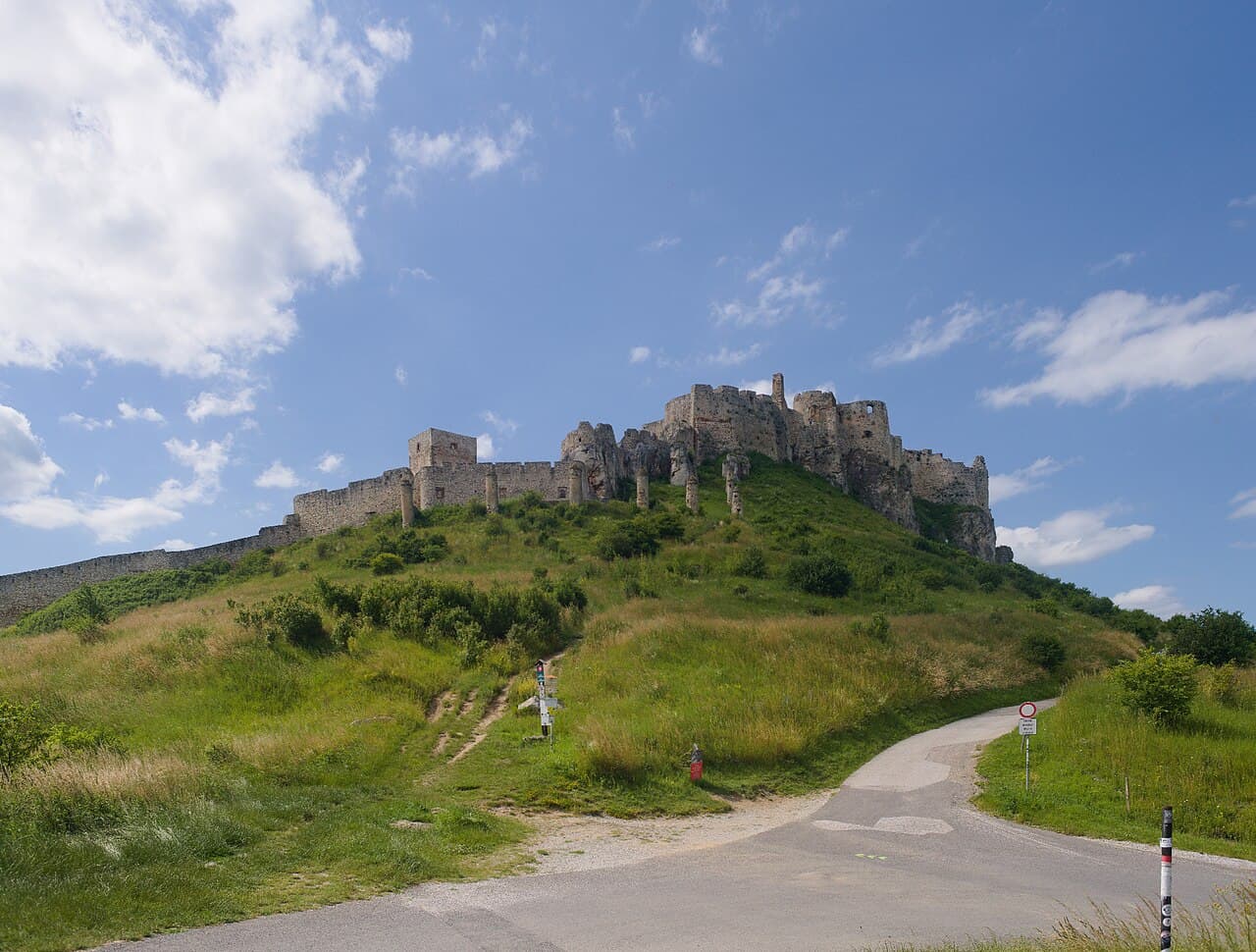
Spiš Castle stands as one of the largest and most significant medieval fortresses in Central Europe, located near the village of Žehra in Slovakia. Its origins trace back to prehistoric times, with archaeological evidence revealing continuous human occupation from the Paleolithic era through the Neolithic, Bronze Age, and Celtic periods. The site evolved over centuries into a monumental castle complex that played a vital role in the political, administrative, and cultural history of the Kingdom of Hungary and the broader region.
The castle's strategic position atop a travertine hill rising approximately 200 meters above the surrounding landscape provided natural defensive advantages, enhanced by steep cliffs and later extensive man-made fortifications. Construction of the medieval stone castle began in the 11th and 12th centuries, initially featuring a Romanesque cylindrical tower with walls four meters thick and a diameter of 22.5 meters. This tower replaced an earlier wooden fortification and was surrounded by a stone curtain wall enclosing the hilltop summit.
Early medieval origins and romanesque foundations
The earliest written mention of Spiš Castle dates to 1209 in a document issued by King Andrew II of Hungary. Archaeological research confirms that by the late 11th century, the castle's core included the massive stone tower and defensive walls. The castle became royal property in the early 13th century, notably owned by Koloman, son of King Andrew II, who initiated significant expansions. A new cylindrical tower was constructed to replace one damaged by an earthquake, and a two-story Romanesque palace was built on the northern edge of the hill, constructed from large hewn stones. This period also saw the erection of a fortified gate with a drawbridge over a dry moat and the castle chapel.
The castle's robust defenses were proven during the Mongol invasion of 1241, when Spiš Castle was one of the few fortresses in the region to withstand the Tatar onslaught. Following this, a small outer bailey was established on the southwest side, including a residence for the prelate of the nearby Spiš Chapter.
Gothic expansions and medieval conflicts
During the 14th century, Spiš Castle was involved in regional conflicts, including unsuccessful sieges during King Charles Robert's struggles with the Omodei family. In 1312, the castle resisted an assault by the forces of Mate Csáko. Later, under King Sigismund of Luxembourg in the 15th century, the fortress underwent further fortification. A new middle bailey, known as the "middle castle," was constructed on the western side, surrounded by walls and a dry moat. The main entrance was fortified with a gate tower and barbican, while the bailey housed essential buildings such as barracks and an arsenal.
Following King Sigismund's death in 1437, the castle became a focal point in regional power struggles. The Spiš župan (county head) from the Rozgonyi family entrusted the castle's defense to Piotr Baska, who later opened its gates to mercenaries under Jan Jiskra, loyal to Queen Elizabeth fighting for her son's claim to the Hungarian throne. Jiskra's forces established a large fortified camp at the castle's base, surrounded by stone walls and towers, including a central circular fortification with a moat, known as Jiskra's fort.
Renaissance transformation and noble ownership
In the 16th century, ownership passed to the powerful Zapolya family, who made Spiš Castle their principal residence. They renovated the oldest Romanesque sections and built new structures, including a castle chapel. After the Battle of Mohács in 1526, the castle was seized by Habsburg forces and transferred to the Thurzo family in 1531 as a reward for their support. The Thurzos transformed Spiš Castle into a Renaissance fortress and noble residence, unifying the upper castle buildings with an elegant arcade corridor and reinforcing the walls to accommodate artillery, reflecting advances in military technology.
Following the extinction of the Thurzo line in 1639, the castle passed to the Csáky family, who held it until 1945. The Csákys expanded the middle castle with new residential buildings and developed the extensive lower bailey, which contained service and domestic structures for the castle's staff and garrison.
Decline, destruction, and preservation
The castle's military importance waned by the late 17th century. It was occupied by Francis II Rákóczi's insurgents during the early 18th century anti-Habsburg uprisings. After the suppression of the rebellion, the castle was garrisoned by a small imperial force but gradually fell into neglect. A devastating fire in 1780 severely damaged the castle, leading to its abandonment and ruin. Theories about the fire's cause include accidental lightning strike, deliberate destruction to avoid taxation, or an accident involving distilling spirits.
From the 1960s onward, extensive conservation and archaeological work have been undertaken to stabilize and study the ruins. These efforts have uncovered significant insights into the castle's complex history, architecture, and role in regional politics. Today, Spiš Castle is a protected cultural monument and a major tourist attraction, open to visitors as a "permanent ruin." It features accessible ruins of the upper castle, including the massive donjon, remains of the Romanesque palace, the Gothic chapel with its distinctive sgraffito decoration, and foundations of the 12th-century tower.
Architectural highlights and visitor experience
The castle complex covers over 4 hectares, making it one of the largest stone castles in Europe. Its defensive structures reflect a blend of Romanesque, Gothic, and Renaissance architectural styles, illustrating its evolution over several centuries. The upper castle houses the key historical buildings, including the chapel dedicated to Saint Elizabeth of Hungary, which underwent transformations from a flat coffered ceiling to a vaulted Gothic design, later adapted as a funerary chapel with a crypt.
The middle castle serves as the main entrance area and hosts exhibitions showcasing medieval crafts and castle life. The lower castle includes the remnants of defensive walls, towers, and a gate tower, as well as Jiskra's circular fortification with its moat and palisade. Visitors can explore restored interiors such as the torture chamber, medieval kitchen, armory, bedrooms, and bath, each offering insights into the daily life and military functions of the castle.
The castle's construction materials primarily include local travertine and sandstone, contributing to its distinctive appearance. Decorative elements such as sgraffito on the chapel's exterior and Renaissance arcades highlight the artistic influences across its long history. Ongoing archaeological research continues to reveal new facets of Spiš Castle's past, enriching its significance as a cultural and historical landmark.
Since 1993, Spiš Castle and its surrounding sites, including Spišská Kapitula, Spišské Podhradie, and the church in Žehra, have been recognized as a UNESCO World Cultural Heritage Site, underscoring their outstanding universal value and importance in Central European heritage.
Frequently asked questions (FAQ)
- How do I get to Spiš Castle from Spišské Podhradie?
- Spiš Castle is located near the village of Spišské Podhradie and can be reached by a short hike uphill from the village center. There are also local buses and tour services that provide transportation to the castle entrance.
- What are the main architectural styles visible at Spiš Castle?
- Spiš Castle features a blend of Romanesque, Gothic, and Renaissance architectural styles, reflecting its long history and various phases of construction and renovation.
- When is the best time to visit Spiš Castle?
- The castle is best visited during the warmer months from late spring to early autumn when the weather is favorable and the full extent of the ruins can be explored comfortably.
- Is Spiš Castle accessible for visitors with limited mobility?
- Due to its hilltop location and uneven terrain, Spiš Castle has limited accessibility for visitors with mobility challenges. Some areas may be difficult to reach without assistance.
- Are guided tours available at Spiš Castle?
- Yes, guided tours are available and provide detailed information about the castle's history, architecture, and significance. Tours can be booked at the visitor center or online.
- What facilities are available for visitors at Spiš Castle?
- Visitors can find amenities such as a museum exhibition, souvenir shops, and refreshment points within the castle complex and nearby village.
- What is the significance of Spiš Castle in Slovak history?
- Spiš Castle served as a political, administrative, and military center for centuries, playing a crucial role in the Kingdom of Hungary and later Slovak heritage. It is a symbol of regional identity and medieval architecture.
Photo gallery

Information
Opening hours
9:00-18:00, daily (seasonal)
Ticket prices
€7 adult, €4 child
Current owner
State museum
Website
Visit websiteFeatured in
Articles on the Castlopedia blog that feature Zamek Spiski.
Sources & official resources
Verify the information above using these authoritative references.
Loading map...
Visitor reviews
No reviews yet. Been here? Write the first review and help other travelers!
Write the first reviewVisited this castle? Share your experience
Your review helps other travelers and adds first-hand knowledge to our encyclopedia.