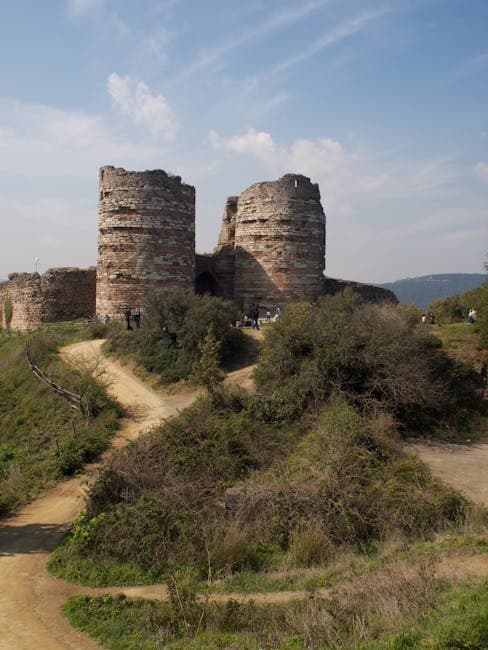
Yoros Castle
Yoros Castle, locally known as Yoros Kalesi, is a historic hilltop fortress situated in the village of Anadolu Kavağı on the Asian side of the Bosphorus Strait in Istanbul, Turkey. This strategic stronghold commands a commanding view over one of the narrowest points of the Bosphorus where it meets the Black Sea, making it a vital military and maritime control point throughout history.
The castle's origins trace back to the Byzantine Empire, with significant construction attributed to the reign of Emperor Michael VIII Palaiologos in the latter half of the 13th century. It was part of a defensive system that included a now-lost fortress on the opposite shore at Rumeli Kavağı. Together, these castles could have supported a massive chain across the Bosphorus to prevent enemy ships from accessing the strait, similar to the famous chain across the Golden Horn that protected Constantinople.
Historical significance and military role
Yoros Castle played a crucial role in controlling naval passage between the Black Sea and the Sea of Marmara, and by extension, access to Constantinople. The castle changed hands multiple times among the Byzantines, Ottomans, and Genoese across centuries, reflecting its strategic importance.
In 1305, the Ottomans first captured the castle but lost it soon after to the Byzantines. Later, in 1391, Sultan Bayezid I seized Yoros Castle while preparing for the siege of Constantinople. He used it as his military headquarters during the construction of the nearby Anadolu Hisarı fortress, which was instrumental in the eventual Ottoman conquest of Constantinople in 1453.
The Byzantines attempted to reclaim the castle in 1399 but failed, and the Ottomans maintained control until 1414, when the Genoese took over. The Genoese occupation lasted about four decades, earning the castle its popular name "Genoese Castle" (Ceneviz Kalesi).
Following the Ottoman conquest of Constantinople, Sultan Mehmed II expelled the Genoese and undertook extensive repairs and fortifications. He established a customs office, quarantine facilities, and a garrison, reinforcing the castle's role as a defensive and administrative post.
Architectural features and layout
The castle features an irregular ground plan divided into an upper and a lower castle. The lower castle area remains a military zone, underscoring the site's enduring strategic value. The surviving ruins include robust walls, two prominent towers approximately 20 meters high, and a partially intact eastern gate strengthened with brickwork to prevent collapse.
Historically, the fortress's walls extended down to the Bosphorus shoreline, where maritime facilities such as a pier and lighthouse once stood to aid navigation. Inscriptions in ancient Greek and symbols of the Palaiologos dynasty remain visible on parts of the walls, highlighting the castle's Byzantine heritage.
Additional Ottoman contributions include a mosque commissioned by Sultan Bayezid II (1481–1512) within the castle walls, a bathhouse added by the fortress commander Mehmed Agha, and watchtowers constructed under Sultans Osman III and Abdülhamid I in the 18th century.
Fortifications and defensive structures
The castle's strongest fortifications face east towards Anatolia, designed to defend against threats from both sea and land. The walls are built to withstand prolonged sieges, with battlements and towers offering vantage points for surveillance and defense.
Religious and cultural elements
Within the castle grounds, the presence of a mosque and a small Turkish quarter consisting of about 25 houses indicates the castle's role as a garrison and community center during peaceful periods. The nearby Hill of Saint Joshua (Yuşa) adds religious significance to the area, featuring a tomb traditionally linked to the biblical figure Joshua ibn Nun. This site attracts Christian, Jewish, and Turkish Sufi pilgrims and includes a mosque and terrace restored by Sultan Abdulaziz in 1863.
Decline and modern status
After the 18th century, Yoros Castle gradually fell into disrepair as its military importance waned. By the establishment of the Turkish Republic in 1923, the castle was no longer in active use. Today, the ruins of the citadel and surrounding walls remain, with the upper castle accessible to visitors, although interior access is restricted by metal gates for safety and preservation.
The lower castle area remains under military control and is closed to the public. Despite these restrictions, Yoros Castle is a popular day-trip destination from Istanbul, offering visitors panoramic views of the Bosphorus and the Black Sea and a tangible connection to the region's layered history.
Archaeological and preservation efforts
Preservation efforts focus on maintaining the structural integrity of the remaining walls and towers, with particular attention to the eastern fortifications, which are relatively well-preserved. Inscriptions and architectural details are studied to better understand the castle's Byzantine and Ottoman phases.
Visitor information
- Location: Anadolu Kavağı, Beykoz district, Istanbul, Turkey
- Access: The upper castle exterior is open to visitors; interior access is restricted.
- Surroundings: The lower castle area is a military zone and closed to the public.
- Best time to visit: Spring and autumn for mild weather and clear views.
- Nearby attractions: The Hill of Saint Joshua tomb complex and the village of Anadolu Kavağı.
Frequently asked questions
- What is the historical importance of Yoros Castle? Yoros Castle was a key Byzantine and Ottoman fortress controlling the Bosphorus Strait's maritime traffic, playing a strategic role in regional defense and trade.
- Can visitors enter the interior of Yoros Castle? Currently, only the exterior of the upper castle is accessible; interior areas are closed off for preservation and safety reasons.
- How do I get to Yoros Castle from Istanbul? Yoros Castle is reachable by boat or road from central Istanbul, with Anadolu Kavağı village serving as the gateway to the fortress.
- Why is it called Genoese Castle? The castle earned the nickname "Genoese Castle" due to the Genoese occupation from 1414 to the mid-15th century.
- Is there any religious significance near the castle? Yes, the nearby Hill of Saint Joshua features a tomb revered by multiple faiths and includes a mosque and terrace restored in the 19th century.
- When was Yoros Castle built? The primary construction phase dates to the 13th century during the Byzantine Palaiologos dynasty.
- What architectural styles are evident in Yoros Castle? The castle exhibits Byzantine military architecture with later Ottoman modifications, including Islamic religious structures and watchtowers.
Frequently asked questions (FAQ)
- How do I get to Yoros Castle?
- Yoros Castle is located in Anadolu Kavağı, Turkey, and can be reached by car or public transportation from Istanbul. The most convenient way is to take a ferry to Anadolu Kavağı from the city, which offers a scenic view of the Bosphorus Strait.
- What is the historical significance of Yoros Castle?
- Yoros Castle dates back to the Byzantine era and played a crucial role in the defense of the region against invasions. It later became an Ottoman fortress, showcasing the architectural evolution and military history of the area.
- When was Yoros Castle built?
- Yoros Castle was initially constructed in the 14th century during the Byzantine period. It has undergone several renovations over the centuries, reflecting the changes in architectural styles and military needs.
- Can I enter Yoros Castle and explore its grounds?
- Yes, visitors can enter Yoros Castle and explore its ruins and surrounding grounds. The castle offers spectacular views of the Bosphorus and is a popular spot for photography and picnics.
- Why is Yoros Castle a popular tourist attraction?
- Yoros Castle is popular due to its rich history, stunning panoramic views, and its picturesque location on the Bosphorus. It provides visitors with a unique opportunity to learn about the region's past while enjoying the natural beauty of the area.
- Is it possible to visit Yoros Castle year-round?
- Yes, Yoros Castle is open to visitors year-round, but the best time to visit is during the spring and fall when the weather is pleasant. Summer can be quite hot, while winter may bring some challenging weather conditions.
- What are the opening hours of Yoros Castle?
- Yoros Castle typically opens at 9 AM and closes at sunset, but it's advisable to check the local listings for any seasonal changes in hours. Visiting earlier in the day can help you avoid crowds and enjoy a more peaceful experience.
- Are there any nearby attractions to visit?
- Yes, nearby attractions include the charming village of Anadolu Kavağı, where you can enjoy local cuisine and shops. Additionally, the beautiful beaches along the Bosphorus and other historical sites are easily accessible, making it a perfect day trip.
- What are the ticket prices for Yoros Castle?
- As of the latest information, the entrance to Yoros Castle is generally free, although there may be a small fee for guided tours. It's a good idea to verify current prices before your visit, as they can change.
Photo gallery

Photo by Yesim G. Ozdemir
Information
Loading map...
Visitor reviews
No reviews yet. Been here? Write the first review and help other travelers!
Write the first reviewVisited this castle? Share your experience
Your review helps other travelers and adds first-hand knowledge to our encyclopedia.



