Wolfstein Castle

Wolfstein castle in neumarkt in der oberpfalz
Neumarkt in der Oberpfalz, Germany
High Medieval (11th–13th c.)
Well Preserved

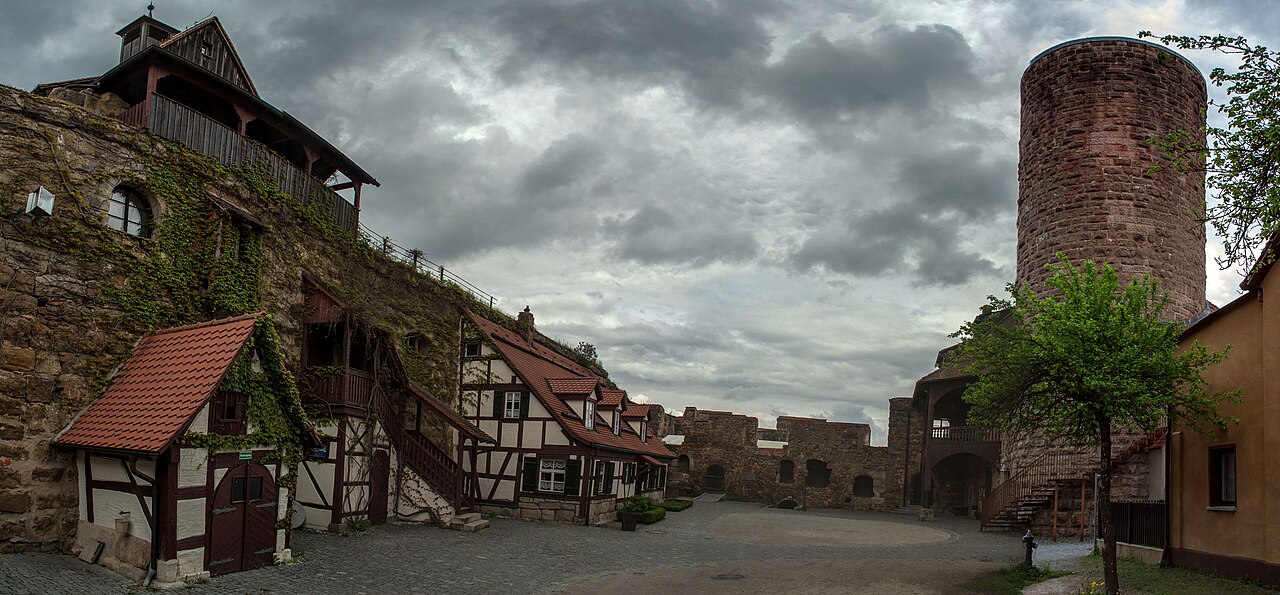
Wolfstein Castle is a significant example of a high medieval hill castle located in Neumarkt in der Oberpfalz, Germany. Its origins trace back to the mid-12th century, as confirmed by archaeological excavations, although the precise details of its initial construction and early history remain somewhat obscure. The castle's strategic position atop a hill provided defensive advantages typical of medieval fortifications, overseeing the surrounding landscape and controlling important regional routes.

Early history and noble lineage

The earliest written record mentioning the castle dates from 1283, when Gottfried von Sulzbürg adopted the name von Wolfenstein, establishing a noble family line associated with the castle. This change signifies the castle's importance as a seat of local power and influence during the high medieval period. The Wolfenstein family held the castle and its surrounding lands for several generations, playing a role in the region's feudal structure.

Architectural features and layout

Wolfstein Castle was constructed primarily as a hill castle, utilizing the natural topography for defense. While much of the original structure is now in ruins, archaeological investigations have revealed elements of its stone curtain walls and foundations of towers and residential buildings. The castle likely included a keep (donjon) serving as the last line of defense and residence for the lord. Defensive features would have included battlements, a gatehouse, and possibly a moat or ditch adapted to the hillside setting.

Historical events and decline

Wolfstein Castle's prominence declined significantly after the War of the Succession of Landshut in 1504, during which it sustained damage. Following this conflict, the castle was abandoned and gradually fell into disrepair. The death of Hans von Wolfenstein in 1462 without heirs led to the castle passing into the possession of the Bohemian (Czech) crown, marking a shift in ownership and political significance.

Modern preservation and archaeological work

In the late 20th century, particularly during the 1990s, Wolfstein Castle underwent extensive archaeological excavations and renovations to stabilize and preserve the ruins. These efforts have ensured that the castle remains in a well-preserved condition today, allowing visitors to explore the site and appreciate its historical and architectural significance. The restoration work focused on maintaining the integrity of the remaining structures while providing safe access for educational and touristic purposes.

Cultural and regional significance

Wolfstein Castle is an important cultural landmark in the Neumarkt region, reflecting the medieval history and feudal heritage of Bavaria. Its ruins offer insights into the defensive architecture and noble residences of the 12th to 16th centuries. The castle's connection to regional noble families and its role during key historical conflicts contribute to its value as a heritage site.

Visiting wolfstein castle

Today, Wolfstein Castle is accessible to the public as a historical ruin. Visitors can explore the remnants of the castle's walls, towers, and courtyards while enjoying panoramic views of the surrounding landscape. The site is a popular destination for those interested in medieval architecture, archaeology, and Bavarian history. Informational signage and guided tours may be available to enhance the visitor experience.

Frequently asked questions (FAQ)

How do I get to Wolfstein Castle?
Wolfstein Castle is located in Neumarkt in der Oberpfalz, Germany. You can reach the castle by car, and there is parking available nearby. Public transportation options, including buses and trains, also connect to Neumarkt, making it accessible for visitors.
What is the historical significance of Wolfstein Castle?
Wolfstein Castle dates back to the 12th century and has served as a strategic fortification throughout its history. It played a crucial role in the defense of the region during various conflicts and has witnessed significant historical events. Today, it stands as a testament to medieval architecture and regional history.
When was Wolfstein Castle built?
Wolfstein Castle was constructed in the early 12th century, specifically around the year 1130. Over the centuries, it has undergone several renovations and expansions, reflecting the architectural styles of different periods. Its long history makes it an important landmark in the region.
Can I visit Wolfstein Castle year-round?
Yes, Wolfstein Castle is open to visitors throughout the year, though specific opening hours may vary by season. It is advisable to check the official website or contact the visitor center for the latest information on accessibility and any special events. Guided tours are also available during peak seasons.
Why is Wolfstein Castle a popular tourist destination?
Wolfstein Castle attracts visitors due to its rich history, stunning architecture, and beautiful surrounding landscapes. The castle offers breathtaking views of the surrounding area and provides insight into medieval life. Additionally, nearby hiking trails and cultural events enhance its appeal.
Is it possible to explore the interior of Wolfstein Castle?
Yes, visitors can explore certain areas of the interior of Wolfstein Castle, including historical exhibits that showcase its past. Guided tours are often available, providing deeper insights into the castle's architecture and history. Be sure to check for any seasonal restrictions or special events that may affect access.
What are the ticket prices for visiting Wolfstein Castle?
Ticket prices for Wolfstein Castle are generally affordable, with discounts available for students, seniors, and children. Group rates may also apply, making it a great option for educational outings. It is recommended to check the castle's official website for the latest pricing details and any special offers.
What are the best times to visit Wolfstein Castle?
The best times to visit Wolfstein Castle are during the spring and early autumn when the weather is mild and the surrounding nature is in full bloom. Summer is also popular, but be prepared for larger crowds. Visiting during weekdays can provide a more relaxed experience.
Are there any nearby attractions to visit along with Wolfstein Castle?
Yes, there are several attractions near Wolfstein Castle, including the picturesque old town of Neumarkt, which features charming shops and restaurants. Additionally, the surrounding natural parks offer hiking and outdoor activities. Museums and cultural sites in the area also enhance the visitor experience.

Information

Hill Castle

Loading map...

Visitor reviews

No reviews yet. Been here? Write the first review and help other travelers!

Write the first review

Visited this castle? Share your experience

Your review helps other travelers and adds first-hand knowledge to our encyclopedia.
Write a review

(5/5)

0/2000 characters

Your review will be visible after admin approval

Nearby castles

14.4 km
Thann Castle — Germany castle

Thann Castle

, Germany

Thann Castle is a notable example of a high medieval hill castle located in Germany. Constructed in the 12th century, it served as a strategic fortification during the medieval period. Today, the castle exists as archaeological ruins, offering valuable insight into medieval defensive architecture and regional history. Historical background and significance The origins of Thann Castle date back to the high medieval period, a time when castles were essential for territorial control and defense. Built in the 12th century, it was likely commissioned by local nobility or feudal lords to assert dominance over the surrounding landscape and protect trade routes. The castle's location on elevated terrain classified it as a hill castle, offering natural defense advantages. Throughout the medieval era, the castle would have played a role in regional conflicts and governance, although detailed historical records specific to Thann Castle are limited. Its ruins today reflect the typical architectural features of high medieval fortifications, including remnants of curtain walls, defensive towers, and gate structures. Architectural features and layout The surviving remains of Thann Castle reveal a compact fortress designed primarily for defense. The castle's stone curtain walls once enclosed the inner courtyard, protecting the residential and administrative buildings within. Portions of these walls remain, showcasing the masonry techniques of the period. Evidence of towers at key points suggests that the castle had lookout and defensive positions to monitor the surrounding area. The entrance would have been fortified with a gatehouse, possibly equipped with a portcullis and defensive mechanisms common in 12th-century castles. Although much of the superstructure has not survived, archaeological studies indicate the presence of living quarters, storage rooms, and possibly a chapel within the castle grounds. The layout reflects the functional needs of a medieval fortress balancing defense with habitation. Current condition and archaeological importance Today, Thann Castle stands as ruins, with significant portions of its walls and foundations exposed. The site has been subject to archaeological investigation, which has helped document its construction phases and usage over time. These findings contribute to understanding the development of medieval fortifications in Germany. The castle's ruins are accessible to visitors interested in medieval history and archaeology. While the remains are fragmentary, they provide a tangible connection to the region's feudal past and the architectural practices of the 12th century. Visiting Thann Castle Visitors to Thann Castle can explore the ruins and surrounding landscape, which offers panoramic views typical of hill castles. The site is an open-air archaeological location, ideal for those interested in medieval architecture and history. Facilities may be limited due to the castle's ruinous state, so visitors should prepare accordingly. Legacy and cultural context Thann Castle represents the widespread phenomenon of medieval fortification construction in Germany during the high medieval period. Although now in ruins, it reflects the strategic importance of castles in feudal society for defense, administration, and control of territories. The site contributes to the cultural heritage of the region, illustrating the architectural and historical evolution of medieval castles. Its preservation as an archaeological site allows ongoing study and appreciation of medieval military architecture.

High Medieval (11th–13th c.)
Details
16.2 km

Klosterburg Kastl

Kastl, Germany

Klosterburg Kastl is a remarkable historical site located near Kastl in Bavaria, Germany, known for its rich evolution from a Carolingian fortress to a prominent Benedictine monastery. Perched strategically on an elongated ridge of dolomite rock overlooking the Lauterach valley, the castle's location provided natural defensive advantages that were enhanced through successive architectural developments. The site's history is deeply intertwined with regional power dynamics and religious transformations spanning over a millennium. Early history and carolingian origins The earliest recorded mention of Klosterburg Kastl dates back to 954, when it was granted as a fief to Margrave Luitpold of Austria. This grant included control over the surrounding Heubischgau region, encompassing settlements such as Kastl, Habsberg, Illschwang, and Sulzbach. The fortress was originally constructed during the Carolingian period, reflecting the military and administrative needs of that era. Its initial masonry walls, some of which survive integrated within later structures, formed the core defensive elements of the hilltop castle. Transition to a religious institution By the late 11th century, the castle's ownership was fragmented among several noble families including Count Berengar of Sulzbach, Friedrich I of Habsberg-Kastl and his son Count Otto, as well as Luitgard of Zähringen, wife of Margrave Diepold II of Vohburg. Between 1098 and 1102, these owners agreed to convert the fortress into a Benedictine monastery, a transformation ratified by Pope Paschal II in 1102. This marked a significant shift from a military stronghold to a religious complex, which would grow in influence over the following centuries. Monastic expansion and architectural development Throughout the medieval period, the Benedictine monastery expanded its landholdings and wealth, becoming one of the more influential abbeys within the Holy Roman Empire. The monastery was a center for religious reform, notably during the late 14th and early 15th centuries with the Kastl Reform, which aimed to revitalize monastic discipline across Bavaria. Architecturally, this period saw the construction of new buildings and fortifications, including a 14th-century gate tower that enhanced the complex's defensive capabilities. The gate tower, still standing today, served as the main entrance and symbolized the monastery's dual role as a spiritual and fortified site. Later history and varied uses The monastery's prominence declined in the mid-16th century, leading to its closure as a Benedictine abbey in 1556. Subsequently, the site was repurposed as a residence for the Jesuit order until their suppression in 1773. In 1782, the Knights of Malta took control, reflecting the site's continued religious and military associations. The secularization of the early 19th century transformed the complex into a judicial building in 1808, housing district and local courts until 1930. In the modern era, the former monastery served educational purposes as the "Hungarian Gymnasium" from 1958 to 2007. Following restoration efforts, the site has been utilized since 2023 as a police training college under the administration of the Bavarian state. Architectural features and preservation The castle-monastery complex reflects a layered architectural history, with elements from its original Carolingian fortress phase integrated into later monastic buildings. The site is enclosed by a defensive wall known as a bering, delineating the fortified perimeter. The gate tower from the 14th century remains a prominent feature, illustrating medieval defensive architecture adapted for monastic use. Archaeological investigations at Klosterburg Kastl have revealed medieval and early modern remains, providing valuable insights into the site's continuous occupation and adaptation. The complex is protected as a monument within Bavarian heritage registers, emphasizing its cultural and historical significance. Site layout and structural evolution The elongated ridge location dictated a linear layout, with defensive walls and buildings arranged to maximize natural topography advantages. The transition from fortress to monastery is evident in the juxtaposition of military features like battlements and gate towers alongside religious structures such as cloisters and chapels. This blend of functions underscores the complex's unique role in Bavarian history. Cultural and historical significance Klosterburg Kastl stands as a testament to the dynamic history of Bavaria, illustrating the interplay between military power, religious authority, and institutional adaptation. Its evolution from a Carolingian hill castle to a Benedictine abbey, and later uses by Jesuits, Knights of Malta, judicial authorities, and educational institutions, reflect broader historical trends in the region. The site offers valuable opportunities for studying medieval monastic reforms, fortress architecture, and the secularization processes that reshaped European religious sites. Today, Klosterburg Kastl's preservation and adaptive reuse continue to honor its multifaceted legacy, making it a significant destination for historians, architects, and visitors interested in Bavarian heritage.

Early Medieval (5th–10th c.)
Details
16.9 km

Burgruine Adelburg

Germany, Germany

Burgruine Adelburg stands as a remarkable testament to the medieval history of Bavaria, located in the municipality of Seubersdorf, Germany. This high medieval hill castle was established in the latter half of the 12th century by the noble family known as the Herren von Adelburg. The earliest documented reference to this lineage is Engelhardus de Adelenburg around 1180, firmly anchoring the castle's origins within the German medieval nobility and the complex political landscape of the Holy Roman Empire. The castle's strategic position atop the Kellerberg hill, rising to an elevation of 610.7 meters, provided a commanding vantage point over the surrounding landscape. This location was not chosen at random; it offered natural defensive advantages and allowed control over the nearby villages and trade routes. The castle formed part of a network of fortifications including nearby castles such as Parsberg, Lupburg, Velburg, and Helfenberg, which collectively secured the region during the turbulent Middle Ages. Medieval origins and noble heritage The construction of Burgruine Adelburg is closely tied to the rise of the Herren von Adelburg, a noble family whose influence was notable in the region during the high medieval period. The castle's initial purpose was both residential and defensive, embodying typical characteristics of a hill castle designed to assert feudal control and provide refuge during conflicts. The noble family disappears from records by around 1230, suggesting their line may have ended or they lost prominence, after which the castle's ownership became more contested. During the mid-13th century, the castle became a focal point of political intrigue amid the waning years of the Staufer dynasty. In 1246, the anti-king Heinrich Raspe promised the castle to Gottfried von Sulzbürg if he could capture it, reflecting the castle's strategic importance. By 1269, it was recognized as part of the possessions of Conradin, the last Staufer duke, before transferring to Duke Heinrich of Lower Bavaria. This transition marked the castle's integration into broader ducal holdings in the region. Ownership transitions and political significance Over subsequent centuries, Burgruine Adelburg passed through the hands of various noble families, including the Auer in the 14th century, the Mendorfer around the 15th century, the Parsberg family, and finally the Wiesbeck von Velburg in the early 16th century. These frequent changes in ownership often occurred through pledges, exchanges, or inheritance, highlighting the castle's role as a valuable asset within the shifting political landscape of Bavaria. The castle's overlordship also shifted within the powerful Wittelsbach dynasty, moving between various principalities such as the Electoral Palatinate, the Kingdom of Bohemia, Upper Bavaria, Bavaria-Munich, and ultimately the Principality of Palatinate-Neuburg established in 1505. These transitions reflect the complex feudal allegiances and territorial disputes that characterized the region during the late medieval period. Conflicts, decline, and local legends Between 1413 and 1584, Burgruine Adelburg endured multiple episodes of destruction amid local feuds, which contributed to its reputation as a robber baron’s stronghold. This reputation underscores the lawlessness and instability that could affect medieval castles, especially those located in contested border regions or along important trade routes. By the mid-18th century, the castle had fallen into significant ruin. The construction of a pilgrimage church in nearby Batzhausen around 1755 accelerated the castle's decay, as many facing stones from its outer walls were removed and repurposed as building materials. Despite its ruinous state, the castle continues to inspire local folklore, particularly the legend of an underground tunnel running beneath the Schwarze Laber river. This tunnel is said to have connected the castle with nearby villages such as Klapfenberg and Oberweiling, serving as a refuge for villagers during times of military danger. Archaeological significance and prehistoric heritage Excavations at the Kellerberg hill have revealed that the site’s significance extends far beyond the medieval period. Archaeological findings include Neolithic artifacts linked to the Chamer culture, dating from approximately 3100 to 2700 BCE. This evidence places the site among the westernmost outposts of this prehistoric culture, indicating a long history of human settlement in the area. Additional discoveries include metal objects and pottery with distinctive gold-glimmer designs, which suggest that the lower plateau of the site may have functioned as a refuge during the Hungarian invasions of the early medieval period. These findings enrich the historical narrative of the castle, connecting it to broader patterns of settlement, conflict, and cultural exchange in Central Europe. Architectural remains and castle layout The remains of Burgruine Adelburg reveal a complex castle structure originally composed of three main parts: the central core castle (Kernburg) and two outer baileys (Vorburgen). This layout reflects typical medieval defensive architecture designed to provide multiple layers of protection and controlled access. The most prominent surviving feature is the ring wall, which currently stands about five meters high and measures approximately 1.45 meters thick. The wall is constructed primarily from rusticated ashlar blocks known as Buckelquader, large stones with a characteristic rough surface typical of 12th-century masonry. Although much of the original facing stone was removed in the 18th century, sections remain visible on the lower parts of the wall, offering valuable insight into the castle's original construction techniques. The castle's elevated position on Kellerberg provided natural defenses, with access limited to hiking trails from surrounding villages, enhancing its security. The site's protected status as both an architectural and archaeological monument (registered under codes D-3-73-167-72 and D-3-6835-0044) ensures the preservation of its historical fabric and ongoing study of its layered past. Castle fortifications and defensive features The castle's fortifications include remnants of walls enclosing the baileys, which would have housed auxiliary buildings and provided additional defensive depth. The use of rusticated ashlar masonry for the ring wall was not only a structural choice but also a display of strength and durability, typical of high medieval castle construction. While no complete towers or keeps survive, the layout suggests a well-planned defensive complex designed to withstand sieges and control the surrounding territory. The presence of multiple baileys allowed defenders to fall back and regroup if outer defenses were breached. Cultural heritage and tourism Today, Burgruine Adelburg serves as a cultural landmark reflecting the rich medieval heritage of Bavaria. Its ruins attract visitors interested in history, archaeology, and hiking. The castle's location on a wooded hill offers scenic views and a tangible connection to the region's past. Visitors can explore the hiking trails leading to the site, which also connects them to nearby historical landmarks and other medieval castles, providing a broader understanding of the area's strategic importance throughout history. Local legends and archaeological discoveries add layers of intrigue to the experience, making Burgruine Adelburg a compelling destination for those interested in the intersection of medieval and prehistoric history.

Details

