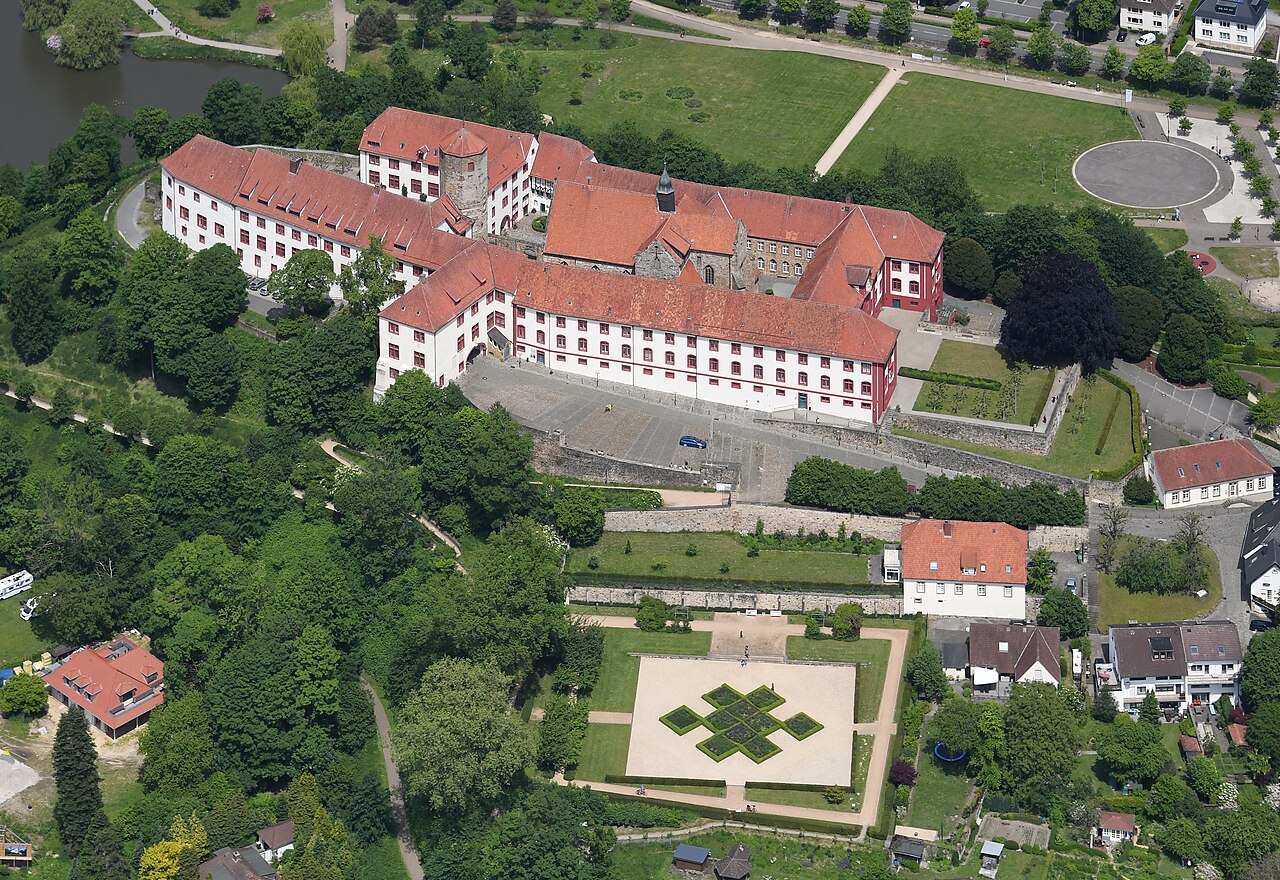
Wittekindsburg
Wittekindsburg is a significant early medieval fortification located in the municipality of Wallenhorst, Germany. This hill castle stands as the largest of its kind in Lower Saxony, covering approximately 16 hectares atop a prominent promontory in the Wiehengebirge hills. Its strategic position and robust defensive works illustrate the military and settlement strategies of the Saxon people during the early Middle Ages.
Early construction and historical context
The origins of Wittekindsburg trace back to the early 7th century, around 605 AD, marking it as a refuge settlement constructed by the Saxons, a Germanic tribe inhabiting the region. The initial fortifications consisted of outer ramparts and ditches designed to protect the inhabitants amid rising threats. These defenses predate the Saxon Wars (772–804 AD), a series of conflicts initiated by Charlemagne to subjugate the Saxons and incorporate their lands into the Frankish Empire.
During the Saxon Wars, Wittekindsburg served as a defensive stronghold against Frankish incursions. Following the conquest of Saxony by Charlemagne, the fort transitioned into Carolingian control. The Carolingian rulers undertook significant refurbishments and expansions of the fortifications from the late 8th through the 10th centuries. Radiocarbon dating of timber posts indicates ongoing occupation and maintenance from approximately 920 to 1020 AD.
Architectural layout and defensive features
The fort’s layout is roughly rectangular, measuring about 140 by 110 meters, and it is oriented to maximize natural defenses. The northern and southwestern sides benefit from steep slopes, reducing the need for heavy fortifications on those flanks. The western defenses include a substantial earth rampart backed by a dry stone wall nearly 85 centimeters thick, fronted by a deep V-shaped ditch over three meters deep, creating a formidable obstacle for attackers.
Similar defensive arrangements are present on the northern and southern sides, with the southern side featuring an additional outer ditch for enhanced protection. The eastern side, considered the most vulnerable, is fortified by a strong masonry wall built with mortar up to 1.15 meters thick. Behind this wall lies an earthen embankment, with a deep V-shaped ditch up to 3.9 meters in front, underscoring the importance of this approach.
Access to the fort was controlled through carefully designed gate complexes. The main enclosure and its eastern outer bailey both feature gates with chamfered chambers, a defensive design intended to regulate entry and provide strong points against assault. The outer bailey is enclosed by a mortar-bound stone wall with an earthen rampart, indicating a heavily fortified inner zone.
Two defensive towers mark the corners of the enclosure: a round tower in the southwest corner and a nearly seven-meter square tower integrated into the northeast corner’s eastern wall. This northeast corner also includes a corridor-like passage formed by the northern wall, likely leading down the slope to a water source, an essential feature for sustaining inhabitants during sieges.
Internal structures and settlement use
Excavations within the fort have revealed foundations of multiple wooden and stone buildings constructed in various phases. While the exact functions of these buildings remain uncertain, their diversity suggests a complex settlement involving habitation, military, and possibly administrative uses. The site’s continuous occupation through the early medieval period reflects its importance as a regional stronghold.
Later history and archaeological research
By the end of the 10th century, Wittekindsburg was abandoned as a fortification. Medieval documents from 1253 refer to a farmhouse on the site linked to the nearby Rulle monastery, indicating a shift from military to agricultural use. Despite its name, there is no direct evidence connecting the fort to Widukind, the Saxon leader who famously resisted Charlemagne.
Archaeological interest in Wittekindsburg began in the late 19th century with investigations led by Carl Schuchhardt around 1890. More extensive excavations between 1966 and 1972 uncovered detailed information about the fort’s construction and use. Research resumed in 2001 and continues to contribute to understanding this key early medieval site.
Preservation and present-day remains
Today, Wittekindsburg exists primarily as archaeological ruins with visible earthworks and foundation outlines. The surviving stone walls, ditches, and ramparts shape the landscape and provide insights into the fort’s defensive design. No artistic decorations or inscriptions have been found, but the preservation of structural elements allows clear study of early medieval fortification techniques.
The site’s extensive earthworks and masonry remain a valuable resource for understanding Saxon military architecture and settlement patterns. Wittekindsburg’s position and construction illustrate the evolving defensive strategies during a turbulent period of Germanic and Frankish history.
Frequently asked questions (FAQ)
- How do I get to Wittekindsburg?
- Wittekindsburg is located in Wallenhorst, Lower Saxony, Germany. Visitors can reach the site by car or local public transport, followed by a walk to the hillfort location.
- What is the historical significance of Wittekindsburg?
- Wittekindsburg is the largest early medieval Saxon hillfort in Lower Saxony, reflecting Saxon defensive strategies before and during the Carolingian conquest.
- Can I see original structures at Wittekindsburg?
- The site primarily consists of archaeological remains such as earthworks, foundation outlines, and partial stone walls, with no standing buildings.
- When was Wittekindsburg built and used?
- Wittekindsburg was initially constructed in the early 7th century and remained in use through the 10th century, with refurbishments during the Carolingian period.
- Is there a connection between Wittekindsburg and Widukind?
- Although the fort’s name suggests a link to Widukind, there is no direct historical evidence connecting the Saxon leader to Wittekindsburg.
Information
Loading map...
Visitor reviews
No reviews yet. Been here? Write the first review and help other travelers!
Write the first reviewVisited this castle? Share your experience
Your review helps other travelers and adds first-hand knowledge to our encyclopedia.