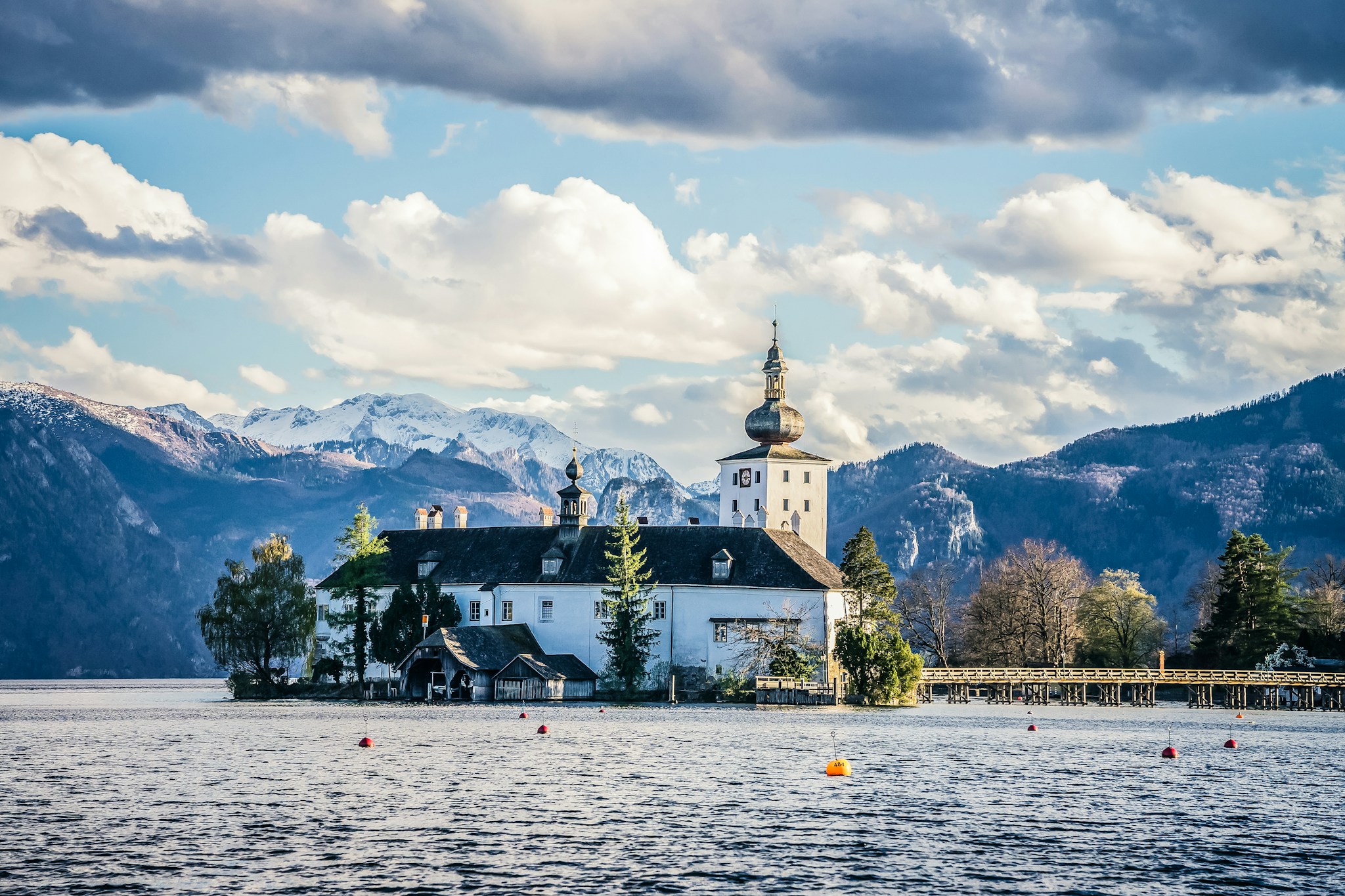
Wildenstein Castle
Wildenstein Castle, locally known as Burg Wildenstein, is a historic hill castle located near Kaltenbach in the province of Upper Austria. Nestled on a rocky spur of the Katrin mountain, it commands a strategic position overlooking the Traun valley. This medieval fortress, dating back to the 13th century, played a significant role in regional administration and the salt economy of the Salzkammergut area.
Early history and strategic significance
Although the first written mention of Burg Wildenstein dates from 1392, archaeological and architectural evidence suggests its origins lie firmly in the high medieval period, specifically the 13th century. The castle was originally constructed by regional powers to oversee and control the vital trade routes and resources in the Salzkammergut, a region famed for its salt mines. Salt was a highly valuable commodity in medieval Europe, and the castle's location allowed it to serve as a guardian of this economic lifeline.
The fortress's elevated position on the Katrin mountain provided a commanding view over the surrounding landscape, including the Traun valley. This vantage point was essential for early warning against potential invaders and for controlling movement through the region. The castle's placement reflects typical medieval military architecture principles, emphasizing natural topography to enhance defense.
Habsburg ownership and administrative role
From 1419, Wildenstein Castle became the property of the House of Habsburg, one of Europe's most powerful dynasties. Under Habsburg control, the castle's function evolved beyond a mere military stronghold to become an important administrative center. It served as the seat of the Pfleger, a governor responsible for managing legal and economic affairs in the Ischlland region, corresponding approximately to the modern Bad Ischl judicial district.
The castle's administrative duties included overseeing the production and trade of salt, which was a critical economic activity for the Habsburg monarchy. Burg Wildenstein acted as a local authority under the Austrian state treasury, regulating salt mining operations and ensuring the flow of this valuable resource. This role highlights the castle's importance not only as a defensive structure but also as a hub of regional governance.
Architectural features and fortifications
Burg Wildenstein was designed as a typical medieval hill castle, incorporating multiple defensive elements to protect against siege and assault. The fortress featured several towers and battlements, which provided elevated platforms for surveillance and defense. These towers were interconnected by robust curtain walls enclosing the castle's courtyard, creating a fortified perimeter.
The walls were pierced with arrow slits, narrow vertical openings that allowed archers to defend the castle while minimizing exposure. Surrounding the castle was an artificial moat, a trench that added an extra layer of defense by hindering enemy approach. The main entrance was protected by a drawbridge, which could be raised to prevent access across the moat during attacks.
The castle's construction utilized local stone, fashioned and assembled with medieval masonry techniques to ensure durability. Although much of the original architectural detail has been lost due to time and damage, surviving elements offer valuable insights into the military engineering of the period.
Fires, decline, and abandonment
Wildenstein Castle endured two major destructive fires in its history. The first, on August 28, 1593, caused significant damage but left the structure largely intact enough for rebuilding. However, a devastating fire in 1715 completely destroyed the castle, leaving it in ruins.
Following the 1715 fire, the decision was made not to reconstruct the fortress. Administrative functions previously housed at Wildenstein were relocated first to Reiterndorf near Ischl in 1717, then to the market town of Ischl, and eventually to Goisern in Neu-Wildenstein by 1770. This marked the end of the castle's active role in regional governance.
Modern preservation and visitor experience
Today, the ruins of Burg Wildenstein stand as a testament to its historical significance. Although the site is not extensively restored and lacks detailed architectural features, it offers visitors a unique glimpse into medieval fortification and administration in the Salzkammergut region.
Access to the castle ruins requires a 15-minute walk through forested paths, enhancing the sense of discovery and connection with nature. Local heritage groups such as the Bad Ischl Heimatverein and the Ritterbund Raubritter zue Wildensteyn have undertaken efforts to stabilize and partially restore the ruins, preserving the site for future generations.
Visitors can explore the remains of the walls, towers, and moat, appreciating the castle's strategic location and the craftsmanship of its construction. The surrounding natural environment adds to the appeal, making a visit to Wildenstein Castle a rewarding experience for history enthusiasts and hikers alike.
Cultural and historical importance
Wildenstein Castle holds an important place in the history of Upper Austria and the broader Salzkammergut region. Its connection to the Habsburg dynasty and its role in managing the vital salt economy underscore its significance in medieval and early modern Austria.
The castle's ruins serve as a cultural landmark, reflecting the architectural styles and defensive strategies of the high medieval period. Preservation efforts continue to highlight the importance of maintaining such sites to understand regional history, governance, and economic development during the Middle Ages.
Frequently asked questions (FAQ)
- How do I reach Wildenstein Castle from the nearest road?
- Wildenstein Castle can be reached by a 15-minute walk through forest paths from the nearest roads, providing a scenic approach to the ruins.
- What is the historical significance of Wildenstein Castle?
- Wildenstein Castle was a key administrative center under the Habsburgs, overseeing the salt economy in the Salzkammergut region during the high medieval period.
- Is Wildenstein Castle open to the public?
- Yes, the ruins of Wildenstein Castle are freely accessible to visitors year-round, allowing exploration of the site without an entrance fee.
- What architectural features remain at Wildenstein Castle?
- Visitors can see portions of the curtain walls, towers, moat, and the site of the drawbridge, reflecting typical high medieval defensive architecture.
- Why was Wildenstein Castle abandoned?
- After a devastating fire in 1715, the castle was not rebuilt, and administrative functions were relocated to nearby towns, leading to its abandonment.
Information
Current owner
Local heritage organizations
Loading map...
Visitor reviews
No reviews yet. Been here? Write the first review and help other travelers!
Write the first reviewVisited this castle? Share your experience
Your review helps other travelers and adds first-hand knowledge to our encyclopedia.