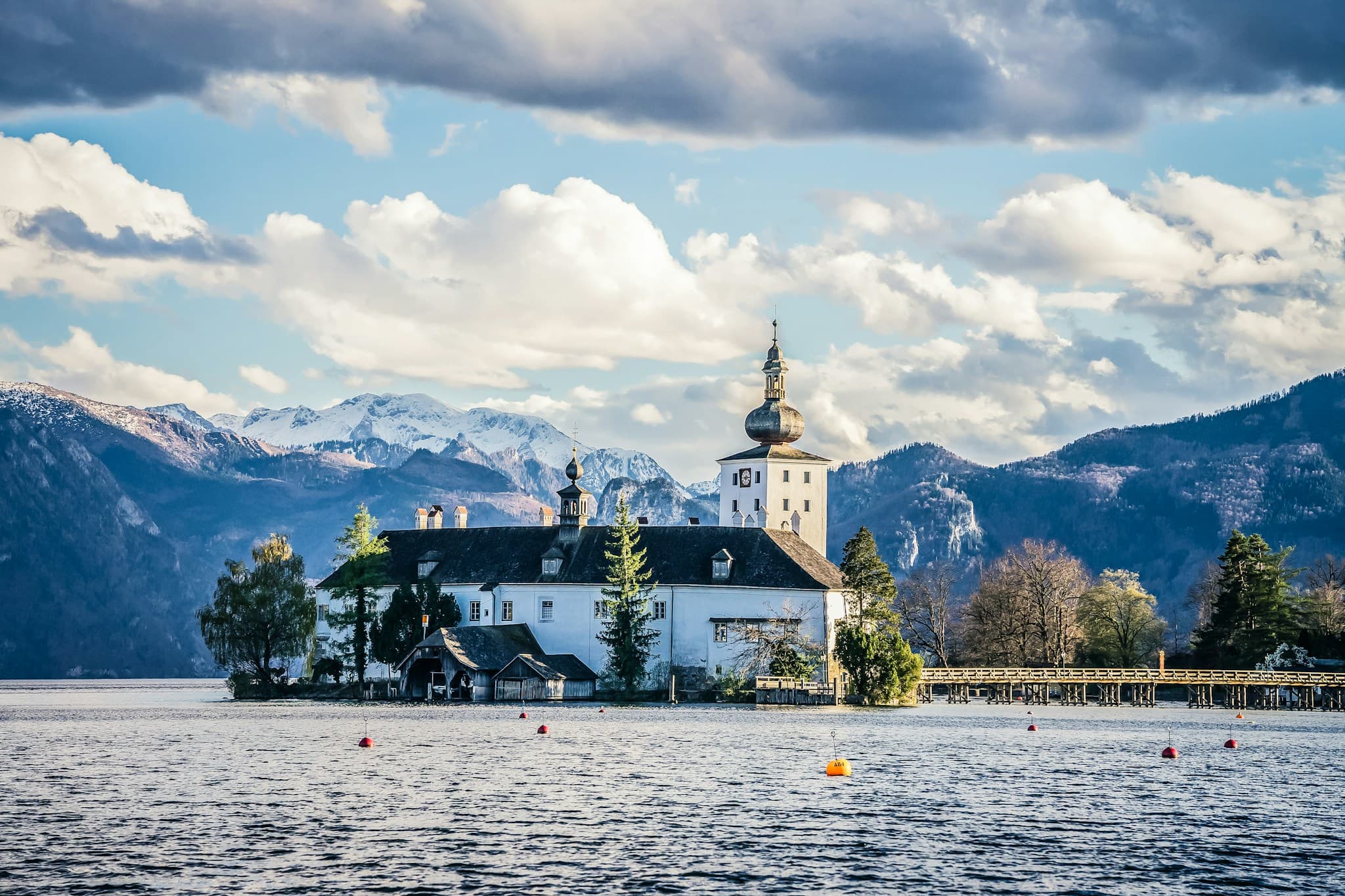
Schloss Ort
Schloss Ort is a remarkable hill castle located on a small island in the Traunsee lake near the town of Gmunden in Upper Austria. Founded around 1080 by Hartnidus of Ort, this castle is one of the oldest and most historically significant structures in the Salzkammergut region. Its unique setting on an island surrounded by water has contributed to its enduring allure and strategic importance throughout the centuries.
The castle's origins trace back to the high medieval period, with the initial construction reflecting the typical characteristics of an early water castle. Originally, it was fortified with a moat and outer walls to protect against invaders, serving both defensive and residential functions. Over time, the castle underwent numerous modifications and expansions, particularly during the 13th century, as successive owners adapted it to changing architectural styles and needs.
Early history and ownership transitions
The founding family, the von Ort lineage, maintained control of the castle from its establishment until the mid-13th century. The last of the family, Hartnidus V, made significant improvements in 1244 before the family's decline following a dispute with their overlord, which led to their imprisonment and loss of the estate.
Ownership passed through several noble families thereafter. In 1344, the castle was purchased by the brothers Friedrich and Reinprecht I of Wallsee, with Friedrich becoming the sole owner in 1350. The Wallsee family held the castle until 1483, when it was acquired by Frederick III, Holy Roman Emperor. This marked a pivotal moment in the castle's history, as it transitioned from a feudal stronghold to an imperial residence.
Renaissance era and imperial influence
Under the rule of Frederick III and subsequent governors such as Gotthard von Starhenberg (1484–1491) and the Starhenberg family until 1584, Schloss Ort was transformed with enhancements befitting a luxurious residence rather than a purely military fortress. The castle's architecture began to reflect Renaissance influences, with more emphasis on comfort and aesthetic appeal.
In the late 16th century, the castle changed hands several times, including ownership by Weikhard Freiherr of Pollheim and the city of Gmunden. However, the high maintenance costs led Gmunden to sell the castle to Rudolf II in 1595. The castle eventually returned to imperial possession under Leopold I, Holy Roman Emperor.

Photo by Willian Justen de Vasconcellos
Turmoil during the 17th century and reconstruction
The Thirty Years’ War brought significant upheaval to the region. In 1620, Upper Austria was pawned to Bavaria, and Adam Graf von Herberstorff became governor, residing at Schloss Ort. He is infamously associated with the brutal Frankenburg Dice Games of 1625, where peasants were executed by a cruel game of chance.
The following year, in 1626, the castle was attacked and largely destroyed by rebellious peasants during the Upper Austrian Peasants’ War. The fire devastated much of the structure, necessitating extensive rebuilding. Johann Warmund acquired the castle from Herberstorff's widow and led the reconstruction completed in 1634, which gave the castle much of its present late Gothic architectural character.
Architectural features post-reconstruction
The rebuilt castle features an irregular triangular layout around a central courtyard, with late Gothic elements such as two-sided double-storey arcades and an external staircase typical of the period. The castle retains a chapel dedicated to St. James the Greater, constructed in 1634, which remains a highlight of the interior.
Notably, three of the original four prison cells from the castle's use as a state prison remain intact, along with a "hunger tower" historically associated with imprisonment and deprivation. A unique feature is the castle’s 1634 clock mechanism, which is still operational today and requires daily manual winding.
Later history and cultural significance
In the 19th century, the castle was acquired by Archduke John Salvator of Austria (also known as Johann Orth) in 1876. His dramatic renunciation of his imperial title and mysterious disappearance at sea in 1890 add a romantic aura to the castle's history. The castle reverted to Emperor Franz Joseph I in 1914 but was intended for public educational use before World War I intervened.
Since 1995, Schloss Ort has been owned by the city of Gmunden and serves as a museum and venue for cultural events. Its picturesque location and rich history have made it a popular tourist destination, further popularized by the German-Austrian television series "Schlosshotel Orth," filmed here from 1996 to 2004.
The city castle (landschloss ort)
Adjacent to the island castle is the Landschloss Ort, built between 1626 and 1629 on the site of former farm buildings destroyed during the peasants’ war. This castle features a square courtyard with four towers topped by onion-shaped domes and a rococo fountain dated 1777.
The interior boasts a painted wooden coffered ceiling from the early 17th century and large paintings from the 1910 International Hunting Exhibition in Vienna. The exterior windows are protected by wrought-iron grilles dating from the 17th century, and original stucco frames adorn doors and fireplaces.
Environment and preservation
The castle grounds include a naturally protected siltation zone on the western side of the island, preserving the local ecosystem around this historic site. The preservation of architectural elements and the natural environment contribute to Schloss Ort's status as a cultural heritage landmark in Austria.
Visitors today can explore the castle's rich history, architectural beauty, and natural surroundings, making Schloss Ort a unique destination for those interested in medieval castles, imperial history, and Austrian culture.
Frequently asked questions (FAQ)
- How do I visit Schloss Ort and what are the opening hours?
- Schloss Ort is open to the public as a museum and cultural venue. Visiting hours vary seasonally, so it is best to check the official website or local tourist information for current times.
- What is the historical significance of Schloss Ort?
- Schloss Ort is one of the oldest castles in the Salzkammergut region, with origins dating back to the 11th century. It has served as a noble residence, imperial property, prison, and forestry study center, reflecting diverse historical roles.
- Can I explore the interior prison cells and chapel?
- Yes, visitors can tour the castle's interior, including the preserved prison cells and the chapel dedicated to St. James the Greater, which showcase the castle's medieval and early modern history.
- Is Schloss Ort accessible for visitors with mobility issues?
- Due to its historic architecture and island location, some areas of Schloss Ort may have limited accessibility. It is advisable to contact the castle administration ahead of your visit for specific accessibility information.
- What architectural styles are evident in Schloss Ort?
- The castle predominantly features late Gothic architectural elements from its 17th-century reconstruction, including arcades and external staircases, along with Renaissance influences from earlier modifications.
Photo gallery

Photo by Leonhard Niederwimmer


Information
Sources & official resources
Verify the information above using these authoritative references.
Loading map...
Visitor reviews
No reviews yet. Been here? Write the first review and help other travelers!
Write the first reviewVisited this castle? Share your experience
Your review helps other travelers and adds first-hand knowledge to our encyclopedia.



