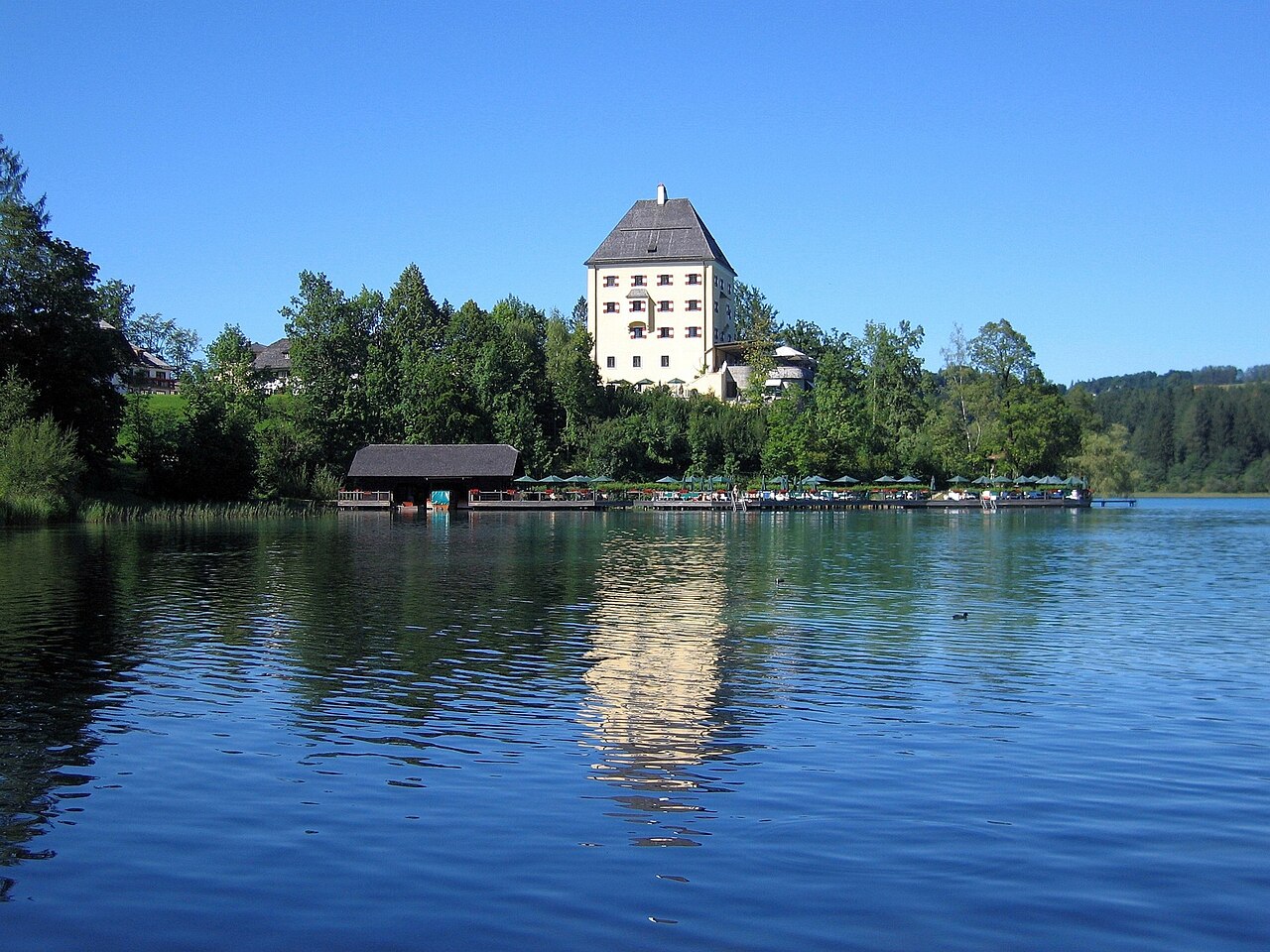
Wildeneck Castle
Wildeneck Castle stands as a significant medieval fortress ruin located within the municipality of Zell am Moos in Austria. Originally constructed around 1140 by Rapoto I of Ortenburg, a notable noble from medieval Bavaria, the castle exemplifies the strategic and administrative roles typical of High Medieval hill castles in the region. Its position atop a steep rocky outcrop overlooking the western shore of the Irrsee lake and on the eastern slope of the Kolomansberg hillside highlights its defensive importance and control over surrounding lands.
Medieval origins and feudal significance
The establishment of Wildeneck Castle during the 12th century reflects the expansion of the Ortenburg family's influence in the Bavarian and Austrian borderlands. Rapoto I of Ortenburg initiated the construction to secure territorial claims and oversee judicial and fiscal matters in the area. The castle's early role was closely tied to feudal governance, serving as a noble residence and administrative center.
Throughout the 13th and 14th centuries, Wildeneck's ownership shifted in response to the complex political landscape. In 1286, the castle was sold to Dukes Stephan and Otto of Lower Bavaria, only to be reacquired by Count Heinrich III of Ortenburg in 1321. This reacquisition restored Ortenburg control and reinforced the castle's status as a local power base.
Administrative role and judicial authority
Around 1370, the castle became the center of the Wildeneck bailiwick, a judicial district under the treasury office in Burghausen. The bailiwick's caretakers acted as both overseers and judges, administering justice and managing fiscal responsibilities. This administrative function underscores the castle's dual military and civil significance in the late medieval period.
In the following centuries, control over Wildeneck alternated between the Bavarian dukes, the Archbishopric of Salzburg, and the Mondsee monastery. Transactions recorded in 1390, 1462, 1494, 1506, and 1565 illustrate the ongoing jurisdictional negotiations and territorial disputes typical of the era. These shifts reflect the castle's strategic value and the contested nature of regional authority.
Decline and abandonment
By the late 16th or early 17th century, specifically by either 1572 or 1611, Wildeneck Castle was abandoned following the transfer of the judicial seat to Mondsee. This move diminished the castle's administrative importance and initiated its physical decline. The abandonment coincided with broader changes in territorial administration and the reduced military relevance of such fortifications.
The region experienced persistent legal and fiscal conflicts, including disputes over judicial authority and tax rights, which continued until the Peace of Teschen in 1779. This treaty incorporated the Innviertel region into Austria, stabilizing governance and ending many territorial disputes. Additionally, the castle's history is marked by social unrest, notably peasant revolts between 1611 and 1662, which were suppressed by ruling authorities, reflecting the turbulent socio-political climate of the time.
Architectural features and current condition
The ruins of Wildeneck Castle reveal a typical hill castle layout adapted to its natural environment. The site occupies a steep rocky promontory, providing commanding views and natural defensive advantages. Remnants include a partially preserved tower and enclosing defensive walls, which once formed a protective circuit around the main structures.
Vegetation now covers much of the enclosing walls, but their original function as a barrier against attackers remains evident. A notable defensive feature is the deep neck ditch on the approach side, a narrow trench cut into the terrain designed to impede enemy access. Archaeological evidence suggests the presence of a drawbridge spanning this ditch, though no physical remains survive.
Within the castle grounds, depressions correspond to the locations of vaulted rooms and chambers that have collapsed over time. These vaulted spaces were characteristic of medieval stone construction, providing durable ceilings and secure underground areas. The ruins also include fragments of walls and other structural elements, offering insights into the castle's defensive architecture and spatial organization.
Access to the site requires a steep climb from the lakeshore, consistent with the castle's elevated and strategic position. While no decorative elements or inscriptions have been documented in the surviving ruins, the site remains a valuable example of medieval fortification adapted to its natural terrain and administrative functions.
Historical context and regional significance
Wildeneck Castle's history reflects the broader political and social dynamics of the Bavarian-Austrian border region during the High and Late Middle Ages. Its construction and use by the Ortenburg family illustrate the role of noble families in territorial control and administration. The castle's changing ownership and jurisdictional disputes mirror the fragmented and contested nature of medieval European governance.
The castle's decline corresponds with shifts in administrative centers and the evolving military technology that rendered many hill castles obsolete. Despite its ruinous state, Wildeneck remains a testament to the medieval feudal system and the architectural strategies employed to defend and manage territory in a challenging landscape.
Frequently asked questions (FAQ)
- How do I access Wildeneck Castle ruins?
- Access to Wildeneck Castle ruins involves a steep climb from the western shore of Irrsee lake near Zell am Moos. Visitors should be prepared for uneven terrain and wear appropriate footwear.
- What is the historical significance of Wildeneck Castle?
- Wildeneck Castle was built around 1140 by Rapoto I of Ortenburg and served as a feudal administrative center and judicial district in medieval Austria, reflecting regional political dynamics.
- When was Wildeneck Castle abandoned?
- The castle was abandoned by either 1572 or 1611 after the judicial seat was transferred to Mondsee, marking the end of its administrative role.
- What remains can be seen at Wildeneck Castle today?
- Visitors can see ruins including a partially preserved tower, enclosing walls, a deep neck ditch, and depressions indicating vaulted chambers, illustrating its medieval defensive design.
- Is there any visitor infrastructure at Wildeneck Castle?
- Wildeneck Castle ruins are in a natural state with no developed visitor facilities. There are no ticket requirements or opening hours, but visitors should plan accordingly for the hike and terrain.
Information
Loading map...
Visitor reviews
No reviews yet. Been here? Write the first review and help other travelers!
Write the first reviewVisited this castle? Share your experience
Your review helps other travelers and adds first-hand knowledge to our encyclopedia.