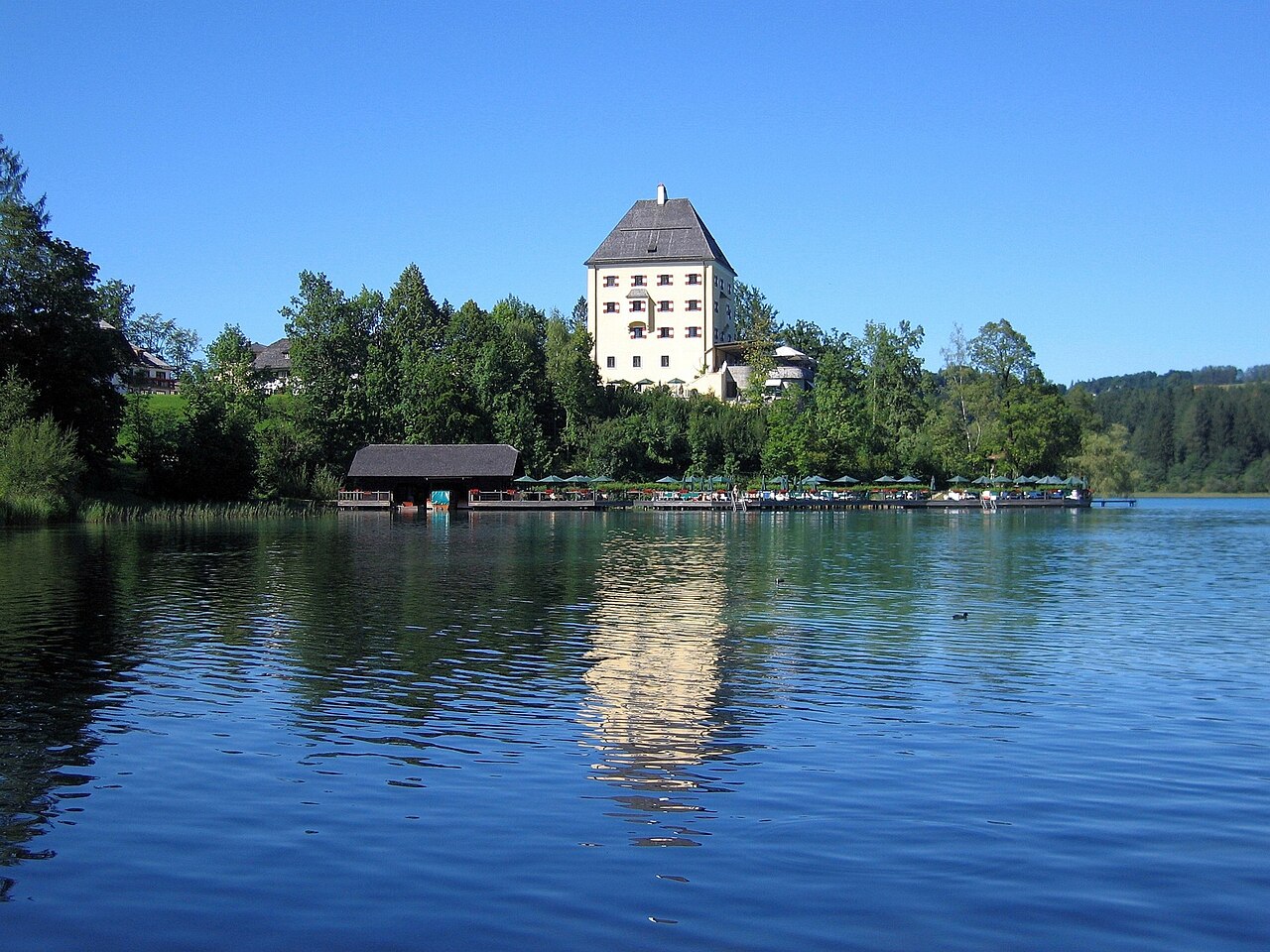
Burg Lichtentann
Burg Lichtentann stands as a significant medieval hill castle ruin located near Henndorf am Wallersee in Austria. This fortress, perched at an elevation of 736 meters above sea level, embodies the historical and architectural legacy of the High Middle Ages in the region. Established by the noble Herren von Tann family, who were ministeriales serving the Archbishops of Salzburg, the castle played a crucial role in local governance and military defense during a turbulent era marked by shifting allegiances and territorial disputes.
The initial construction phase began circa 1272 under the direction of Eckhart VI. von Tann. This period coincided with the Interregnum (1254–1273) of the Holy Roman Empire, a time when imperial authority was notably weak, allowing regional powers greater autonomy. The castle’s erection without formal permission from the Archbishopric of Salzburg led to a temporary seizure by Archbishop Friedrich II. von Walchen, who held the castle for five years before it was returned to the von Tann family. This episode highlights the complex feudal relationships and the delicate balance of power between secular and ecclesiastical authorities.
Historical significance and feudal conflicts
By 1314, Eckhart VII. von Tann agreed to halt further expansion of Burg Lichtentann through a formal accord, yet construction was completed, solidifying the castle’s stature as a local power seat. The castle was integral to the administration of the Henndorf county, which was divided into two judicial districts: Lichtentann-Köstendorf and Altentann-Seekirchen. These districts exercised high jurisdiction, including the authority to adjudicate serious criminal cases and impose capital punishment, underscoring the castle’s role as a center of legal and administrative control.
The 14th century brought a series of conflicts involving the Archbishops of Salzburg and the Bavarian dukes, with the von Tann family embroiled in the so-called "Tanner Fehde". This feud exemplifies the frequent territorial and political struggles that shaped the medieval landscape of the region. Ultimately, in 1369, control of Burg Lichtentann and its judicial authority was permanently transferred to the Archbishopric of Salzburg, marking a shift from noble family dominance to ecclesiastical administration.
Administrative role and decline
Following its acquisition by the Archbishopric, Burg Lichtentann served primarily as an administrative center. It housed pfleger, officials appointed by the archbishops to manage local courts and oversee the surrounding territories. This function continued until the 17th century, when administrative reforms and the destruction of nearby Burg Altentann in 1680 led to the consolidation of judicial responsibilities elsewhere. Consequently, Burg Lichtentann was abandoned, and over time, much of its stonework was repurposed for other constructions.
By the early 19th century, ownership had passed to the Moser family, notable for their brewing enterprise, reflecting the castle’s transition from a feudal stronghold to a historical relic entwined with local economic developments.
Architectural features and current remains
The ruins of Burg Lichtentann occupy a strategic hilltop position, characteristic of hill castles designed for defense and surveillance. The site preserves the layout typical of medieval fortifications, with fortified stone walls encircling an inner courtyard. Significant portions of the outer gate remain, illustrating the castle’s controlled access points and defensive strategies.
The surviving masonry reveals robust construction techniques typical of the 13th and 14th centuries, with thick walls designed to withstand sieges. While detailed internal plans are unavailable, the ruins suggest a well-organized complex with living quarters, administrative chambers, and defensive structures. The absence of decorative elements or inscriptions indicates a primarily functional design focused on military and administrative needs rather than aesthetic embellishment.
Burg Lichtentann’s proximity to Burg Altentann highlights its role within a network of noble estates that collectively managed local governance and justice. Despite centuries of neglect and stone removal, the ruins remain an important cultural and historical landmark, offering valuable insight into the feudal and ecclesiastical history of the Salzburg region.
Visiting burg lichtentann today
Today, Burg Lichtentann is accessible via several walking routes, including the popular Eiszeitrundweg, which attracts hikers and history enthusiasts alike. The site’s elevated position provides scenic views of the surrounding landscape, enhancing its appeal as a destination for cultural tourism and outdoor recreation.
Visitors can explore the castle’s remnants, gaining a tangible connection to the medieval past through the preserved walls and gate structures. Informational signage and local guides help contextualize the castle’s historical significance, making it an educational experience for those interested in medieval architecture and Austrian history.
Preservation and future prospects
While Burg Lichtentann remains a ruin, efforts to maintain the site focus on preventing further deterioration and promoting its historical value. Preservation initiatives aim to stabilize the remaining structures and enhance visitor safety, ensuring that this emblematic hill castle continues to inform and inspire future generations.
As a testament to the region’s medieval heritage, Burg Lichtentann offers a unique window into the complex interplay of noble power, ecclesiastical authority, and architectural ingenuity that shaped Austria’s history during the High and Late Middle Ages.
Frequently asked questions (FAQ)
- What are the opening hours of Burg Lichtentann?
- Burg Lichtentann is open to visitors from 9 AM to 5 PM daily. It is advisable to check the castle's official website for any seasonal changes in opening hours or special events that may affect access.
- How do I get to Burg Lichtentann?
- Burg Lichtentann is located in Henndorf am Wallersee, Austria, and can be easily accessed by car or public transport. The nearest train station is in Salzburg, from which you can take a bus or taxi to reach the castle.
- Is it possible to take guided tours of the castle?
- Yes, guided tours are available at Burg Lichtentann, providing visitors with in-depth information about the castle's history and architecture. It is recommended to book tours in advance, especially during peak tourist seasons.
- What is the historical significance of Burg Lichtentann?
- Burg Lichtentann dates back to the medieval period and played a crucial role in the region's defense and governance. Its well-preserved structures and artifacts offer insight into the historical lifestyle and architectural styles of the time.
- Can I take photos inside the castle?
- Photography is generally allowed in designated areas of Burg Lichtentann, but flash photography may be restricted to protect the artworks and artifacts. Always check for signage or ask a staff member if you are unsure.
- When is the best time to visit Burg Lichtentann?
- The best time to visit Burg Lichtentann is during the spring and early autumn months when the weather is mild and the surrounding landscape is particularly beautiful. Additionally, visiting during weekdays may help you avoid larger crowds.
- What are the ticket prices for visiting Burg Lichtentann?
- Ticket prices for Burg Lichtentann are quite reasonable, with discounts available for children, students, and seniors. It’s advisable to check the official website for the latest pricing and any special offers that may be available.
- Are there any nearby attractions to visit?
- Yes, there are several attractions near Burg Lichtentann, including the picturesque Wallersee lake and the charming town of Henndorf. Visitors can enjoy various outdoor activities such as hiking, cycling, and water sports in the surrounding area.
- Is Burg Lichtentann accessible for individuals with mobility challenges?
- Burg Lichtentann strives to be accessible for all visitors, with some facilities available for those with mobility challenges. However, due to the historical nature of the castle, certain areas may have limitations; it is best to inquire ahead for specific accessibility options.
Information
Loading map...
Visitor reviews
No reviews yet. Been here? Write the first review and help other travelers!
Write the first reviewVisited this castle? Share your experience
Your review helps other travelers and adds first-hand knowledge to our encyclopedia.