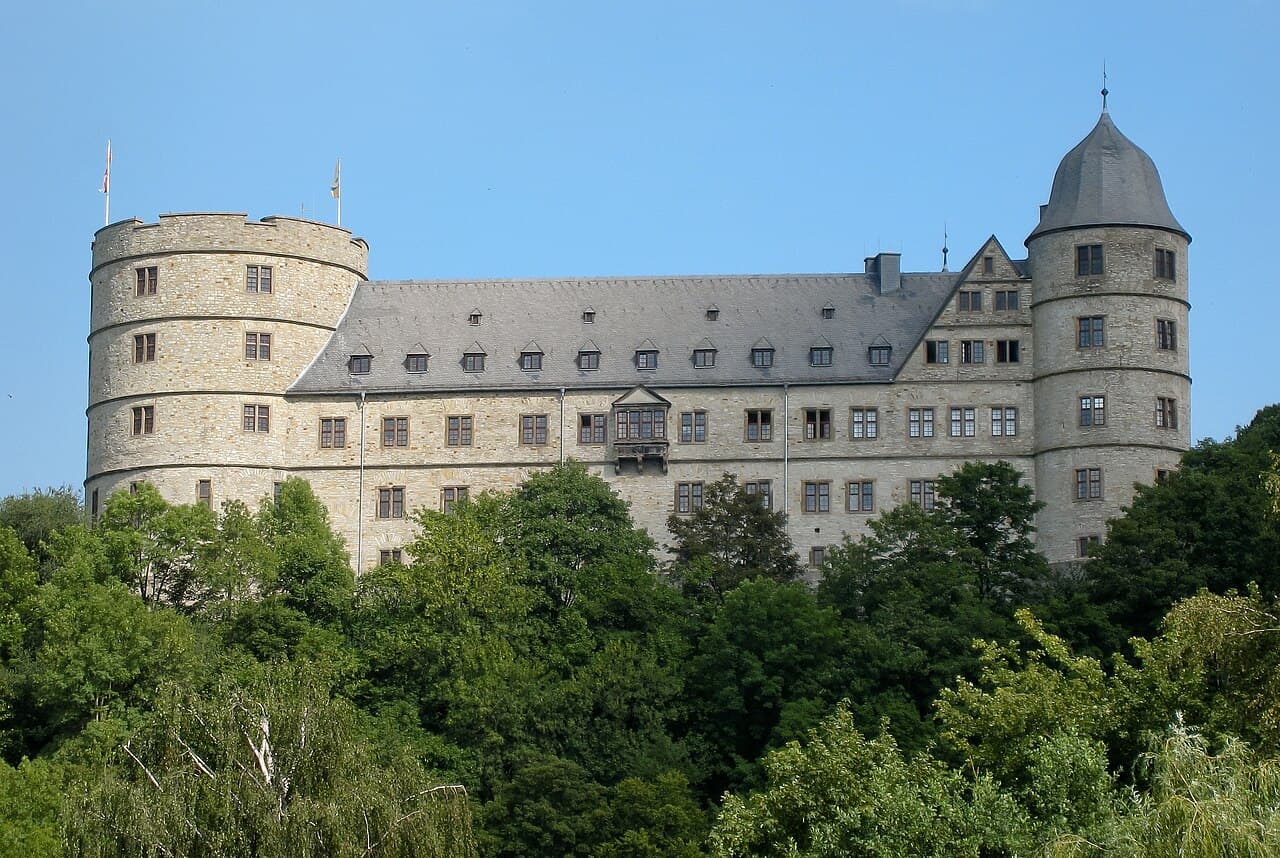
Wewelsburg castle stands as a remarkable example of Renaissance architecture in the region of Buren, Germany. Its distinctive triangular layout, featuring three imposing round towers connected by massive curtain walls, sets it apart from more traditional castle designs. Originally constructed in the early 17th century, the castle was strategically positioned as a hill castle to oversee the surrounding landscape and provide a defensible stronghold.
Architectural design and features
The castle's triangular plan is unique in European fortifications, with each of the three round towers serving both defensive and symbolic purposes. The massive stone walls connecting the towers enclose a central courtyard, which historically served as a functional space for gatherings and military drills. The castle's design reflects Renaissance ideals of symmetry and proportion, while also incorporating practical defensive elements such as battlements and narrow arrow slits.
Inside, the castle contains a variety of chambers, halls, and vaulted rooms that were used for residential, administrative, and military functions. The great hall and the knights' hall are notable for their architectural detailing, including ornate woodwork and stone carvings that exemplify Renaissance craftsmanship.
Historical significance and ss era
While the castle dates back to the 17th century, its most infamous period came in the 20th century. After 1934, Wewelsburg castle was appropriated by the Schutzstaffel (SS) under the leadership of Heinrich Himmler. Himmler envisioned the castle as the ideological center and cult site for the SS, intending to transform it into a symbol of Nazi mysticism and power. Plans were drawn up for extensive expansions to create a complex that would serve as the spiritual and administrative heart of the SS.
During this time, the castle was used for SS ceremonies and meetings, and it became associated with the occult and pseudo-historical narratives promoted by the Nazi regime. However, the full realization of Himmler's plans was never completed due to the outbreak of World War II and the eventual defeat of Nazi Germany.
Post-war restoration and current use
Following the war, the castle underwent significant restoration efforts to repair damage and remove Nazi symbolism. In 1950, Wewelsburg was reopened to the public as a museum dedicated to its complex history, including exhibits on its medieval origins, Renaissance architecture, and the SS period. Additionally, the castle now houses a large youth hostel, making it a popular destination for tourists and educational groups.
The museum offers visitors a chance to explore the castle's unique architectural features, learn about its layered history, and reflect on the darker chapters of the 20th century. The surrounding area also provides scenic views and opportunities for hiking and cultural tourism.
Cultural heritage and tourism
Wewelsburg castle is recognized as an important cultural heritage site in Germany. Its combination of Renaissance architecture and 20th-century history attracts a diverse audience, from architecture enthusiasts to historians and general tourists. The castle's preservation as a restored hill castle allows visitors to experience the imposing structure in a well-maintained condition, providing insight into both its military origins and its role in modern history.
Educational programs and guided tours are available, emphasizing the castle's architectural uniqueness and its significance within the broader context of German and European history.
Frequently asked questions (FAQ)
- How do I get to Wewelsburg castle?
- Wewelsburg castle is located near the town of Buren in North Rhine-Westphalia, Germany. It is accessible by car and public transportation, with local bus services connecting to nearby towns. Parking is available near the castle for visitors arriving by car.
- What is the historical significance of Wewelsburg castle?
- Wewelsburg castle is notable for its Renaissance architecture and its use by the SS under Heinrich Himmler during the Nazi era. It was intended to be the central cult site for the SS, making it a unique historical landmark with complex layers of history.
- Can I stay overnight at Wewelsburg castle?
- Yes, the castle houses a large youth hostel that offers accommodations for visitors. This provides a unique opportunity to experience the castle atmosphere overnight while exploring its history and surroundings.
- When is the best time to visit Wewelsburg castle?
- The castle is open year-round, but the best time to visit is during spring and summer when the weather is favorable for exploring the castle grounds and nearby hiking trails. Guided tours are available daily during visiting hours.
- Are guided tours available at Wewelsburg castle?
- Yes, guided tours are offered to provide detailed insights into the castle's architecture, history, and its association with the SS. Tours can be booked in advance or upon arrival at the museum.
Photo gallery

Information
Opening hours
10:00-17:00, daily
Ticket prices
€5 adult, €3 child
Current owner
State museum
Website
Visit websiteSources & official resources
Verify the information above using these authoritative references.
Loading map...
Visitor reviews
No reviews yet. Been here? Write the first review and help other travelers!
Write the first reviewVisited this castle? Share your experience
Your review helps other travelers and adds first-hand knowledge to our encyclopedia.



