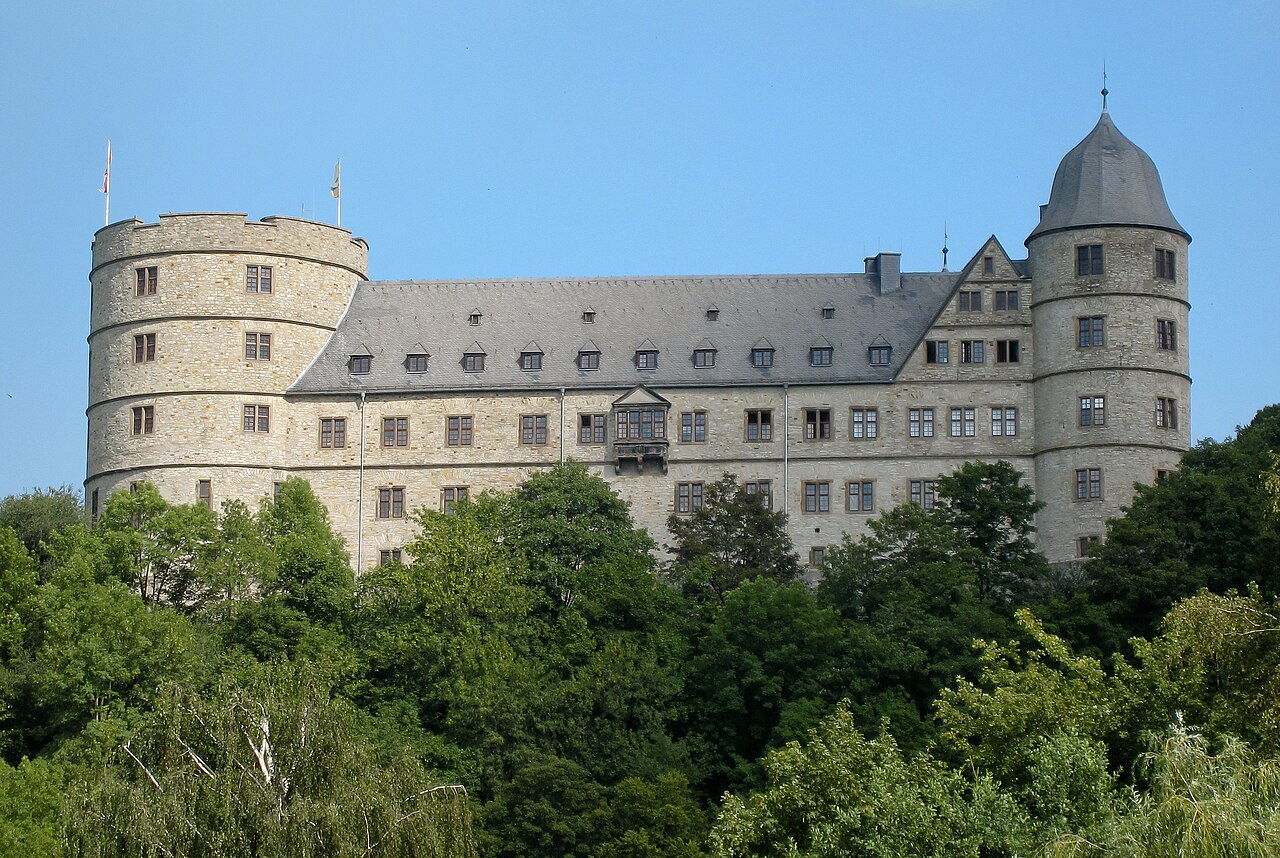
Ringelstein Castle
Ringelstein Castle, located near the village of Harth in the municipality of Büren, Germany, is a significant late medieval hill castle ruin with a rich history spanning several centuries. Constructed in the 14th century, this castle served multiple roles, from a strategic stronghold and noble residence to a hunting lodge and a judicial center during turbulent times.
The castle's origins trace back to 1383 when the Davensberg branch of the noble lords of Büren acquired it as a fief from Archbishop Friedrich III of Cologne. This acquisition marked the beginning of the castle's role as an important outpost in the Alme valley, held jointly by the Davensberg family and the Archbishopric of Cologne. Early records mention a fortification at this site as early as 1376 under the name “nyen borch boven Buren,” though it remains uncertain if this referred to an earlier structure or an unfinished predecessor to Ringelstein Castle.
Medieval origins and ownership transitions
The castle was built as a strategic lookout overseeing the Alme valley, a vital geographic feature in the region. In 1394, the Davensbergers pawned their half of the castle to Johann von Scharfenberg, a member of the Padberg family, while another share was pledged to Hermann von Padberg. This division of ownership reflects the complex feudal relationships and political maneuvering of the time. The castle was fully redeemed by Berthold von Büren in 1399, when the name Burg Ringelstein first appears in written records.
Throughout the 15th century, Ringelstein remained a noble residence and administrative center. In 1458, it was granted as a fief to the Landgrave of Hesse, indicating its continued political importance. Members of the Büren family served under the Landgraves, with notable appointments such as Johann von Büren's lifelong councilor role in 1519 under Landgrave Philipp I.
Architectural features and castle layout
Ringelstein Castle was constructed as a hill castle atop a prominent spur overlooking the Alme valley, providing commanding views and defensive advantages. Excavations have revealed a complex layout with several functional buildings and significant defensive structures.
The castle's fortifications included a substantial defensive tower that once rose approximately 20 meters, serving both surveillance and protection roles. Although now in ruins, the tower's remains demonstrate robust masonry construction typical of late medieval military architecture.
Noteworthy are the vaulted cellars and underground passages discovered during archaeological excavations. These vaulted spaces, built with durable stone masonry and arched ceilings, were used for storage of essential provisions such as eggs, wine, and meat, as confirmed by a detailed inventory from 1574. This inventory also lists a brewhouse, bakehouse, brushwood stable, and granary, indicating a self-sufficient estate capable of supporting the needs of a noble household.
The witches' cellar and judicial role
A particularly somber part of the castle's history is its role during the Thirty Years' War as a judicial center for witch trials. The Hexenkeller, or "witches' cellar," was used as a prison and torture chamber for those accused of witchcraft. In 1631 alone, 55 people were convicted and executed within a span of 30 days, reflecting the dark period of persecution associated with the castle.
Later history and decline
By the late 16th century, Ringelstein Castle had transitioned into a hunting lodge for the Büren nobility, as evidenced by the 1574 inventory listing multiple domestic and agricultural buildings. However, after 1802, the castle's strategic and administrative importance waned, leading to its gradual decline and eventual ruin.
Modern archaeological excavations began in December 2005, uncovering important structural remains and providing insights into the castle's construction and use. Since 2006, restoration efforts have focused on stabilizing the ruins, particularly the vaulted ceilings and masonry walls, to preserve the site for future generations.
Cultural significance and preservation
Today, the ruins of Burg Ringelstein stand as a testament to its layered history, reflecting its evolution from a medieval fortress to a noble residence, hunting lodge, and judicial site. The castle's prominent hilltop location continues to offer expansive views of the Alme valley, connecting visitors with the region's medieval past.
Preservation efforts emphasize maintaining the architectural integrity of the remaining structures, allowing for public engagement with this historically significant site. The castle's association with witch trials adds a unique dimension to its heritage, drawing interest from historians and visitors alike.
Ringelstein Castle remains an important cultural landmark within the region of North Rhine-Westphalia, embodying the complex feudal, political, and social history of the late medieval period in Germany.
Frequently asked questions (FAQ)
- How do I get to Ringelstein Castle?
- Ringelstein Castle is located near the village of Harth in the municipality of Büren, North Rhine-Westphalia, Germany. Visitors can reach the site by car or local public transport, followed by a short hike up the hill to the ruins.
- What is the historical significance of Ringelstein Castle?
- Ringelstein Castle was a strategic medieval hill castle built in the 14th century, serving as a noble residence, hunting lodge, and judicial center during the Thirty Years' War, notably for witch trials.
- Can I visit the witches' cellar at Ringelstein Castle?
- The Hexenkeller, or witches' cellar, is part of the castle ruins and can be viewed during guided tours or special events, providing insight into the castle's judicial past during the 17th century.
- When is the best time to visit Ringelstein Castle?
- The best time to visit Ringelstein Castle is during the warmer months from late spring to early autumn when the weather is favorable for hiking and exploring the hilltop ruins.
- Are there guided tours available at Ringelstein Castle?
- Guided tours are occasionally offered by the local municipality or historical societies, especially during special events or heritage days, enhancing visitors' understanding of the castle's history and architecture.
Information
Sources & official resources
Verify the information above using these authoritative references.
Loading map...
Visitor reviews
No reviews yet. Been here? Write the first review and help other travelers!
Write the first reviewVisited this castle? Share your experience
Your review helps other travelers and adds first-hand knowledge to our encyclopedia.