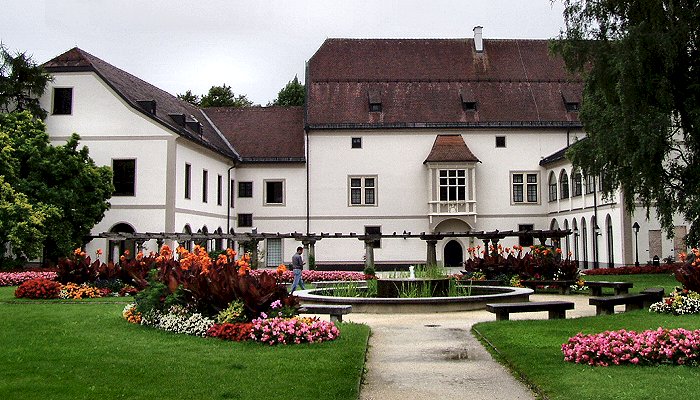
Wasserschloss Hueb
Wasserschloss Hueb is a remarkable example of a moated castle located in the municipality of Hueb, Austria. This castle exemplifies the strategic and architectural ingenuity of medieval fortifications, enhanced over centuries with Baroque stylistic elements and artistic embellishments. Surrounded entirely by a water-filled moat, Wasserschloss Hueb stands as a testament to the feudal history and evolving architectural trends in Central Europe.
Medieval origins and feudal ownership
The earliest documented mention of Wasserschloss Hueb dates back to 1356, when the estate was held as a fief by the Volkensdorffer family. It was granted to Eberhard Mühlwanger, a city judge of Steyr, highlighting the castle's early role in regional governance and administration. Over the following centuries, ownership passed through several noble families, including the Prueschenk brothers, Siegmund and Heinrich, who served as feudal lords of the castle. By the early 16th century, the estate was acquired by the Sproll family in 1525, and later, in 1557, ownership transferred to Daniel Luger, a prominent citizen of Steyr.
Peasant uprising and social tensions
A significant historical episode associated with Wasserschloss Hueb occurred in the late 16th century, around 1588, when high taxes imposed by the son of Urban Johann Steurer triggered a peasant uprising. This unrest was not isolated to Wasserschloss Hueb but also affected neighboring estates such as Eggendorf and Leompach. The revolt underscores the tensions between the local nobility and peasantry during this period, reflecting broader socio-economic challenges in the region.
Architectural evolution and baroque transformation
Following a devastating fire towards the end of the 17th century, Wasserschloss Hueb underwent significant reconstruction around 1700. This rebuilding phase was overseen during the ownership of Wolf Spiller von Mitterberg (1696-1709) and introduced many of the architectural features visible today. The castle’s design integrates its original medieval moated structure with Baroque architectural elements, particularly evident in its distinctive towers and decorative details.
Structural features and artistic elements
The castle is distinguished by its water-filled moat that completely encircles the building, a classic defensive feature of moated castles. Access is provided by a stone bridge adorned with a statue of Saint Nepomuk, symbolizing protection against water-related dangers and reflecting the cultural-religious motifs common in Central European castles.
One of the castle’s most notable architectural features is a projecting turret positioned at one corner, which adds both defensive capability and aesthetic interest. The rear façade is dominated by a large tower capped with an onion dome roof, a hallmark of Baroque design. This tower includes open arcades on its ground and first floors, supported by robust granite columns, which lend the structure both elegance and strength.
Adjacent to the tower, an open terrace with a granite balustrade offers an outdoor space that historically may have served leisure or defensive purposes. Surrounding the castle grounds is a park featuring several stone sculptures, including a religious group depicting Mary as Queen of Heaven with the infant Jesus and angels, as well as Baroque-style figures and lion statues. These artistic elements enrich the castle’s cultural heritage and highlight the tastes of its historical owners.
Ownership changes and modern restoration efforts
Throughout its history, Wasserschloss Hueb has changed hands multiple times, reflecting the shifting political and social landscape of the region. After the Pröller von Ladendorf family acquired it in 1608, the estate was later held by figures such as Johann Friedrich Mörk von Gneisenau in 1650 and the ecclesiastical authority of Schlierbach Abbey. Eventually, Ehrenreich von Schallenberg consolidated Wasserschloss Hueb with the nearby estate of Eggendorf.
In the 20th century, the castle saw new uses and owners. The Wiesmayer family operated a tavern on the premises after acquiring it in 1956. In 1961, ownership passed to the Wimmer family, and currently, the castle is privately owned by Erwin Machgraber, an antiques dealer from Marchtrenk. Mr. Machgraber has been actively engaged in restoration efforts aimed at preserving the castle’s historical character and architectural integrity.
Current condition and cultural significance
Today, Wasserschloss Hueb appears largely unoccupied and shows signs of needing renovation. However, ongoing conservation work seeks to restore the building in a manner consistent with its historical and architectural significance. The castle’s combination of medieval water defenses, Baroque architectural features, and sculptural park elements makes it a valuable cultural heritage site in Austria.
Wasserschloss Hueb offers a tangible connection to the region’s feudal past, showcasing the evolution of castle architecture from medieval fortification to Baroque residence. Its rich history of ownership, social conflict, and artistic embellishment provides a multifaceted narrative that continues to attract interest from historians, architects, and visitors alike.
Frequently asked questions (FAQ)
- What is the historical significance of Wasserschloss Hueb?
- Wasserschloss Hueb is a remarkable example of a water castle in Austria, showcasing the region's medieval architectural heritage. Built in the 12th century, it served as a defensive stronghold and residence for nobility, reflecting the social and political dynamics of its time.
- When is the best time to visit Wasserschloss Hueb?
- The best time to visit Wasserschloss Hueb is during the late spring and early autumn months when the weather is pleasant and the surrounding landscapes are at their most beautiful. This period also features fewer crowds, allowing for a more enjoyable exploration of the castle and its grounds.
- Can I take guided tours of Wasserschloss Hueb?
- Yes, guided tours of Wasserschloss Hueb are available, providing visitors with in-depth knowledge about its history and architecture. These tours are typically conducted by knowledgeable guides who share fascinating stories and insights about the castle's past.
- Is it possible to access Wasserschloss Hueb with mobility aids?
- Wasserschloss Hueb strives to be accessible for all visitors, including those with mobility aids. However, due to its historical structure, some areas may have limited accessibility, so it's advisable to check in advance for specific accommodations.
- What are the opening hours of Wasserschloss Hueb?
- Wasserschloss Hueb generally opens its doors to visitors from 9 AM to 5 PM, with extended hours during the peak tourist season. It is recommended to check the official website for any seasonal changes or special events that may affect opening times.
- How much do tickets cost to visit Wasserschloss Hueb?
- Ticket prices for Wasserschloss Hueb vary depending on the type of tour and any special exhibitions. Generally, adult tickets range from €8 to €12, while discounts are often available for students, seniors, and children.
- What nearby attractions can I explore while visiting Wasserschloss Hueb?
- While visiting Wasserschloss Hueb, you can explore several nearby attractions such as the picturesque village of Hueb, scenic hiking trails, and other historic sites in the region. The surrounding countryside offers beautiful landscapes, perfect for outdoor activities.
- How do I get to Wasserschloss Hueb?
- Wasserschloss Hueb is easily accessible by car and public transportation from major cities in Austria. Visitors can take a train to the nearest station and then a short bus ride or taxi to reach the castle, making it a convenient destination for day trips.
Information
Loading map...
Visitor reviews
No reviews yet. Been here? Write the first review and help other travelers!
Write the first reviewVisited this castle? Share your experience
Your review helps other travelers and adds first-hand knowledge to our encyclopedia.