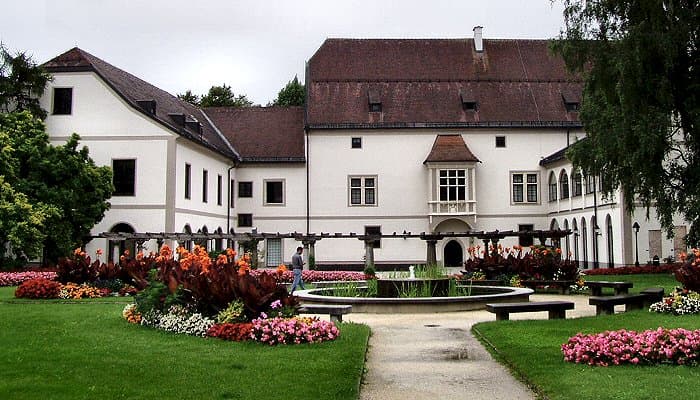
Burg Wels is a prominent hill castle located in the historic town of Wels in Upper Austria. Its origins trace back to the early medieval period, specifically to the year 776, when it was first established as a wooden fortification. This initial structure was built to defend the local settlement against incursions by the Avars, a nomadic group that posed a significant threat to the region during that era.
Through the 9th century, Burg Wels evolved from a simple wooden fort into a more formidable stronghold, becoming recognized as a curtis regia, or royal court castle, under the Carolingian dynasty. This status underscored its importance as a regional administrative and military center. The castle successfully withstood the Hungarian raids of the 10th century, a testament to its strategic location and defensive capabilities.
Medieval transformations and noble ownership
During the 12th and 13th centuries, Burg Wels underwent substantial architectural changes. The original wooden fortifications were replaced with stone structures, reflecting the broader medieval trend toward more durable and defensible castles. Around this time, the castle came under the control of various noble families, including the counts of Wels and Lambach, and later the Formbach counts. In 1158, it was acquired by Margrave Ottokar III of Steyr, further cementing its status as a key regional fortress.
The castle's ownership shifted again in 1186 when the Babenberg dynasty took control. By the early 13th century, specifically around 1220, Duke Leopold VI had secured parts of the castle's holdings. Throughout the Middle Ages, Burg Wels was typically administered by appointed bailiffs rather than serving as a permanent noble residence. This administrative arrangement allowed the castle to function as a regional hub for governance and justice.
Notable historical events
One of the castle's significant historical moments occurred in 1235 when Emperor Frederick II celebrated his engagement within its walls. Later, under the reign of Przemysl Ottokar, the castle served as a venue for important regional meetings, highlighting its continued political relevance.
Renaissance expansions and imperial connections
In the late 15th and early 16th centuries, Burg Wels experienced further development under the patronage of Emperor Maximilian I. The emperor was a frequent visitor, particularly for hunting expeditions in the surrounding forests. Between 1504 and 1514, he commissioned expansions in the late Gothic style, which included the addition of architectural features that enhanced both the castle's defensive and residential functions.
Maximilian I ultimately died at Burg Wels in 1519, cementing the castle's place in imperial history. The castle's status was elevated in 1654 to that of a county under Johann Weikhard, Prince Auersperg. By the mid-18th century, the castle governed an area with nearly 1,450 subjects, reflecting its administrative importance.
Architectural features and layout
Burg Wels is situated in the southeastern part of Wels' historic center. Originally, the castle was surrounded by a moat, which has since been filled in, changing the approach to the site. The castle's layout historically comprised four wings arranged around a courtyard, all constructed in the Gothic architectural style. Today, only the south and west wings remain intact, facing a garden that provides a scenic outdoor space connected to the castle.
The castle's roof features a steep pitch typical of Gothic design, contributing to its distinctive silhouette. A notable architectural element is the oriel window on the courtyard side of the south wing. This elevated bay window is supported from below and exemplifies late Gothic craftsmanship. Although it is simpler and smaller than the famous Golden Roof in Innsbruck, it shares stylistic similarities that highlight the regional Gothic tradition.
On the west wing, Renaissance pergolas stand on the courtyard side, an unusual feature in Upper Austria that indicates the castle's architectural evolution over time. The west wing also preserves original Gothic door jambs and window sills, which offer insights into medieval construction techniques.
Historical interiors
Within the west wing lies a chamber of great historical significance: the room where Emperor Maximilian I died. This space is now part of the castle's museum circuit, allowing visitors to connect with the castle's imperial past. The east wing was a later addition from the 19th century, constructed to house a margarine factory after the castle was acquired by Ludwig Hinterschweiger.
Above the court entrance archway, visitors can see the imperial coat of arms, a symbol of the castle's royal associations and its historical significance within the Habsburg realm.
Lapidarium and preservation
Along the north wall of the west wing and enclosing the garden's western side is a lapidarium containing gravestones and monuments dating from the 15th to the 19th centuries. These stone relics were relocated from local churches and cemeteries, preserving a tangible record of regional funerary art within the castle grounds.
Burg Wels is legally protected as a historic monument by the Republic of Austria, ensuring its architectural and cultural legacy is preserved for future generations. Since 1937, the castle has been owned by the city of Wels and repurposed primarily for cultural and museum uses, making it an accessible site for visitors interested in medieval and Renaissance history.
Visiting burg wels today
Today, visitors to Burg Wels can explore its surviving wings, appreciate the blend of Gothic and Renaissance architectural elements, and learn about the castle's rich history through its museum exhibitions. The castle's location within the historic center of Wels makes it a convenient destination for those interested in the medieval heritage of Upper Austria.
The castle's garden and lapidarium offer additional points of interest, providing a peaceful environment for reflection on the region's past. While some parts of the original complex no longer survive, the preserved structures and collections provide valuable insights into the castle's role as a military, administrative, and cultural center across centuries.
Frequently asked questions (FAQ)
- What is the historical significance of Burg Wels?
- Burg Wels is a significant medieval castle in Austria, originally built in the 12th century. It served as a residence for the Counts of Wels and played a vital role in the region's political history. The castle's architecture reflects the various styles that evolved over the centuries, making it a key site for understanding Austria's medieval past.
- When was Burg Wels built?
- The construction of Burg Wels began in the late 12th century, with significant modifications and expansions occurring in the following centuries. Its strategic location and robust design made it an important fortress during the medieval period. The castle has been preserved and restored, allowing visitors to appreciate its long history.
- Can I visit Burg Wels year-round?
- Yes, Burg Wels is open to visitors throughout the year, although specific opening hours may vary by season. It's recommended to check the official website or contact the castle for the most current visiting hours. This allows guests to explore the castle’s rich history and stunning architecture during their visit.
- What are the ticket prices for visiting Burg Wels?
- Ticket prices for Burg Wels are generally affordable, with discounts available for students, seniors, and groups. Children under a certain age may enter for free or at a reduced rate. It's best to check the official website for the latest pricing information and any special offers.
- Is it possible to explore the castle's interior?
- Yes, visitors can explore the interior of Burg Wels, where guided tours are often available to enhance the experience. These tours provide insights into the castle's history, architecture, and the lives of those who once inhabited it. Self-guided tours may also be an option, allowing for a more personalized exploration.
- What is the best time to visit Burg Wels?
- The best time to visit Burg Wels is during the spring and early autumn when the weather is mild and ideal for exploring the grounds. Additionally, visiting during the summer months may provide opportunities for special events or festivals hosted at the castle. However, it's advisable to check the calendar for any seasonal activities before planning your visit.
- How accessible is Burg Wels for visitors with disabilities?
- Burg Wels strives to be accessible for all visitors, including those with disabilities. While some areas of the castle may have limited access due to its historical structure, there are facilities and accommodations in place to assist visitors. It’s recommended to contact the castle in advance to inquire about specific accessibility options and available routes.
- What nearby attractions can I visit while in Wels?
- While visiting Burg Wels, you can also explore the charming city of Wels, which offers a variety of attractions, including museums, parks, and local markets. Nearby, the Wels Zoo and the historic town center provide additional opportunities for sightseeing. Consider spending a full day in the area to fully appreciate its rich culture and history.
Photo gallery

Photo by Gerhard Anzinger, Wels•Public domain
Information
Website
Visit websiteSources & official resources
Verify the information above using these authoritative references.
Loading map...
Visitor reviews
No reviews yet. Been here? Write the first review and help other travelers!
Write the first reviewVisited this castle? Share your experience
Your review helps other travelers and adds first-hand knowledge to our encyclopedia.


