Waldegg Castle
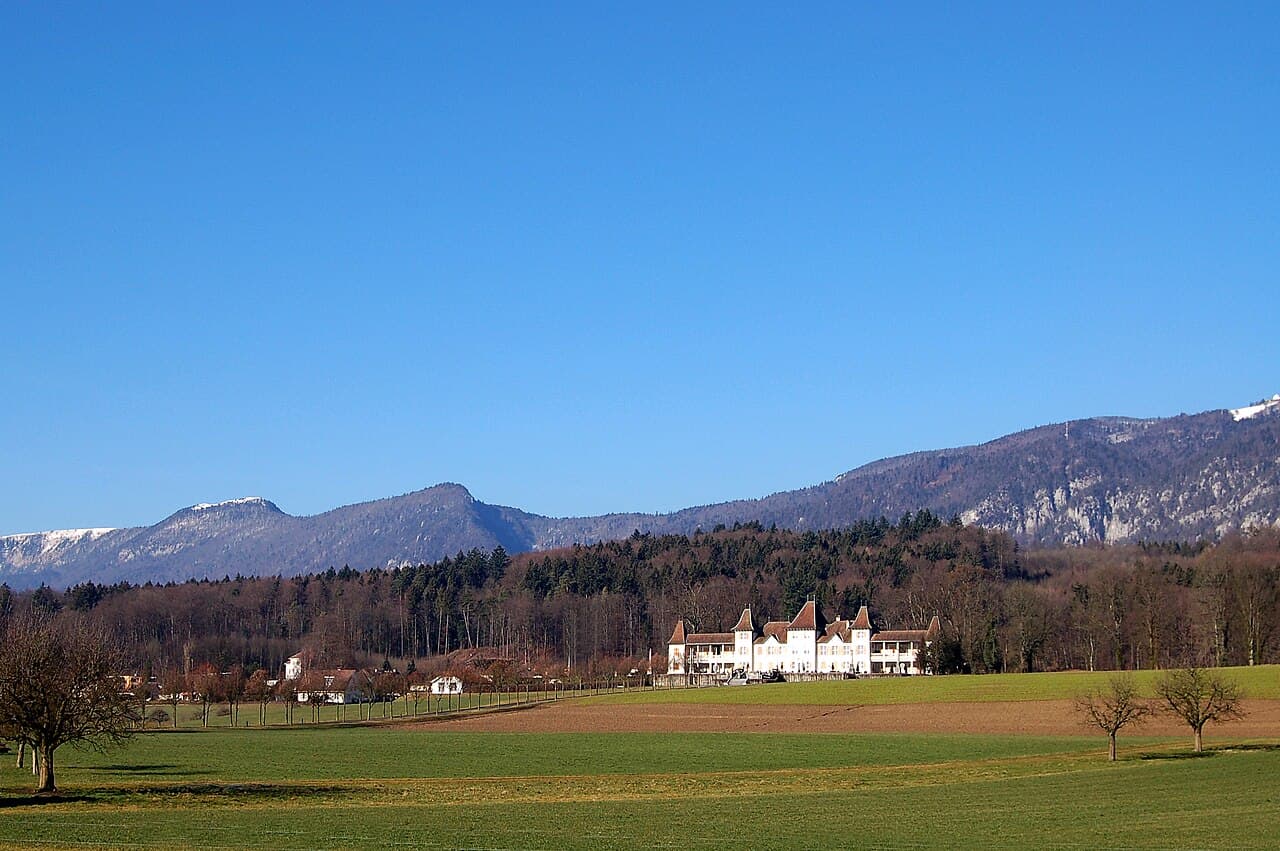
Waldegg Castle, located near Solothurn in the municipality of Feldbrunnen-St. Niklaus, Switzerland, is a Baroque hill castle renowned for its architectural elegance, historical significance, and cultural heritage. Constructed between 1682 and 1686, it served originally as the summer residence of Schultheiss Johann Viktor von Besenval (1638-1713) and his wife Maria Margaritha von Sury (1649–1713). The castle exemplifies the Turmlihaus style typical of the region, while skillfully incorporating elements of French and Italian Baroque architecture, making it a unique fusion of local and continental design influences.
Architectural design and features
The castle's layout centers around a main building with three large towers, flanked symmetrically by two-story galleries each crowned with corner turrets. These galleries are adorned with allegorical statues carved in 1683 by Johann Peter Frölicher, which add artistic depth and symbolism to the castle's exterior. The eastern turret houses the castle chapel, featuring a high-Baroque altar dating from 1720, illustrating the religious and artistic priorities of the era.
Inside, the castle boasts richly decorated interiors that reflect the tastes of its noble inhabitants. The main hall is embellished with ten allegorical paintings representing the Arts and Sciences, accompanied by supraporte and trompe-l'œil illusions that enhance the spatial experience and artistic sophistication. The eastern salon features a grisaille style ceiling painting, a monochromatic technique that emphasizes form and volume, while the western salon and billiard room display intricate trompe-l'œil ceiling paintings that create optical illusions of architectural depth and decoration.
Historical development and ownership
After its initial construction, the castle underwent significant renovations between 1729 and 1734 under the direction of Johann Viktor II von Besenval (1671-1736), a diplomat and officer in the French Swiss Guards. He added a theater and the chapel of St. Michael, and redecorated the interiors in the prevailing French style of the period. During his travels, he acquired numerous works of art from France, enriching the castle's cultural assets.
Baron Peter Viktor von Besenval (1721-1791), born at Waldegg Castle, contributed to its development by adding an orangery in 1780. However, his life was largely spent in France. The French Revolution of 1789 severely impacted the family's fortunes, forcing them to flee to Switzerland due to their close ties to the French nobility. This marked the beginning of the castle's decline in prominence.
Following the extinction of the Besenval family line, the castle was abandoned until its purchase in 1865 by Joseph von Sury von Besenval. He introduced two apartments and transformed the original Baroque garden into an English landscape garden, reflecting the 19th-century taste for naturalistic garden design.
Modern restoration and cultural role
In 1963, ownership of Waldegg Castle passed to the Waldegg Castle Foundation. By 1975, the castle became the headquarters for the Center for Intercultural Dialogue, an organization dedicated to promoting understanding among Switzerland's diverse linguistic and cultural communities. This modern use reflects the castle's ongoing role as a site of cultural exchange and education.
Starting in 1985, an extensive renovation and repair project was undertaken, lasting approximately twenty years. The castle museum opened in 1991, allowing public access to its rich collections and historic interiors. These efforts have preserved Waldegg Castle as a well-preserved example of Baroque architecture and a significant cultural landmark in the Canton of Solothurn.
Artistic treasures and chapel highlights
The castle's chapels contain notable artworks, including reproductions of St. Michael by Raphael and St. Raphael by Domenico Fetti. The originals of these masterpieces are housed in the Louvre, underscoring the high artistic standards and connections of the Besenval family. The high-Baroque altar in the eastern chapel is a fine expression of religious art from the early 18th century.
Garden evolution and landscape architecture
The transformation from a formal Baroque garden to an English garden in the 19th century marked a significant shift in the castle's landscape architecture. The English garden style favored naturalistic arrangements, winding paths, and varied plantings, contrasting with the geometric precision of Baroque gardens. This change reflects broader European trends in garden design during that period.
Location and heritage significance
Waldegg Castle is situated in the municipality of Feldbrunnen-St. Niklaus, near the city of Solothurn in Switzerland. It is recognized as a Swiss heritage site of national significance, highlighting its importance in the cultural and architectural history of the region. The castle's blend of local and international architectural styles, its rich history tied to prominent families, and its role in fostering intercultural dialogue contribute to its enduring significance.
Visitor information and accessibility
Today, Waldegg Castle operates as a museum and cultural center, welcoming visitors interested in its architecture, history, and art collections. The castle's well-preserved interiors and gardens offer insight into the lifestyle of Swiss nobility during the Baroque period. Visitors can explore the castle's halls, chapels, and galleries, as well as enjoy the surrounding gardens that reflect centuries of landscape design evolution.
Frequently asked questions (FAQ)
- How do I visit Waldegg Castle and what are the opening hours?
- Waldegg Castle is open to the public as a museum and cultural center. Visitors should check the official website or contact the Waldegg Castle Foundation for current opening hours, as they may vary seasonally or for special events.
- What architectural styles are featured in Waldegg Castle?
- The castle showcases a blend of the local Turmlihaus style with French and Italian Baroque architectural elements, evident in its towers, galleries, and interior decorations.
- When was Waldegg Castle built and who was its original owner?
- Waldegg Castle was constructed between 1682 and 1686 as the summer residence of Schultheiss Johann Viktor von Besenval and his wife Maria Margaritha von Sury.
- Can I see original artworks inside the castle?
- While the castle houses reproductions of important artworks such as St. Michael by Raphael and St. Raphael by Domenico Fetti, the originals are located in the Louvre. The castle's interior features original allegorical paintings and trompe-l'œil decorations.
- What is the significance of the castle's gardens?
- Originally a Baroque garden, the grounds were transformed into an English landscape garden in the 19th century, reflecting changing tastes in garden design and adding to the castle's historic charm.
Photo gallery

Information
Current owner
Waldegg Castle Foundation
Loading map...
Visitor reviews
No reviews yet. Been here? Write the first review and help other travelers!
Write the first reviewVisited this castle? Share your experience
Your review helps other travelers and adds first-hand knowledge to our encyclopedia.