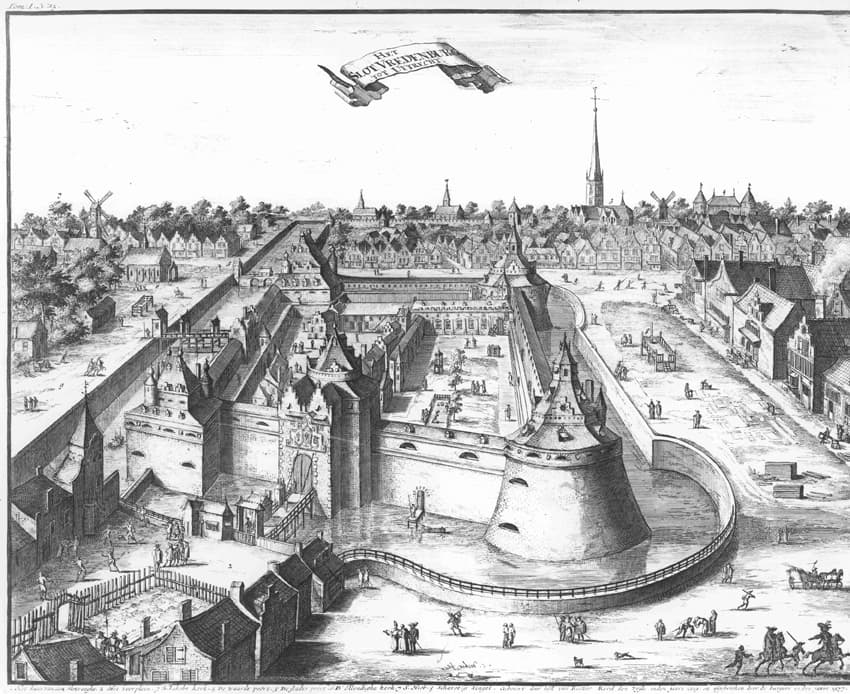
Vredenburg
Vredenburg Castle, known in Dutch as Kasteel Vredenburg or Vredeborch, was a prominent 16th-century Renaissance hill castle constructed under the orders of Habsburg emperor Charles V in the city of Utrecht, Netherlands. Built during a period of significant political and religious upheaval, the castle was intended as a strategic military fortress and symbol of imperial authority in the region.
Historical context and purpose
Commissioned in the early 16th century, Vredenburg Castle was erected to assert control over the rebellious city of Utrecht, which had a history of resistance against Habsburg rule. The castle's construction began shortly after Charles V's consolidation of power in the Low Countries, reflecting the broader European trend of fortifying urban centers to maintain imperial dominance during the Renaissance period.
The castle served as both a military stronghold and administrative center, designed to house troops and control key access points within Utrecht. Its presence was a clear message to the local population about the emperor's authority and the need for order in a turbulent era marked by religious and political conflict.
Architectural design and features
As a hill castle, Vredenburg was strategically located on elevated ground to maximize defensive capabilities and surveillance over the surrounding cityscape. The castle's design incorporated typical Renaissance military architecture elements, including thick walls, bastions, and artillery platforms adapted to withstand cannon fire, which was becoming increasingly important in siege warfare at the time.
The layout featured a compact, polygonal fortress with angled bastions at the corners, allowing defenders to cover all approaches effectively. The walls were constructed from brick and stone, materials commonly used in the Netherlands during the period. Although detailed architectural plans have not survived, historical records and archaeological findings suggest the presence of a central keep, curtain walls, and a moat that enhanced the castle's defensive perimeter.
Short lifespan and legacy
Despite its formidable construction, Vredenburg Castle had a relatively brief existence, standing for only about 50 years. It was largely demolished in the early 17th century as political circumstances changed and Utrecht's military needs evolved. The castle's removal was also influenced by urban development pressures and shifts in military technology that rendered such fortifications less critical.
Today, remnants of the castle remain visible at Vredenburg Square in Utrecht, where archaeological excavations have uncovered foundations and fragments of the original structure. These remains provide valuable insight into Renaissance military architecture in the Netherlands and the historical significance of Habsburg influence in the region.
Vredenburg castle in the context of Dutch fortifications
Vredenburg Castle represents a key example of Renaissance fortification in the Netherlands, reflecting the transition from medieval castles to modern bastioned forts designed to counter artillery. Its construction aligns with a broader European movement toward adapting castle architecture to new warfare technologies.
Although the castle no longer stands in its entirety, its historical footprint contributes to the understanding of Utrecht's urban and military development during a critical period. The site continues to attract interest from historians, archaeologists, and visitors intrigued by the city's layered past.
Visiting and cultural significance
While the castle itself no longer exists as a complete structure, the archaeological site at Vredenburg Square offers a tangible connection to Utrecht's Renaissance history. Interpretive displays and signage help visitors appreciate the castle's original scale and purpose.
The site is accessible to the public and forms part of Utrecht's rich cultural heritage, often included in historical tours of the city. It serves as a reminder of the complex political dynamics of the 16th century and the architectural responses to emerging military challenges during the Renaissance.
Frequently asked questions (FAQ)
- When was Vredenburg Castle built and by whom?
- Vredenburg Castle was built in the 16th century by Habsburg emperor Charles V to establish control over Utrecht.
- What architectural style characterizes Vredenburg Castle?
- The castle is an example of Renaissance military architecture with bastions and thick walls adapted for artillery defense.
- Can visitors see any remains of Vredenburg Castle today?
- Yes, archaeological remains of the castle are visible at Vredenburg Square in Utrecht and are accessible to the public.
- Why was Vredenburg Castle demolished after only 50 years?
- The castle was demolished due to changing military needs, urban development, and advances in warfare technology that made it less relevant.
- Is Vredenburg Castle significant in Dutch history?
- Yes, it represents an important phase of Renaissance fortification and Habsburg influence in the Netherlands during the 16th century.
Photo gallery

Photo by Coenraet Decker•Public domain
Information
Address
Vredenburg square, Utrecht, Netherlands
Loading map...
Visitor reviews
No reviews yet. Been here? Write the first review and help other travelers!
Write the first reviewVisited this castle? Share your experience
Your review helps other travelers and adds first-hand knowledge to our encyclopedia.



