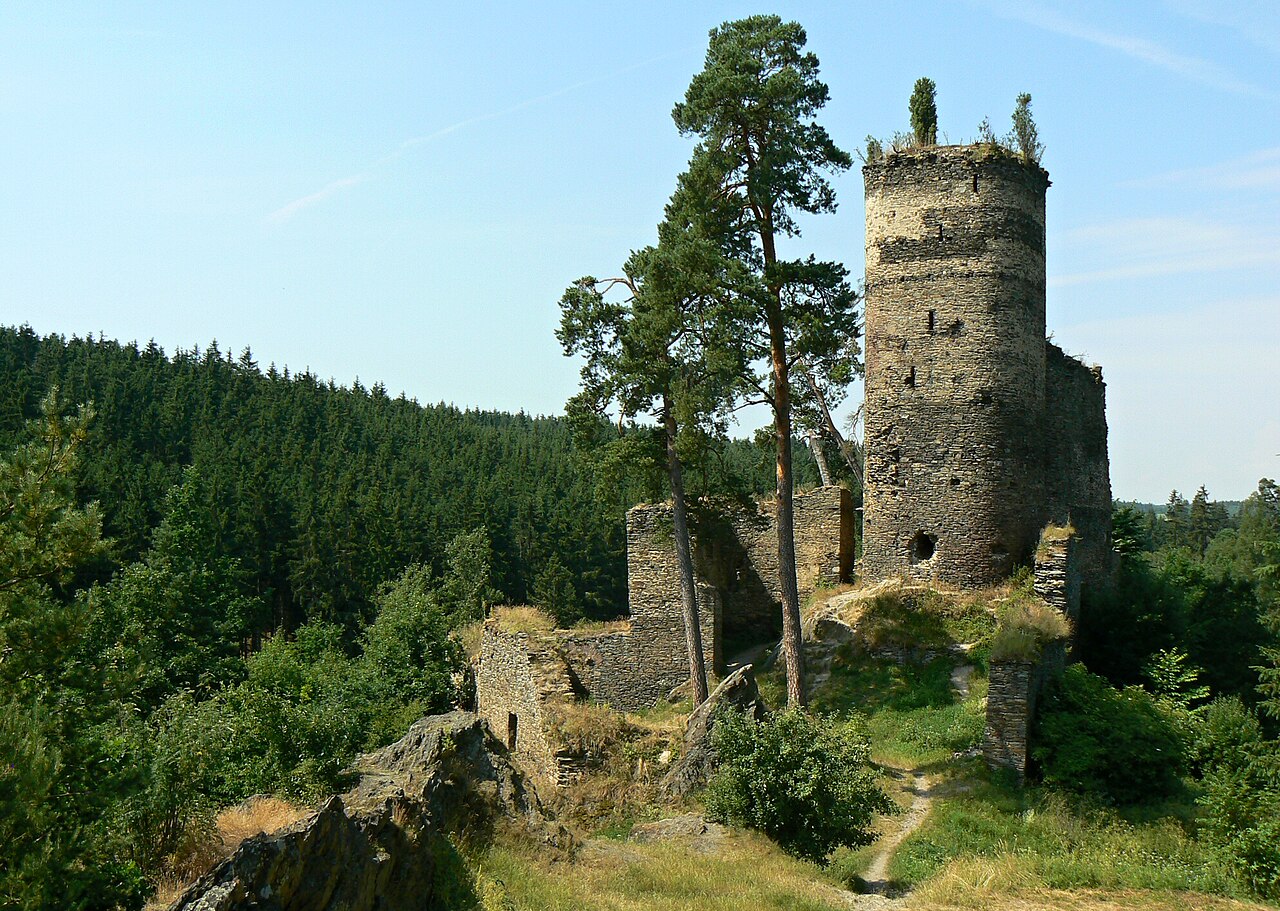
Volfštejn Castle

Volfštejn castle: medieval hill fortress in Czechia
Černošín, Czech Republic
High Medieval (11th–13th c.)
Ruins

Volfštejn castle stands as a significant medieval hill fortress located in the municipality of Černošín-Stříbro in Czechia. Constructed in the early 13th century, this castle served as a fortified residence and administrative center for the local nobility known as the lords of Volfštejn. Its strategic position atop a hill provided a commanding view of the surrounding landscape, typical of hill castles designed for defense and regional control during the High Medieval period.

The castle's origins are firmly dated to the first half of the 1200s, with dendrochronological analysis of timber from the main bergfrit tower indicating construction around 1260–1262. This method provides precise scientific evidence supporting the castle's early medieval foundation. The earliest written record of the castle appears in 1316, when Benda of Volfštejn brought a legal case concerning the murder of his father, Ctibor of Volfštejn. This document not only confirms the castle's existence but also highlights the family's active role in regional affairs during the early 14th century.

Historical significance and ownership lineage

The lords of Volfštejn maintained ownership of the castle through the 14th and 15th centuries, with notable family members including Beneda, Ctibor, Protiva, Oldřich, Vilém, and Jan. Their heraldic symbols, featuring transverse stripes and a wolf’s head or full wolf crest, reflected their identity and alliances, notably with the noble houses of Svojšín and Třebel. These symbols were important markers of noble lineage and political alliances in medieval Bohemia.

The family was engaged in regional politics and religious patronage, as evidenced by their support of the nearby Černošín church. Their political involvement extended to peace agreements with Bavarian dukes, underscoring the castle’s role as a center of diplomacy and local governance.

Role during the Hussite wars and decline

During the Hussite Wars of the early 15th century, Vilém of Volfštejn sided with the Catholic faction. His loyalty was rewarded by Emperor Sigismund with imperial pledges of estates, indicating the family's significant role within the broader imperial politics of Bohemia. However, by 1460, the family seat moved to the nearby Třebel castle after Jan of Volfštejn acquired it, marking the beginning of Volfštejn castle’s decline in strategic importance.

Conflicts in the mid-15th century, notably involving the Zelená Hora faction and King George of Poděbrady, likely led to the castle’s destruction around 1470. By 1527, written sources describe Volfštejn as deserted, although occasional meetings, such as one involving the Banbach brothers, suggest intermittent use. Since 1964, the site has been legally protected as a cultural monument, preserving its historical legacy.

Architectural features and castle layout

The ruins of Volfštejn castle offer a well-preserved example of a bergfrit-type fortress, characterized by a central stone tower used primarily for defense and refuge. The castle’s nearly oval ground plan was designed to follow the natural topography of the hill, maximizing defensive potential in line with medieval fortification principles.

The bergfrit tower

The most dominant feature is the round bergfrit tower, constructed from solid masonry. Unlike later medieval towers that often featured vaulted ceilings, this tower’s interior has a flat ceiling. One floor contains a fireplace, indicating that the tower was not only a military stronghold but also provided habitable space for warmth and shelter. This tower is the oldest surviving structure on the site and serves as a key architectural element for understanding early 13th-century castle construction.

Palace and auxiliary buildings

Opposite the bergfrit lies a larger building identified as the palace, currently standing two stories high in its ruined state. This structure incorporates architectural fragments reused from earlier or different construction phases, reflecting the castle’s evolution over time and practical adaptation of materials. Adjacent to the eastern curtain wall, just below the bergfrit, are remnants of a two-room building, partially preserved. On the opposite side of the site stands a smaller, square-footprint tower-like structure, which likely served a defensive or auxiliary function.

Cultural heritage and preservation

Today, the ruins of Volfštejn castle remain in situ, offering valuable insights into medieval noble life and military architecture. The site’s protection as a cultural monument since 1964 ensures its preservation for future generations. Visitors can explore the fragmentary remains, which provide tangible evidence of the castle’s medieval origins and the layered development of its defensive and residential structures.

The castle’s relatively intact bergfrit tower and palace ruins make it an important site for studying High Medieval fortification techniques in Czechia. Its historical connections to regional noble families and involvement in significant events such as the Hussite Wars contribute to its cultural and historical significance.

Visitor experience and significance

While the castle is in ruins, its elevated position offers scenic views of the surrounding countryside, enhancing the visitor experience. The site’s historical narrative, architectural features, and preservation status make it a compelling destination for those interested in medieval history, castle architecture, and Bohemian heritage.

Frequently asked questions (FAQ)

How do I get to Volfštejn Castle?
Volfštejn Castle is located in Černošín, Czechia, and can be accessed by car or public transport. If you are driving, there is parking available near the castle. For public transport, you can take a bus from nearby towns, which offers a scenic route to the castle.
What is the historical significance of Volfštejn Castle?
Volfštejn Castle, founded in the 14th century, is an important historical site that showcases medieval architecture and the region's feudal history. It was originally built as a defensive fortress and has played a significant role in local conflicts throughout the centuries. Today, it stands as a testament to the rich history of the Czech lands.
When was Volfštejn Castle built?
Volfštejn Castle was constructed in the second half of the 14th century, specifically around the year 1370. It was commissioned by the Lords of Volfštejn and has since undergone various renovations and restorations, reflecting different architectural styles over the centuries.
Can I take guided tours of Volfštejn Castle?
Yes, guided tours of Volfštejn Castle are available and provide visitors with in-depth knowledge of its history and architecture. Tours are typically conducted in Czech, but audio guides in other languages may be available upon request. It's advisable to check in advance for availability and any specific tour schedules.
Why is Volfštejn Castle a popular tourist destination?
Volfštejn Castle attracts visitors due to its stunning views of the surrounding countryside and its rich historical background. The castle's well-preserved ruins and unique architectural features offer a glimpse into the past, making it a fascinating site for history enthusiasts and casual visitors alike. Additionally, its proximity to other attractions in the region enhances its appeal.
Is it possible to visit Volfštejn Castle with children?
Yes, Volfštejn Castle is a family-friendly destination and welcomes visitors of all ages. The castle grounds provide plenty of space for children to explore, and the history lessons can be engaging for young minds. Additionally, there may be special events or activities for families during peak visiting seasons.
What are the opening hours for Volfštejn Castle?
Volfštejn Castle is typically open to visitors from April to October, with varying hours depending on the month. It is recommended to check the official website or contact the castle directly for the most current opening times, especially if you plan to visit during off-peak seasons or holidays.
What are the ticket prices for visiting Volfštejn Castle?
Ticket prices for Volfštejn Castle are generally affordable, with discounts available for students and seniors. Children under a certain age may enter for free, making it a great option for families. It's best to verify current prices on the castle's official website before your visit.
Are there any nearby attractions to Volfštejn Castle?
Yes, there are several attractions near Volfštejn Castle, including beautiful hiking trails and other historical sites in the region. The picturesque town of Černošín offers charming cafes and shops, perfect for a relaxing break. Additionally, nearby castles and ruins can provide a full day of exploration for history buffs.

Information

Hill Castle

Loading map...

Visitor reviews

No reviews yet. Been here? Write the first review and help other travelers!

Write the first review

Visited this castle? Share your experience

Your review helps other travelers and adds first-hand knowledge to our encyclopedia.

Write a review

(5/5)

0/2000 characters

Your review will be visible after admin approval

Nearby castles

2.5 km

Třebel Castle

Černošín-Stříbro, Czech Republic

Třebel Castle stands as a significant medieval hill castle ruin located within the municipality of Černošín-Stříbro in the Czech Republic. Founded between 1234 and 1239 by the noble lords of Svojšín, the castle was established as a fortified seat to control the surrounding region. Its strategic position atop a rocky promontory at an elevation of 495 meters, overlooking the Kosí potok stream, highlights its defensive purpose and importance in medieval Bohemia. Medieval origins and early history The first documented mention of Třebel Castle dates back to 1251, associated with Oldřich of Třebel, a member of the founding family. This early period saw the castle serving as a local stronghold for the lords of Svojšín, who retained possession for over a century. By the late 14th century, ownership transitioned to Ješek Kozíhlava of Pnětluky in 1379. Shortly after, in 1382, he exchanged the castle with Racek of Švamberk, marking a pivotal change in stewardship that would influence the castle's fate for the coming centuries. Ownership changes and military significance During the mid-15th century, Jan of Sobětice held the castle and used it as collateral in a pledge to Jan of Volfštejn in 1448. After 1482, the castle returned to the Švamberk family, who maintained control until its decline. The castle's military importance became particularly evident during the Thirty Years' War when it was occupied by Swedish troops under the command of General Wrangel. The 1647 Battle of Třebel inflicted significant damage, accelerating the castle's deterioration. Subsequently, Emperor Ferdinand III ordered its final demolition, leading to the relocation of the Třebel estate's administrative center to the nearby Trpísty chateau. Architectural layout and surviving remains Třebel Castle was strategically constructed with two main sections: the outer bailey positioned toward the rear of the promontory and the main castle core above it. Although the outer bailey buildings have vanished, a 1674 engraving depicts a large bastion fortifying this area, underscoring its defensive role. The main core was dominated by a round bergfried, a tall tower serving as both a lookout and a last refuge during sieges. Access was through a gate on the northeast side, protected by a square tower at the corner, enhancing the castle's layered defense. Visitors approached via a path atop an earthen rampart overlooking a surrounding moat, creating formidable barriers against attackers. The central courtyard was flanked by buildings along its longer sides, though these structures have not survived intact. Some of the castle's original masonry has been integrated into a forester's lodge currently on site. Additionally, a Baroque granary built after the castle's destruction marks the location of former castle buildings. Today, only small portions of the original walls remain visible, preserving the memory of Třebel's medieval past. Historical and cultural significance Despite its ruinous state, Třebel Castle holds considerable cultural and historical value. It reflects the evolution of medieval fortifications in Bohemia and the shifting fortunes of noble families during turbulent periods such as the Thirty Years' War. The castle's remains are protected as a monument, offering insight into the architectural and military strategies of the 13th to 17th centuries. The castle's location and design illustrate typical medieval defensive principles, including the use of natural terrain, moats, and fortified baileys. Its history of ownership changes and eventual destruction also mirror the broader political and military upheavals in Central Europe during the late medieval and early modern eras. Visiting and preservation Today, visitors to Třebel Castle can explore the ruins situated on the rocky promontory, appreciating the castle’s strategic placement and remnants of its defensive structures. Although much of the original fabric is lost, the site offers a tangible connection to Bohemia's medieval heritage. The integration of castle masonry into later buildings like the forester's lodge and the presence of the Baroque granary provide additional points of interest. Preservation efforts focus on maintaining the visible remains and protecting the site as a cultural monument. The castle's ruins serve as a valuable resource for historians and archaeologists studying medieval fortifications and noble estates in the Czech Republic.

High Medieval (11th–13th c.)
Details
9.1 km

Švamberk Castle

Kokašice, Czech Republic

Švamberk Castle stands prominently on Krasíkov hill near the village of Kokašice in the western part of the modern Czech Republic. This hill castle was originally constructed in the late 13th century by the noble lords of Švamberk, a family deeply embedded in the medieval Bohemian civilization. The strategic location atop a 636-meter elevation provided natural defensive advantages, overseeing important routes and the surrounding landscape. The earliest written mention of the castle dates back to 1252, indicating its longstanding historical significance. By 1342, the castle included a chapel, reflecting its early religious and community functions. The medieval origins and Švamberk family legacy The Švamberk family maintained ownership of the castle almost continuously throughout its active history, with only a brief interruption between 1544 and 1569. Their stewardship helped shape the castle's development from a stronghold to a refined residence. The castle's role during the medieval period was both military and administrative, serving as a local power center in Bohemia. Military significance during the Hussite wars During the 15th century, Švamberk Castle became a focal point in the Hussite Wars, a series of religious and social conflicts that deeply affected Bohemia. The castle endured several sieges, most notably in 1421 when the renowned Hussite commander Jan Žižka successfully captured it, taking the lord Bohuslav of Švamberk prisoner. This event marked a critical moment in the castle's history, demonstrating its strategic importance. Other sieges, including attempts by noble Hynek Krušina, underscored the castle’s contested status during this turbulent era. Architectural evolution and late Gothic transformation In the early 16th century, Švamberk Castle underwent significant architectural transformation, reflecting broader changes in defensive needs and residential comfort. It was rebuilt into a late Gothic chateau, which included the construction of a new palace and the excavation of a remarkably deep well approximately 90 meters in depth. This renovation enhanced both the castle’s defensive capabilities and its suitability as a noble residence. The castle's layout was adapted to accommodate artillery and firearms, evident in the design of key-shaped loopholes and bastions. Destruction and decline during the Thirty Years’ War The 17th century brought further challenges, especially during the Thirty Years’ War. The castle suffered fires in 1443 and more severely in 1644, which caused extensive damage. Post-1644 restoration was minimal, with only partial roofing maintained. The castle's final military use came in 1647 when Swedish troops briefly occupied and looted it. After the death of the last Švamberk owner in 1659, the estate was sold to the Heissenstein family. Subsequently, the castle was abandoned and fell into ruin, with stones repurposed for local construction, leaving the site as a historical ruin today. Archaeological significance and prehistoric occupation Archaeological excavations have revealed that the site of Švamberk Castle was occupied long before the medieval period. Finds from the late Hallstatt period, part of the early Iron Age, indicate prehistoric human activity on Krasíkov hill. This adds a layer of cultural and historical depth to the site, highlighting its long-term strategic and settlement importance. Castle layout and surviving structures Outer bailey and defensive features Švamberk Castle features a distinctive two-part layout comprising an outer bailey and an inner core. The outer bailey, known as předhradí in Czech, is protected by an earthen rampart topped with a dry stone wall. Although parts of the wall were dismantled over time, the remaining sections illustrate medieval defensive architecture. The bailey was accessed through two gates and contained the Church of St. Mary Magdalene. The church’s early 18th-century presbytery is built atop a late Gothic artillery bastion, which retains key-shaped loopholes designed for firearm defense, reflecting the castle’s adaptation to changing military technology. Economic buildings and religious ties Within the outer bailey, several economic buildings survive, including a well-preserved structure identified as a brewery, indicating local production of food and drink. Nearby are the ruins of a house that once housed the church caretaker, demonstrating the close integration of secular and religious functions within the castle complex. Inner core and fortifications The inner core was separated from the outer bailey by a neck ditch approximately 16 meters wide and 6 meters deep. A basalt pillar within the ditch supported a bridge, marking the main controlled access point. The inner castle entrance was fortified by a 2.2-meter-thick front wall and a 3-meter-wide barbican, an outer defensive gateway complex enhancing security. Residential and defensive structures Foundations within the core reveal a long building along the western side and another probable structure opposite it. The original small vaulted palace occupied the northwest corner, serving residential and administrative purposes. The most prominent surviving feature is a round bergfried (main tower) located on a rocky outcrop at the northern edge of the inner core. This tower occupied the most defensible point and was accessible via a wooden bridge connecting to an upper floor of the palace, a design that increased its defensive isolation. 14th-century fortification enhancements Significant fortification work in the 14th century included the construction of the chapel of St. George within the outer bailey and the extension of the moat to fully encompass the bailey. Access points to the original neck ditch were sealed to strengthen defenses. A southeastern tower-like gate, believed to be the one seized by Jan Žižka in 1421, was later demolished. 15th-century expansions and the Hřeben spur After the sieges of the 15th century, the rocky spur called Hřeben was incorporated into the castle’s fortifications. Here, a defensive platform approximately 6 by 11 meters was constructed, featuring a stone foundation topped by a wooden structure. This addition included a secured access route protected by a gate, enhancing the castle’s control over its surroundings. Early 16th-century remodeling The early 16th-century remodeling transformed the inner core further. The original entrance was closed and replaced by a new gate in the front wall. A probable tower-like building about 6 by 7 meters stood near this gate. New constructions along the sides narrowed the courtyard to approximately six meters wide. The eastern defenses were reinforced with a bastion, which later became the foundation for the presbytery of the Church of St. Mary Magdalene. Natural and cultural heritage today Today, the visible remains of Švamberk Castle include parts of the round bergfried perched on the eastern spur, ruins of the adjacent palace, and a vaulted cellar within the inner core behind the moat. The castle hill slope is protected as a natural monument due to the presence of thermophilic plant species, underscoring the site's dual cultural and natural significance. The ruins attract visitors interested in medieval architecture, Bohemian history, and archaeology, offering a tangible connection to the region's past.

High Medieval (11th–13th c.)
Details
11.8 km
Gutstejn Castle — Czech Republic castle

Gutstejn Castle

Konstantinovy Lázně, Czech Republic

Gutštejn castle is a remarkable example of a late medieval hill castle located near the village of Konstantinovy Lázně in the Tachov district of Czechia. Perched on a rocky promontory overlooking the Hadovka stream, the castle was founded around 1300 by the noble Hroznatovci family, specifically by Jetřich, son of Jetřich of Krašovice. It served as the ancestral seat of the lords of Gutštejn, a cadet branch of this lineage, reflecting the feudal power structures of the region during the 14th and 15th centuries. The castle's strategic location on a rock-bound promontory provided natural defenses, which were enhanced by man-made fortifications such as ditches and enceinte walls. Gutštejn played a notable role during the turbulent Hussite Wars in the early 15th century, enduring a siege led by the famous military leader Jan Žižka around 1422. Although historical records do not confirm whether the castle fell during this siege, it remained a significant stronghold in the region for several centuries. Historical development and ownership Gutštejn castle was initially established as a manor house for the lords of Gutštejn, who maintained ownership until the mid-16th century. The earliest indirect documentation dates from 1319, involving the leasing of nearby villages, which ties the family closely to the estate. Over time, the family shifted their primary residences to other estates but retained Gutštejn as part of their holdings. In 1489, the death of Burian the Rich, a prominent chancellor of the Kingdom of Bohemia, marked a turning point. His sons became notorious as rebels and marauders in Bohemia and Bavaria, using Gutštejn as a prison for captured nobility. This turbulent period reflects the castle’s dual role as both a noble residence and a fortress of control. Ownership changed in 1549 when the castle was sold to Hanuš Elpognar of Bezdružice, integrating it into the larger Bezdružice estate. By the 1550s, Gutštejn was already described as deserted, and it eventually fell into ruin, particularly after the devastations of the Thirty Years’ War in the early 17th century. Architectural features and layout The castle's layout is defined by its adaptation to the uneven, shale bedrock of the promontory. It consists of two main parts: the outer bailey and the inner stronghold, separated by a defensive neck ditch. The outer bailey once contained various functional buildings, now mostly lost except for a rock-cut cellar that hints at the castle’s logistical operations. The inner castle is dominated by a square bergfried with rounded corners, a typical late medieval defensive tower. This tower was not accessible from the ground but entered via a drawbridge linked to a wooden hoarding, emphasizing its role as a last refuge and lookout point. Dendrochronological analysis dates the bergfried’s roof timbers to the early 15th century, with construction phases extending from the mid-14th century through post-1485 modifications. East of the bergfried lies the entrance courtyard, which functioned as a protected economic and service area. It was enclosed by a wide defensive wall forming a zwinger, a narrow outer ward designed to trap attackers. This enceinte wall on the northern and western sides contains the oldest masonry, featuring both straight and rounded corners, indicative of the castle’s phased construction. Two palace buildings flank the inner castle: a northern palace built around the same time as the bergfried and a larger southern palace added in a later phase. The southern palace includes a vaulted cellar and multiple chambers, some of which served as storerooms. Late Gothic renovations enhanced these palaces and the defensive structures, including the addition of firing slits, crenellated walkways, and a heightened bergfried with a new second-level entrance connecting to the northern palace. Cultural significance and preservation Gutštejn castle stands today as a protected cultural monument managed by the National Heritage Institute. Its ruins offer valuable insights into the evolution of medieval fortifications in the Bohemian region. Archaeological excavations have uncovered ceramic stove tiles dating from the late 15th to late 16th centuries, confirming the castle’s continued use even after its decline as a noble residence. The castle’s preservation as a ruin allows visitors to explore the layered history of a site that witnessed noble power, rebellion, and military conflict. Its architectural features, such as the bergfried, enceinte walls, and zwinger, exemplify the defensive innovations of the late medieval period. Gutštejn remains an important landmark for understanding the feudal and military history of Czechia. Visiting gutštejn castle Today, visitors to Gutštejn can explore the castle’s ruins and appreciate its dramatic setting on a rocky promontory. The site’s rugged terrain and preserved defensive structures provide a tangible connection to medieval life and warfare. While much of the castle is in ruins, the remaining walls, towers, and cellars convey the scale and complexity of this once formidable fortress. The castle’s location near Konstantinovy Lázně makes it accessible for those interested in historical architecture and medieval heritage. Visitors should be prepared for uneven terrain and limited facilities, as the site focuses on preservation rather than modern tourist infrastructure. Guided tours and informational signage help contextualize the castle’s history and architectural significance. Architectural highlights Square bergfried with rounded corners dating from the 14th and 15th centuries Defensive neck ditch separating the outer bailey and inner castle Zwinger enclosure providing an additional defensive layer Late Gothic firing slits and crenellations enhancing defense Vaulted cellars and palace chambers illustrating residential aspects Historical context The castle’s history reflects the broader medieval political and military struggles in Bohemia, including the Hussite Wars and noble rebellions. Its use as a prison and stronghold during periods of unrest highlights its strategic importance. The transition from a noble residence to a ruin after the Thirty Years’ War mirrors the fate of many similar castles in Central Europe. Archaeological findings Excavations have revealed valuable artifacts such as ceramic stove tiles from the late 15th to late 16th centuries, indicating ongoing occupation and adaptation. These findings contribute to understanding the castle’s functional evolution and the daily lives of its inhabitants.

Late Medieval (14th–15th c.)
Details